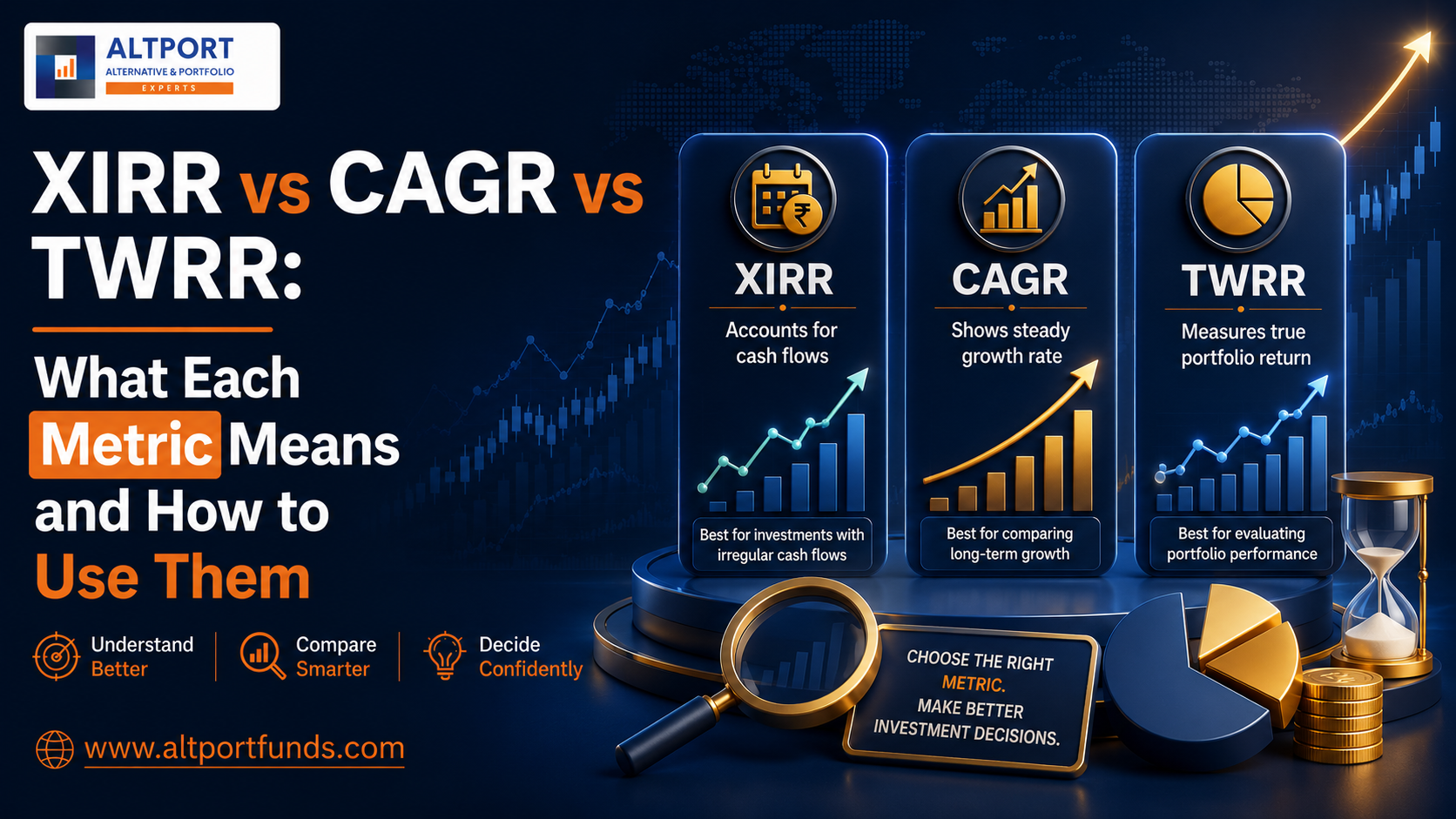
When comparing PMS strategies, mutual funds, or AIF performance, investors often come across three return metrics - CAGR, XIRR, and TWRR. While they all measure returns, they do not measure the same thing. This is why the xirr vs cagr and xirr vs twrr debate matters so much for serious investors. Using the wrong metric can create misleading comparisons, especially in PMS and AIF investments where cash flows happen at different times. This article explains what each return metric means, when to use it, and how to read investment performance reports more accurately.
CAGR - Compound Annual Growth Rate
CAGR stands for Compound Annual Growth Rate. In simple terms, CAGR meaning refers to the average yearly growth of an investment over a period of time, assuming the investment grew at a steady compounded rate every year. It only looks at the starting value and ending value. CAGR does not consider extra investments, withdrawals, or the timing of cash flows. That is the biggest difference in the xirr vs cagr comparison.
CAGR meaning - Formula
Formula: CAGR = (Ending Value / Beginning Value) ^ (1 / Number of Years) - 1
Worked Example
Suppose you invest Rs 10 lakh in a mutual fund. After 5 years, the investment value becomes Rs 20 lakh.
\left(\frac{20}{10}\right)^{\frac{1}{5}} - 1 = 14.87%
So, the CAGR is 14.87% per year.
When to Use CAGR
- Comparing mutual fund returns on a single lump-sum investment
- Quick comparison of long-term wealth creation across asset classes
- Index benchmark comparisons like Nifty 50 CAGR or BSE 500 TRI CAGR
When NOT to Use CAGR
- When you have made multiple investments at different times such as SIPs, AIF drawdowns, or PMS top-ups
- When comparing a manager's skill because CAGR can get distorted by investor cash flow timing
XIRR - Extended Internal Rate of Return
XIRR stands for Extended Internal Rate of Return. In simple terms, xirr meaning refers to the return calculation used when money is invested or withdrawn at different dates. Some cash flows happen earlier, some later. XIRR calculates one annual return rate that adjusts for this timing difference. This is why XIRR is widely used for SIPs, PMS investments with top-ups, and AIF investments with staggered drawdowns.
XIRR meaning - Worked Example
Suppose you invest Rs 10 lakh in January. After six months, you invest another Rs 5 lakh in July. At the end of the next year, you receive Rs 18 lakh.
A normal CAGR calculation will not work properly here because both investments were not invested for the same time period. XIRR adjusts for the exact dates of investment and calculates the actual annualised return earned across all cash flows.
This is also
how to calculate XIRR in most spreadsheet tools like Excel or Google Sheets - by entering all cash flow dates and amounts together.
When to Use XIRR
- SIP investments in mutual funds where money is invested on different dates
- AIF investments where capital is called through drawdowns over time
- PMS portfolios with additional top-ups or withdrawals
- Comparing investor experience across different investment periods
XIRR in AIF Performance
XIRR is the standard performance metric used in AIF investments because cash flows in AIFs are rarely linear. Capital is usually drawn over 12 to 24 months and distributions happen at different stages of the fund lifecycle. A simple CAGR on total committed capital can understate the actual return because all the money was not invested from day one.
This is why XIRR on invested capital is considered a more accurate measure. When reviewing AIF performance, investors should always check whether the reported XIRR is calculated on committed capital or only on invested capital. That difference can materially change the final return figure.
TWRR - Time-Weighted Rate of Return
TWRR stands for Time-Weighted Rate of Return. In simple terms, TWRR meaning refers to a return calculation that removes the impact of investor cash flows like deposits and withdrawals. It measures only the portfolio manager’s investment performance. This is why TWRR is important in PMS reporting. It shows what the portfolio actually delivered, regardless of when investors added or withdrew money. Under SEBI rules, TWRR is the standard method used for PMS performance reporting.
TWRR meaning - Worked Example
Suppose Investor A puts Rs 1 crore into a PMS strategy.
- In Year 1, the portfolio gains 20%
- The investor then withdraws Rs 50 lakh at the market peak
- In Year 2, the market falls 10%
The investor’s XIRR may still look very strong because they withdrew money before the fall. But that does not fully reflect the manager’s performance.
TWRR only measures the portfolio’s actual investment return across both years.
[(1+20%) \times (1-10%)] - 1 = 8%
So, the TWRR is 8% compounded over two years.
This is also a key concept in understanding
what is TWRR in PMS and how to read pms performance correctly.
Why SEBI Mandates TWRR for PMS
SEBI made TWRR mandatory under the SEBI (Portfolio Managers) Regulations 2020. The reason is simple - investors in the same PMS strategy may enter and exit at different times, leading to different XIRR values. TWRR creates one standard performance number for the portfolio strategy itself. This helps investors compare PMS managers fairly and also compare strategies against benchmarks like Nifty 50 TRI or BSE 500 TRI.
When to Use TWRR
- Comparing PMS managers against each other using a standardised return measure
- Comparing PMS performance against BSE 500 TRI or Nifty 50 TRI benchmarks
- Evaluating a manager’s investment skill without the impact of investor cash flow timing
XIRR vs CAGR vs TWRR - Side by Side Comparison
Understanding the difference between xirr vs cagr and
XIRR vs TWRR becomes much easier when the three metrics are compared side by side. Each one answers a different question. CAGR measures simple annual growth, XIRR measures the investor’s actual experience with irregular cash flows, and TWRR measures the portfolio manager’s performance without cash flow distortion.
| Feature |
CAGR |
XIRR |
TWRR |
| Full form |
Compound Annual Growth Rate |
Extended Internal Rate of Return |
Time-Weighted Rate of Return |
| What it measures |
Smooth annual growth of single investment |
True return accounting for irregular cash flows |
Manager skill independent of investor cash flows |
| Cash flows handled |
No - single start and end value |
Yes - multiple inputs and outputs at exact dates |
Yes - but eliminates size distortion of cash flows |
| Best used for |
Single lump-sum, index returns |
SIP, AIF drawdowns, PMS top-ups |
Comparing PMS managers, SEBI-mandated reporting |
| Standard in |
Mutual fund lump-sum, indices |
Mutual fund SIP, AIF |
PMS (SEBI mandate) |
| Investor or manager |
Can be either |
Investor experience |
Manager skill |
| Limitation |
Distorted by irregular cash flows |
Complex to calculate manually |
Does not reflect actual investor experience |
How to Read PMS and AIF Performance Reports
When reading a PMS performance report, focus on the TWRR because this is the SEBI-mandated number used to compare PMS strategies fairly. Your personal XIRR may be different depending on when you invested, added top-ups, or withdrew money. In AIF reports, XIRR on invested capital is usually the most relevant figure because AIF cash flows happen in stages through drawdowns and distributions. Never compare the TWRR of a PMS with the XIRR of an AIF directly because they measure different things. Always check the benchmark used and the exact time period being compared.
Frequently Asked Questions
What is XIRR in mutual funds?
XIRR in mutual fund investing measures the actual annualised return after considering the exact dates of SIP investments. Since SIPs happen every month, all investments are not invested for the same duration. XIRR gives a more accurate return figure than CAGR for SIP investors.
What is TWRR in PMS?
TWRR is the standard return metric used in PMS reporting under SEBI rules. It measures the portfolio manager’s investment performance without getting affected by investor deposits or withdrawals. This helps investors compare PMS strategies fairly.
Is XIRR or CAGR better?
Neither is better in every situation. CAGR works best for a single lump-sum investment with no extra cash flows. XIRR is better when investments and withdrawals happen at different times, such as SIPs, PMS top-ups, or AIF drawdowns.
Why does my PMS XIRR differ from the TWRR in the performance report?
TWRR measures the PMS strategy’s actual portfolio performance. Your personal XIRR depends on when you invested and whether you added or withdrew money during the investment period. Both numbers can be correct because they measure different things.
What return metric should I use for AIF?
XIRR on invested capital is the standard return metric for AIF investments. AIFs usually call money in stages and distribute proceeds at different times, so XIRR captures this better than CAGR. Investors should also check whether the reported XIRR is based on committed capital or invested capital.
Conclusion
CAGR, XIRR, and TWRR are all important, but each one answers a different question. CAGR shows how fast an investment grew, XIRR shows the investor’s actual return after considering cash flow timing, and TWRR measures the manager’s investment skill. Understanding the difference is important when evaluating PMS and AIF investments. Platforms like ALTPORT are helping investors access PMS and AIF opportunities with more transparent reporting and easier performance comparison across products.