
Fund Snapshot
| Fund Attribute | Details |
| Fund Name | Kotak Real Estate Investment Fund II - IFSC |
| Fund Manager | Kotak Alternate Asset Managers Limited (KAAML) |
| Regulatory Authority | International Financial Services Centres Authority (IFSCA) |
| AIF Category | Category-II AIF (Alternative Investment Fund) |
| Registration Number | IFSC/AIF2/2024-25/0181 |
| Date of Registration | October 18, 2024 |
| Domicile / Base | GIFT SEZ, GIFT City, Gandhinagar, Gujarat, India |
| Target Investors | Global Institutional Allocators, Family Offices, and Offshore UHNIs |
| Base Currency | Typically US Dollar (USD) |
Fund Overview
The Kotak Real Estate Investment Fund II - IFSC is a closed-ended private equity real estate fund. It belongs to Kotak's generation of vehicles optimized for the GIFT City ecosystem.
By operating within the International Financial Services Centre (IFSC), the fund is structural proofing for global investors. Instead of dealing with the friction of inbound domestic capital rules, currency hedging hurdles, and cumbersome local administrative processes, international allocators can commit and draw down capital in global currencies (like USD). The fund then operates as a unified corporate investor into Indian micro-markets, reducing operational drag while targeting top-tier real estate developments.
Investment Philosophy
Managed by Kotak's seasoned alternative asset team—which possesses nearly two decades of real estate experience and over $3.5 billion in aggregate capital commitments—the fund follows a strictly defensive, return-optimized philosophy:
-
Late-Stage Real Estate Funding: The strategy strongly leans away from greenfield or speculative raw-land acquisition risks. Instead, it focuses on late-stage execution, construction financing, and inventory-backed bridge capital for residential and commercial assets.
-
Tier-1 Developer Selection: Kotak implements a rigorous institutional counterparty filter, partnering exclusively with top-caliber, highly capitalized developers. This ensures that the projects backed by the fund benefit from premium governance and strong execution velocity.
-
Granular Cash-Flow Underwriting: Investments are structured with strong downside protection. Rather than relying on simple equity upside, deals frequently leverage structured debt, milestone-dependent disbursements, and cash-flow trapping mechanisms to lock in visible exit paths.
-
Exits Aligned with Institutional Liquidity: The fund designs multi-tiered exit paths from day one, planning liquidity via project execution cash flows, developer buybacks, or secondary portfolio sales to public Indian Real Estate Investment Trusts (REITs).
Listen to expert conversations and investment insights anytime on Spotify.

Learn about the experienced fund managers responsible for investment decisions, portfolio strategy, and long-term fund performance.
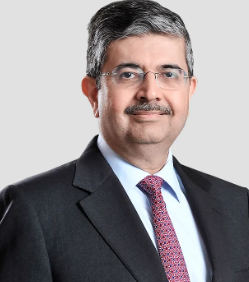
Uday S. Kotak
Uday S. Kotak is the Chairman and Non-Executive Director of the Company, plus he founded and directs Kotak Mahindra Bank Limited. He used to be the Bank's Managing Director and CEO until September 2023. Now, he's in a non-executive position, still helping steer the bank's future. He has almost 40 years of experience and was a key player in growing the Kotak Mahindra Group into one of India's top financial service groups. They do all sorts of things like banking, asset management, insurance, and capital markets. People think of Mr. Kotak as someone who really helped shape India's financial scene. He's been in charge of the Indo-UK Financial Partnership and been on global advisory boards. He's also headed big governance projects and won a bunch of awards for his career and business smarts. He got his bachelor's degree in commerce and an MMS from JBIMS, Mumbai.
View Profile →Our Investment Experts
Our experts will understand your goals, map the right strategy across AIFs, PMS, Mutual Funds and Wealth Solutions, and guide you through every step.
Find answers to common questions about fund investments, performance, portfolio strategy, and investor services.
The primary difference is the regulatory environment and currency framework. Domestic funds require foreign investors to convert capital into Indian Rupees (INR) and comply with direct onshore tax structures. This IFSC fund allows offshore allocators to invest, maintain, and redeem their capital natively in foreign currency (typically USD) under a highly efficient international financial regulatory system (IFSCA).
The fund targets institutional-grade real estate sectors within India’s top metropolitan micro-markets (such as Mumbai, Bengaluru, National Capital Region, and Pune). This covers structured real estate credit and opportunistic equity across Grade-A residential developments, commercial IT parks/offices, and logistics or industrial warehousing.
In accordance with the regulatory standards established by the IFSCA for Category-II Alternative Investment Funds in GIFT City, the minimum investment requirement for a qualified individual investor is $150,000 USD (or its equivalent in other convertible foreign currencies).
The fund is fully registered and supervised by India's unified financial services regulator for offshore hubs: the International Financial Services Centres Authority (IFSCA) under registration number IFSC/AIF2/2024-25/0181.
Category-II AIFs in GIFT City provide non-resident and global investors with an incredibly competitive tax pass-through structure. Capital gains and interest yields are generally optimized via favorable withholding rates under India's Double Taxation Avoidance Agreements (DTAA), alongside complete exemptions from local Indian surcharges and simplified compliance overhead.
Subscribe to the ALTPORT newsletter
Join HNIs, family offices and NRI investors reading with us.
You're on the list
Thanks — we've added your email to the ALTPORT newsletter.