
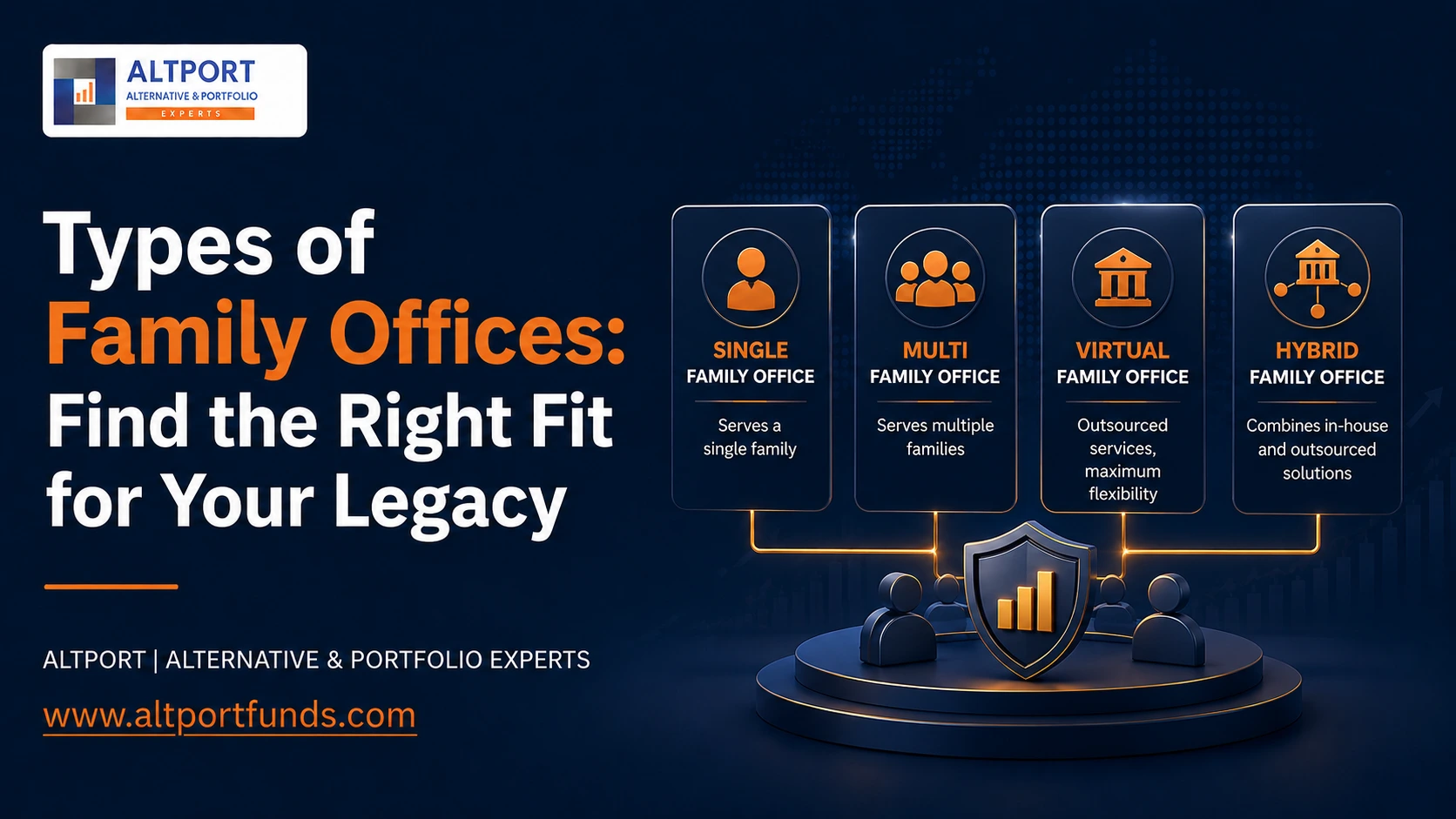
India’s ultra-high-net-worth wealth landscape is evolving rapidly, and with it, the demand for structured wealth management solutions is rising across business families, founders, and global Indian investors. Over the last few years, the number of family office setups in India has grown significantly as more families look beyond traditional investment management toward succession planning, governance, philanthropy, and long-term capital preservation. As this ecosystem expands, understanding the different types of family offices becomes increasingly important because the right structure can directly influence control, costs, flexibility, and investment strategy. For families exploring a modern family office india framework, choosing the right model is often the first major strategic decision.
What is Family Office?
A family office is a private wealth management structure created to manage the financial and non-financial needs of ultra-high-net-worth families. In simple terms, the family office meaning goes far beyond investment advisory - it acts as a centralised platform that helps families manage wealth, businesses, legacy planning, and intergenerational transitions under one framework. Unlike traditional advisory models, family office services are usually customised around the family’s long-term goals, governance preferences, and asset complexity.
Core family office services typically include:
- Investment management
- Estate and tax planning
- Philanthropy management
- Legal and compliance services
- Risk management
- Family governance and succession planning
Types of Family Offices - Overview
As wealth structures become more sophisticated, families are increasingly choosing between different types of family offices based on their investment size, governance needs, operational complexity, and long-term legacy goals. While some families prefer complete control through dedicated structures, others opt for flexible or outsourced models that offer specialised expertise without building a full in-house team.
| Type | Best For | Key Advantage | Typical Corpus (India) |
| Single Family Office (SFO) | One ultra-wealthy family | Full control and privacy | Rs 500 crore and above |
| Multi-Family Office (MFO) | Multiple HNI families | Shared cost, wide expertise | Rs 50 crore and above |
| Virtual Family Office (VFO) | Tech-forward families | Flexibility, low overhead | Rs 25 crore and above |
| Outsourced Family Office | Families without in-house teams | External expertise on demand | Varies |
| Embedded Family Office | Clients of large banks or institutions | Institutional backing | Varies |
| Hybrid Family Office | Families wanting SFO exclusivity at MFO cost | Customised shared model | Varies |
Each types of family offices operates differently in terms of control, cost, staffing, and investment approach, making it important to evaluate which model aligns best with a family’s long-term objectives.
1. Single Family Office (SFO)
A single family office, or SFO, is a dedicated private wealth management structure created exclusively for one ultra-high-net-worth family. It is typically established by business promoters, first-generation entrepreneurs, or legacy families with highly complex financial and succession needs. Unlike shared advisory models, a single family office operates with an in-house team that manages investments, taxation, legal coordination, philanthropy, governance, and intergenerational planning under one umbrella.
What makes the single family office model distinct is the level of control it offers. The family directly influences investment decisions, reporting structures, governance policies, and risk frameworks without relying on standardised external processes.
Advantages of a Single Family Office
- Complete privacy - no data shared with other families
- Full customisation of investment strategy
- Direct oversight and governance by the family
- Consolidated management of all assets, legal, and estate needs
Disadvantages of a Single Family Office
- High operational cost - running a full in-house team
- Talent acquisition and retention challenges
- Only viable for very large wealth bases
In India, an SFO is generally considered practical for families with investable assets of around Rs 500 crore or more. Annual operating costs can be substantial because the structure often requires dedicated investment professionals, legal experts, compliance teams, and external advisors. Depending on the activities involved, certain investment and advisory functions may also fall under SEBI regulatory oversight.
2. Multi-Family Office (MFO)
A multi family office, or MFO, is a wealth management structure that serves multiple high-net-worth families through a shared platform of investment, legal, tax, and advisory services. Unlike a single family office, where one family builds and operates its own dedicated setup, an MFO pools professional resources across several clients, making sophisticated wealth management more accessible and cost-efficient.
The shared-resource model allows families to access experienced investment teams, institutional-grade reporting, estate planning support, and alternative investment opportunities without bearing the full operational cost of an in-house office. This is one of the biggest differences in the single family office vs multi family office debate - MFOs prioritise efficiency and scalability, while SFOs prioritise exclusivity and control.
Advantages of a Multi-Family Office
- Cost-efficient - expenses shared across families
- Access to a broader range of expertise and investment opportunities
- Suitable for families that need sophistication without full SFO overhead
Disadvantages of a Multi-Family Office
- Lower exclusivity compared to SFO
- Investment strategies may be less uniquely tailored
- Some privacy trade-offs due to shared infrastructure
In India, MFOs are commonly preferred by first-generation entrepreneurs, professional executives, startup founders, and business families with investable assets typically starting around Rs 50 crore. Families usually choose an MFO over an SFO when they want advanced wealth management capabilities without building a large internal team or managing high fixed operational costs.
3. Virtual Family Office (VFO)
A virtual family office, or VFO, is a technology-driven wealth management model that operates without a traditional physical office or large in-house staff. Instead of employing a full-time internal team, families work with a network of external advisors, investment specialists, tax experts, and legal professionals coordinated through digital platforms.
The VFO model is designed for flexibility. Families can access services on demand while using technology for portfolio tracking, consolidated reporting, document management, and communication. This structure has become increasingly relevant for globally mobile entrepreneurs, next-generation investors, and digitally inclined HNIs who want institutional-level coordination without the cost structure of a traditional office.
Advantages of a Virtual Family Office
- No physical infrastructure overhead
- Services accessed on a need basis - flexible and scalable
- Digital platforms enable real-time reporting and monitoring
- Lower minimum corpus requirement
Disadvantages of a Virtual Family Office
- May lack the depth of expertise of a fully staffed office
- Dependence on technology platforms
- Less suitable for highly complex or illiquid asset portfolios
4. Outsourced Family Office
An outsourced family office is a model where wealth management, investment coordination, legal oversight, tax planning, and administrative functions are handled by an external specialist firm instead of a fully in-house team. Rather than building a dedicated office from scratch, families partner with experienced providers who deliver family office capabilities through a structured service arrangement.
This model is often preferred by entrepreneurial families, new wealth creators, and globally dispersed families that require professional coordination but do not want the complexity and fixed costs of operating a single family office internally. It also allows families to access specialised expertise across investments, governance, succession, and compliance without long setup timelines.
Advantages of a Outsourced Family Office
- Access to specialist professionals without building an in-house team
- Cost efficiencies through shared resources
- Scalable - services can expand or contract with family needs
- Faster to set up than a dedicated SFO
Considerations of a Outsourced Family Office
- Less direct control than an in-house model
- Privacy concerns - family data managed externally
- Quality depends heavily on the provider chosen
5. Embedded Family Office
An embedded family office is a structure where family office services are offered as part of a larger financial institution such as a private bank, wealth management firm, or asset management company. Instead of creating an independent setup, families access investment advisory, estate planning, reporting, lending, and governance support through dedicated teams operating within the institution’s broader platform.
The model combines personalised wealth management with institutional infrastructure. Families benefit from established research capabilities, global investment access, compliance systems, and operational support without having to manage a standalone office internally. Embedded family offices are often chosen by families seeking convenience, institutional credibility, and integrated financial services under one relationship.
Advantages of an Embedded Family Office
- Institutional backing - access to research, networks, and platforms
- More cost-effective than a standalone SFO
- Established technology and compliance infrastructure
Considerations of an Embedded Family Office
- Potential conflicts of interest with the parent institution's business
- Less autonomy than an independent family office
- Cultural fit between the family and the institution is critical
6. Hybrid Family Office
A hybrid family office combines features of both a single family office and a multi-family office. In this structure, certain functions such as investment research, reporting systems, compliance, or operational support are shared across families, while strategic decisions, governance, and customised planning remain exclusive to each family.
The hybrid family office model is gaining traction among Indian business families that want a balance between control and efficiency. It suits families seeking personalised wealth management without fully absorbing the operational costs of a dedicated SFO setup. As family wealth structures become more sophisticated, hybrid arrangements offer greater flexibility and scalability.
Advantages of a Hybrid Family Office
- Balances personalisation with cost efficiency
- Flexible structure - can be tailored to each participating family
- Access to pooled expertise while retaining some exclusivity
Considerations of a Hybrid Family Office
- Governance complexity - managing shared and exclusive services
- Requires clear agreements between participating families
SFO vs MFO vs VFO - Key Differences
When evaluating a single family office vs multi family office structure, the decision usually comes down to three factors - control, cost, and operational complexity. A virtual family office adds a third option for families looking for flexibility and lower infrastructure requirements. Understanding the difference in types of family offices like between SFO and MFO models is especially important because both serve high-net-worth families but operate very differently in practice.
| Feature | SFO | MFO | VFO |
| Exclusivity | Highest | Moderate | Flexible |
| Customisation | Fully tailored | Partially tailored | Tailored on demand |
| Cost | Highest | Shared and lower | Lowest |
| Control | Full family control | Shared governance | Shared governance |
| Privacy | Maximum | Moderate | Moderate |
| Minimum corpus (India) | Rs 500 Cr+ | Rs 50 Cr+ | Rs 25 Cr+ |
| Best suited for | Ultra-wealthy families | HNI families seeking cost efficiency | Tech-forward or smaller HNI families |
What Is A Family Office In India - Growth and Context
The family office India ecosystem has expanded rapidly over the last few years as business families, startup founders, and next-generation entrepreneurs seek more structured approaches to managing wealth. According to PwC and EY-Julius Baer reports, the number of family offices in India has grown from around 45 in 2018 to more than 300 by 2024, reflecting a major shift toward professionalised wealth management structures.
Several factors are driving this growth - liquidity events from IPOs and private equity exits, increasing global investments, succession planning needs, and the separation of family wealth from operating businesses. Modern family office structure India models are also evolving beyond traditional wealth preservation into areas such as alternative investments, governance frameworks, philanthropy, and global diversification.
Regulatory developments have further accelerated interest in structured setups. SEBI-regulated investment vehicles, AIF participation, and the emergence of GIFT City as an international financial hub are creating new opportunities for sophisticated wealth planning. The model is also increasingly relevant for globally mobile families, making family office investment for NRI solutions an important part of the Indian wealth management landscape.
How to Choose the Right Type Of Family Office Wealth Management
Choosing the right family office structure depends on far more than investment size alone. Families need to evaluate how complex their wealth ecosystem has become, how much operational involvement they want, and whether their long-term priorities extend beyond portfolio management into governance, succession, and legacy planning. This is also where the conversation around family office vs wealth management becomes important - a family office is typically designed to manage the broader financial life of a family, not just investments.
1. Assess Your Wealth Complexity
Families with multiple businesses, global assets, trusts, private investments, or cross-border tax exposure usually require more structured coordination. The more complex the asset mix and ownership structure, the greater the need for a formalised family office framework.
2. Define Your Need for Control
Some families want direct oversight of investments, governance, and strategic decisions, which may favour an SFO structure. Others are comfortable delegating operational responsibilities to professional advisors through MFO or outsourced models.
3. Evaluate Your Budget
Operational costs vary significantly across structures. A single family office requires substantial investment in staffing, technology, compliance, and advisory functions, while MFOs and VFOs offer lower-cost alternatives.
4. Consider Privacy Requirements
Families managing sensitive business holdings or high-profile assets may prioritise confidentiality and prefer structures with tighter internal controls and limited data sharing.
5. Think About Succession Planning
A strong family office structure should support long-term continuity across generations. Governance frameworks, estate planning, and decision-making processes become increasingly important as family wealth transitions over time.
For families exploring how to set up family office India structures, the ideal model is usually the one that balances control, scalability, governance, and operational efficiency in line with long-term family objectives.
Conclusion
There is no one-size-fits-all approach when it comes to choosing between different types of family offices. The right structure depends on factors such as wealth size, investment complexity, privacy needs, level of control, and operational budget. As more Indian business families and global investors move toward professional wealth management, the family office ecosystem in India is continuing to grow and evolve quickly.
For HNIs, NRIs, and family offices exploring alternative investment opportunities, platforms like ALTPORT are helping create access to curated solutions across AIFs, PMS, Gift City Funds, and SIF structures within a more organised investment ecosystem.