
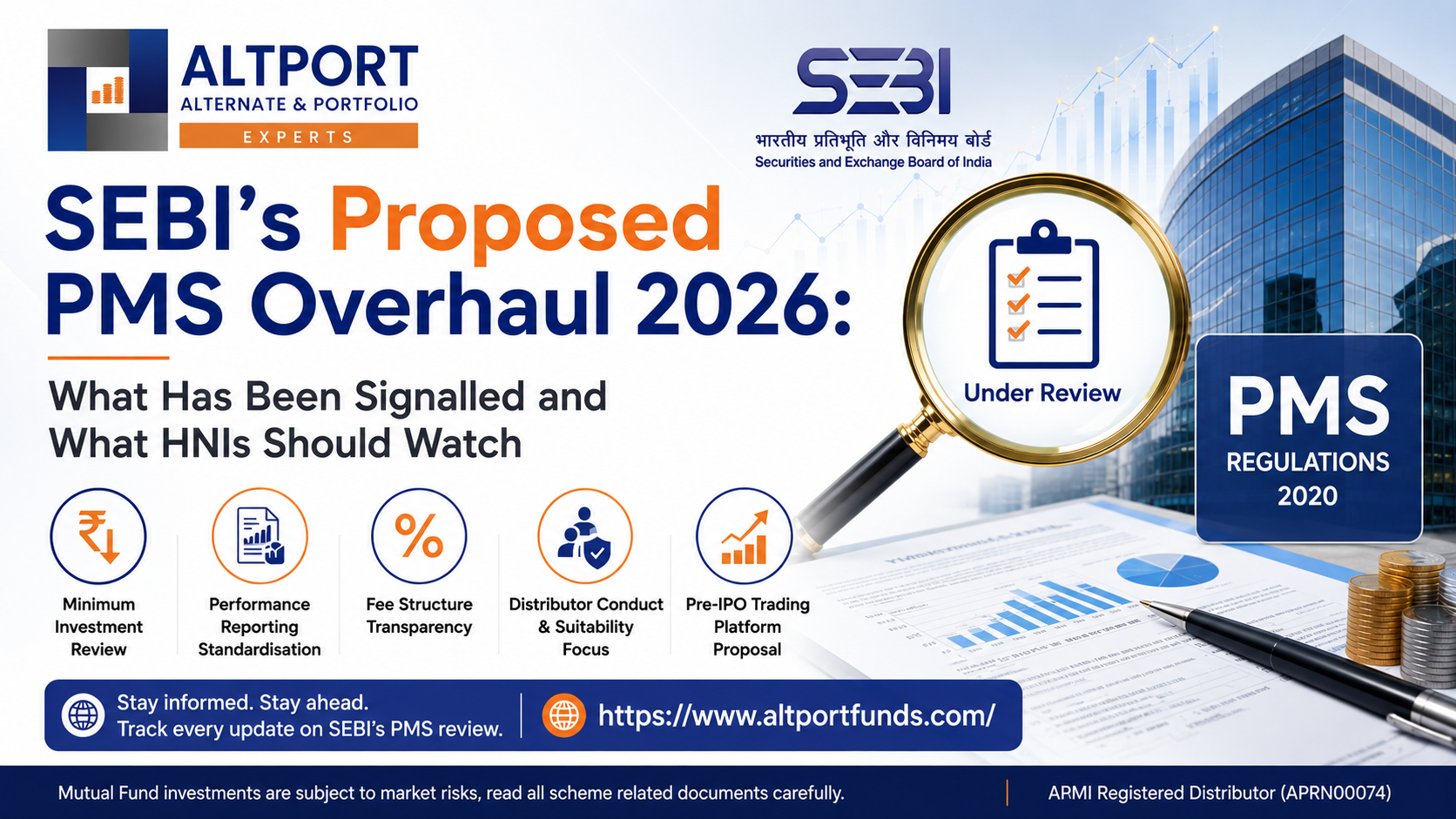
SEBI notified the Portfolio Managers Regulations, 2026 in October 2026, replacing the 2020 framework with effect from 1 April 2027. The ₹50 lakh minimum investment stays, accredited investors are now exempt from it, upfront fees are prohibited, and a new ₹25 lakh route into mutual fund portfolios has been created.
India’s Portfolio Management Services (PMS) industry has grown into a significant segment of the wealth management ecosystem, managing approximately Rs 10.5 lakh crore in assets for around 2.15 lakh clients while expanding at an estimated 17% CAGR. In February 2026, SEBI Chairman Tuhin Kanta Pandey announced a comprehensive review of the Portfolio Managers Regulations, 2020. That review is now complete.
This article explains what the Portfolio Managers Regulations, 2026 changed, what stays the same, and what HNI investors should do before the regulations take effect on 1 April 2027.
Why SEBI Rewrote the PMS Rules
SEBI rewrote the PMS rules because the 2020 framework was built for a materially smaller industry. Assets under management have since crossed Rs 10.5 lakh crore across approximately 2.15 lakh clients, growing at an estimated 17% CAGR.
The Portfolio Managers Regulations were last comprehensively revised in 2020. Against the backdrop of that growth, SEBI Chairman Tuhin Kanta Pandey said in February 2026 that the regulatory framework must remain effective and adaptable as the market evolves. The review responded to three developments: sustained industry growth, greater regulatory focus on mis-selling and investor suitability, and the emergence of newer investment products such as Specialised Investment Funds (SIFs). Regulation 46(1) of the new regulations repeals the 2020 framework with effect from 1 April 2027.
What the 2026 Regulations Changed
Three changes matter most to investors: the minimum investment threshold now has exemptions, upfront fees are prohibited, and mutual fund holdings inside a PMS must use direct plans.
| Area | What SEBI had signalled in early 2026 | What the 2026 Regulations did |
|---|---|---|
| Minimum investment threshold | The industry urged SEBI to consider reducing the Rs 50 lakh minimum. No formal proposal had been confirmed. | Retained at ₹50 lakh per client (Reg 16(3)). Accredited investors are exempt from it (Reg 16(4)). A separate PRIM route carries a ₹25 lakh minimum (Reg 33(1)). |
| Fee structure transparency | Enhanced fee disclosure in client documentation. No fee cap proposed. | Upfront fees prohibited, directly or indirectly (Reg 15(3)(ii)). Fees may be fixed, return-based or a combination, with no guaranteed return (Reg 15(3)(i)). |
| Mutual fund holdings within a PMS | Not specifically signalled. | Mutual fund investments must use direct plans, with no distribution-related fees (Reg 17(1)(g)). |
SEBI had also signalled two further areas for review — performance reporting standardisation and a possible exchange-based framework for pre-IPO trading. This article will be updated once their position under the new framework is confirmed.
Other Changes in the New Framework
Beyond the investor-facing provisions, the regulations also reset the capital requirements for portfolio managers themselves.
- Net worth: ₹5 crore for a general portfolio manager (Reg 4(a)(iv)(i)), with at least 10% held in unencumbered liquid assets. A manager registered only under the PRIM route needs ₹2 crore (Reg 31(1)(iii)(a)).
- Large value accredited investors: up to 100% of their assets under management may sit in unlisted securities (Reg 17(1)(f)).
- Repeal: the Portfolio Managers Regulations, 2020 are repealed with effect from 1 April 2027 (Reg 46(1)).
What Stays Unchanged
The ₹50 lakh minimum investment stays for standard PMS, SEBI registration remains mandatory for portfolio managers, and the core investor protections are intact.
The industry’s request to lower the ₹50 lakh threshold was not granted for the standard route; Regulation 16(3) retains it per client. SEBI registration continues to be mandatory for PMS managers, while fiduciary responsibility, client ownership of demat accounts, and monthly reporting obligations remain in place. Mandatory APMI registration for PMS distributors, effective from January 2025, continues unchanged.
The New PRIM Route — A ₹25 Lakh Entry Point
PRIM — the Portfolio Management Service Route for Investment in Mutual Fund units — creates a ₹25 lakh minimum per client under Regulation 33(1), half the standard PMS threshold, in exchange for a restricted investment universe.
- Minimum investment is ₹25 lakh per client, against ₹50 lakh for standard PMS.
- Investments are limited to direct plans of Indian mutual funds, including index funds, ETFs and Specialised Investment Funds (Reg 32).
- A portfolio manager registered only for PRIM needs net worth of ₹2 crore rather than ₹5 crore (Reg 31(1)(iii)(a)).
PRIM is best understood as a narrower product rather than a cheaper version of PMS. The lower threshold comes with a universe limited to direct mutual fund plans, which is a different proposition from a discretionary equity mandate.
Who Can Now Invest Below ₹50 Lakh
Accredited investors are exempt from the ₹50 lakh minimum under Regulation 16(4), subject to the disclosure document and the terms agreed with the portfolio manager.
Regulation 2(s) defines a large value accredited investor as one who commits ₹10 crore or more. That category carries its own consequence: under Regulation 17(1)(f), up to 100% of a large value accredited investor’s assets under management may be held in unlisted securities. Investors who expect to qualify should establish accredited investor status ahead of the effective date, since the exemption operates through that certification rather than automatically.
What Changes on Fees
Upfront fees are prohibited from 1 April 2027, directly or indirectly, under Regulation 15(3)(ii).
Regulation 15(3)(i) permits fees to be fixed, return-based, or a combination of the two, and prohibits any guaranteed return. Separately, Regulation 17(1)(g) requires that mutual fund investments held inside a PMS use direct plans with no distribution-related fees, and Regulation 32 applies the same restriction to the PRIM route. Investors holding mutual fund units within a PMS mandate should ask their portfolio manager how this will be applied to their portfolio before the effective date.
For HNI investors, this means choosing a distributor that follows a structured recommendation process, documents risk assessments, and explains fees clearly. As an APMI-registered distributor (APRN00074), ALTPORT already follows these standards.
The Timeline — What Happens Before 1 April 2027
The regulations were notified in October 2026 and take effect on 1 April 2027, giving portfolio managers and investors roughly six months to prepare.
| Stage | Date | Status |
|---|---|---|
| SEBI internal deliberations | February to May 2026 | Complete |
| Portfolio Managers Regulations, 2026 notified | October 2026 | Complete |
| Regulations take effect; 2020 regulations repealed | 1 April 2027 | Pending |
When this article was first published in July 2026, it estimated that final regulations could realistically become effective around December 2026 or early 2027. The notified effective date is 1 April 2027.
ALTPORT will update this article as SEBI issues implementation guidance on the new framework.
What HNI Investors Should Do Now
Existing PMS investments continue under the 2020 framework until 1 April 2027, but four things are worth checking before then.
- If you have been charged an upfront fee, that arrangement ends. Regulation 15(3)(ii) prohibits upfront fees directly or indirectly.
- If you hold mutual fund units inside a PMS mandate, ask whether they are direct plans and what changes under Regulation 17(1)(g).
- If your commitment is ₹10 crore or more, check whether large value accredited investor status under Regulation 2(s) changes the terms available to you.
- If ₹50 lakh was the barrier, the PRIM route at ₹25 lakh may apply, subject to its restriction to direct mutual fund plans.
It is also a good time to review your current PMS disclosure document and fee schedule against the new fee provisions, and to ask your portfolio manager which parts of your arrangement change on 1 April 2027.
What is APMI and why is it relevant?
The Association of Portfolio Managers in India (APMI) is the industry body representing the PMS ecosystem, similar to the role played by AMFI in the mutual fund industry. SEBI conducted the PMS review in consultation with APMI, and APMI registration has been mandatory for PMS distributors since January 2025.
Conclusion
The Portfolio Managers Regulations, 2026 are the most significant change to the PMS framework since 2020, and they take effect on 1 April 2027. The direction SEBI signalled in early 2026 has largely been confirmed: greater fee transparency through the prohibition on upfront fees, and a widening of access through the accredited investor exemption and the new PRIM route — while the headline ₹50 lakh minimum stays in place for standard PMS. HNI investors should review their existing fee arrangements and disclosure documents against the new provisions, and consider whether accredited investor status or the PRIM route changes what is available to them. As an APMI-registered distributor (APRN00074), ALTPORT will continue to track implementation and update this article as further guidance is issued.
Compliance Note: This article summarises the SEBI (Portfolio Managers) Regulations, 2026 as notified in October 2026, with effect from 1 April 2027. Regulation references are to the notified text. This is general information, not investment advice. Please refer to the regulations as published by SEBI and consult your portfolio manager or adviser before making any investment decision.