
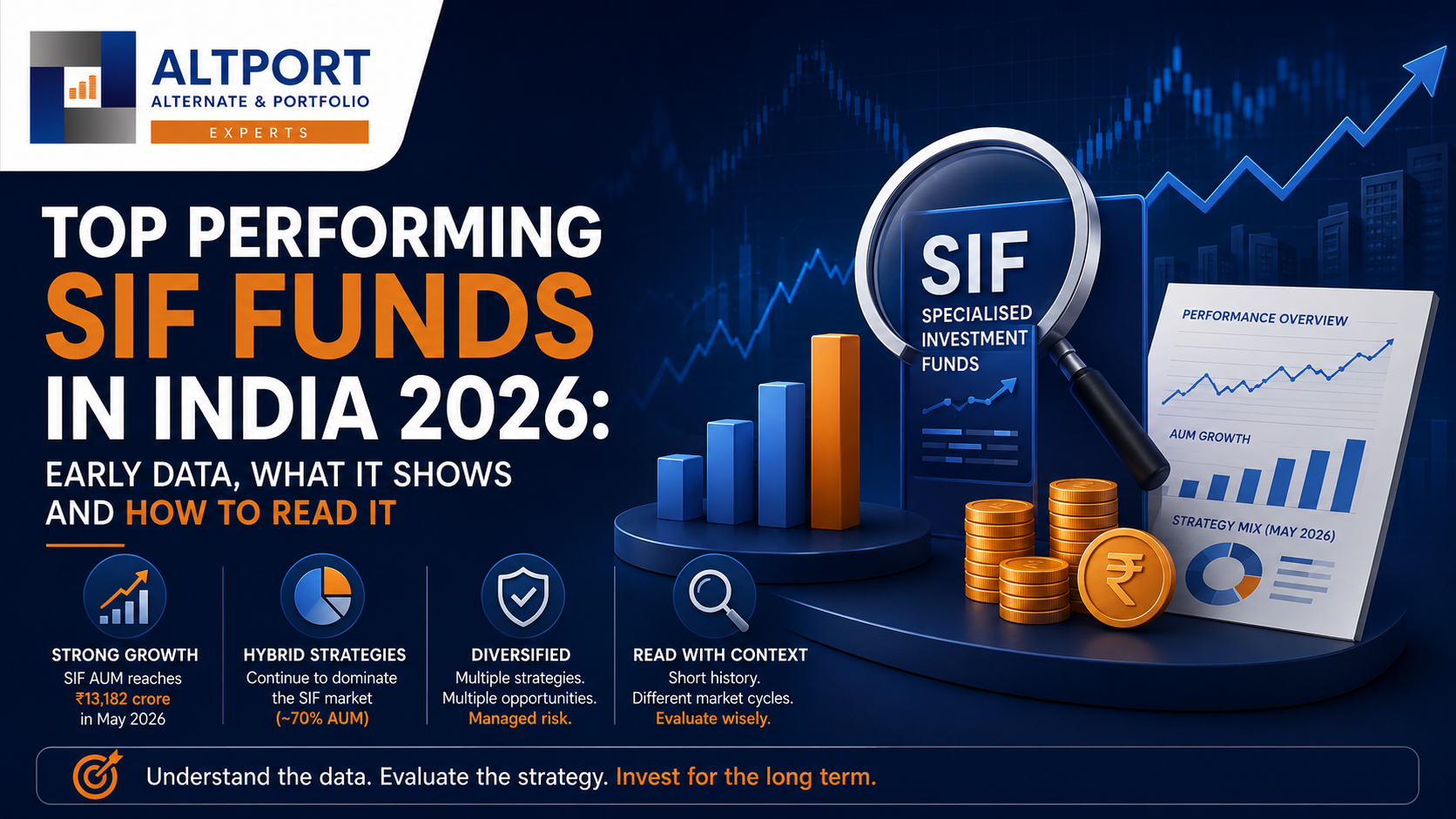
India's Specialised Investment Fund (SIF) category has gathered significant momentum since its launch on April 1, 2025. According to the latest available AMFI data, SIF assets under management (AUM) reached Rs 13,182 crore by May 2026, reflecting strong investor adoption in less than a year.
While this has increased interest in top SIF funds India 2026 and SIF fund returns, investors should interpret the available performance data carefully. Most SIFs still have only 3 to 8 months of since-inception history, covering both a strong market rally and the Nifty's 11.30% correction in March 2026, making direct return comparisons potentially misleading. This article explores the evolving SIF landscape, explains how to read early performance correctly, and outlines the evaluation framework HNIs should apply before making an investment decision.
SIF Adoption in India - AUM Growth and Market Momentum
The growth of SEBI SIF funds has been one of the most notable developments in India's investment landscape.
According to AMFI, SIF AUM India 2026 increased from Rs 2,010 crore in October 2025 to Rs 13,182 crore in May 2026, representing more than a 6.5-fold increase in just seven months. Hybrid strategies continue to dominate the category, accounting for the majority of industry assets. At the same time, established wealth managers such as Nuvama Wealth, Marcellus Investment Managers, Wealth First Portfolio Managers, and ASK Investment Managers have applied for mutual fund licences to launch SIF products, signalling strong institutional confidence in the category's long-term potential rather than treating it as a short-term trend.
SIF Market Data (Latest official AMFI data - May 2026)
| Metric | Figure |
| AUM (October 2025) | Rs 2,010 crore |
| AUM (May 2026) | Rs 13,182 crore |
| AUM Growth | 6.5x+ (October 2025 to May 2026) |
| Net Inflow (May 2026) | Rs 1,396 crore |
| Hybrid SIF Share | Continues to be the dominant category |
| Live SIF Strategies | Verify before publication (latest launches continue) |
| AMCs Offering SIFs | Verify before publication |
| Notable AMCs | Quant Mutual Fund, Edelweiss (Altiva), SBI Mutual Fund (Magnum), Mirae Asset, ITI Mutual Fund and others |
FYI: This article intentionally does not rank funds by short-term returns. Since most SIFs have less than one year of performance history, return comparisons should always be interpreted alongside market conditions, benchmark performance during the same period, and the fund manager's longer-term experience managing similar strategies. AMFI releases SIF statistics monthly, so all AUM and market data should be reviewed before each quarterly update.
Which AMCs Have Launched SIF Funds in India?
The SIF fund list India 2026 has expanded rapidly since the category's launch, with participation from both large, established mutual fund houses and specialised investment managers. Leading AMCs such as SBI Mutual Fund, and Mirae Asset Mutual Fund have introduced SIF offerings alongside specialist players like Quant Mutual Fund and Edelweiss Mutual Fund (through its Altiva platform).
New SIF NFO 2026 launches have focused on differentiated long-short strategies rather than traditional mutual fund categories. The industry is also witnessing convergence between PMS, AIF, and mutual funds, with firms including ASK Investment Managers, Marcellus Investment Managers, Nuvama Wealth, and Wealth First Portfolio Managers applying for mutual fund licences to enter the SIF segment.
This growing institutional participation reflects confidence in the long-term potential of the category rather than a short-term product launch cycle. Investors searching for the best SIF funds India 2026 should therefore focus on understanding the underlying strategy and investment philosophy instead of the number of launches alone.
SIF Strategy Categories Available as Top SIF funds India 2026
As of the latest AMFI May 2026 data, hybrid long-short strategies continue to dominate the SIF market, although equity-oriented strategies have been gaining share with several new launches.
| SIF Category | Investment Approach | Approx. AUM Share (May 2026) | Typical Risk Band |
| Hybrid Long-Short | Combines equity and debt while using long and short positions to manage risk and generate returns | ~70% of total SIF AUM | Risk Band 3 to 4 |
| Equity Long-Short | Buys stocks expected to outperform while shorting stocks expected to underperform | ~13-14% of total SIF AUM | Risk Band 4 to 5 |
| Equity Ex-Top 100 Long-Short | Invests primarily in companies outside India's top 100 by market capitalisation using a long-short strategy | ~14% of total SIF AUM | Risk Band 4 to 5 |
| Active Asset Allocator Long-Short | Dynamically allocates between equity, debt, gold and other eligible assets based on market conditions | ~2% of total SIF AUM | Risk Band 2 to 3 |
The category shares above are calculated using the latest AMFI SIF Monthly Report (May 2026). Unlike the earlier February 2026 data, hybrid strategies now account for approximately 70% of industry AUM (₹9,709 crore of ₹13,814 crore), reflecting the continued preference for diversified long-short portfolios. The category mix will continue to evolve as new SIF strategies are launched.
How to Read SIF Fund Returns Correctly - The Critical Context
When reviewing SIF fund returns or conducting a SIF returns comparison, remember that most Specialised Investment Funds have only 3 to 8 months of performance history. This is too short a period to draw reliable conclusions. First, different launch dates mean funds have operated under very different market conditions - a fund launched in late 2025 experienced a different environment from one launched after the March 2026 Nifty correction of 11.30%. Second, funds that were operational during this market decline have already faced a meaningful stress test, while newer launches have not. Third, short return periods magnify statistical noise, where one exceptionally strong or weak month can disproportionately influence since-inception performance. At this stage, understanding the context behind returns is far more valuable than comparing headline percentages.
Three Things to Check Before Trusting a SIF's Early Returns
1. Inception Date
Start by checking when the fund was launched. A SIF's since-inception return only makes sense when viewed alongside the market environment it has experienced. Ask whether the fund operated through a predominantly bullish, bearish, or sideways market, as this provides essential context for its performance.
2. Benchmark Comparison
Evaluate how the fund performed relative to its SEBI-disclosed benchmark over the same period. This comparison is considerably more meaningful than looking at absolute returns in isolation. A modest positive or even slightly negative return may still represent strong relative performance if the benchmark declined even further.
3. Manager's Prior Track Record
Since SIF is a new category, the fund manager's experience becomes particularly important. Examine whether the investment team has successfully managed a similar strategy through PMS or AIF over multiple market cycles. A manager with a well-documented five-year or longer TWRR track record in the same investment approach provides a stronger basis for evaluation than a newly constituted team with only a few months of SIF history.
A SIF reporting -3% since inception may have launched just before the March 2026 market correction and still significantly outperformed its benchmark. Conversely, a SIF showing +15% since inception could simply have benefited from favourable launch timing during a strong rally.
At this stage of the category's evolution, the context behind the return is far more important than the return itself. That is why informed investors should evaluate market conditions, benchmark-relative performance, and manager experience before drawing conclusions from early SIF performance data.
How HNIs Should Evaluate SIF Funds Right Now
For investors asking how to evaluate SIF funds or should HNIs invest in SIF funds, the answer is yes - but with a disciplined evaluation process rather than a focus on short-term returns. Since most SIFs have only a few months of performance history, greater emphasis should be placed on the fund manager's experience, the robustness of the investment strategy, and how the fund has behaved relative to its benchmark during different market conditions. A structured assessment today is likely to be more informative than comparing since-inception returns alone.
| Evaluation Criterion | Why It Matters Now | What to Look For |
| Fund manager's prior track record | SIF performance history is still limited. The manager's experience in a similar PMS or AIF strategy provides stronger evidence. | A comparable strategy with a 3+ year SEBI-compliant TWRR track record before the SIF launch. |
| Strategy clarity | Long-short investing requires disciplined execution and clearly defined rules. | The Scheme Information Document (SID) should clearly explain the investment process, long-short limits, and benchmark. |
| Benchmark performance vs absolute return | Relative outperformance is more meaningful than headline returns over a short period. | Compare the fund's alpha versus its stated benchmark for the same since-inception period. |
| Risk band | SEBI's five risk bands allow fair comparisons between funds with similar risk profiles. | Understand the fund's assigned risk band before comparing returns with another SIF. |
| AUM momentum | Growing assets may indicate increasing investor confidence, although inflows alone should not drive decisions. | Look for sustained HNI participation rather than short-term asset growth driven primarily by new fund launches or distribution activity. |
| Fee structure | Costs directly influence long-term investor returns. | Review the Total Expense Ratio (TER) and whether any performance fee includes an appropriate hurdle rate. |
Where Is the SIF Market Headed?
The early trajectory suggests that the SIF market is entering a strong growth phase. Industry AUM has expanded rapidly, and more AMCs continue to launch new strategies while established PMS and AIF managers such as Nuvama Wealth, Marcellus Investment Managers, and ASK Investment Managers pursue mutual fund licences to enter the segment. SEBI's parallel expansion of investment options for accredited investors further complements the broader alternatives ecosystem. As more SIFs complete their first 12-month performance cycle and track records mature, investor confidence and product adoption are likely to strengthen, supported by wider distribution and increasing institutional participation.
How ALTPORT Evaluates and Curates SIF Strategies
At ALTPORT, SIF strategies are evaluated using our 3Is Framework - Investment Manager Style, Investment Portfolio Quality, and Investment Performance Consistency. Given that most SIFs have only a short operating history, we place greater emphasis on the fund manager's prior PMS or AIF track record in managing the same or a closely comparable strategy. We also assess how consistently the investment process has been executed across different market cycles, including risk management during the March 2026 market correction. Investors who would like to understand this framework in greater detail can explore ALTPORT's dedicated SIF resources before evaluating individual strategies.
Frequently Asked Questions
Which SIF fund has the best returns in India 2026?
It is too early to identify the "best" SIF based on returns alone. Most SIFs have only 3 to 8 months of performance history, making rankings unreliable and potentially misleading. Instead of focusing on short-term returns, evaluate the fund manager's prior PMS or AIF track record, the clarity of the investment strategy, and how the fund has performed relative to its benchmark over the same period.
How many SIF funds are there in India?
The number of SIF strategies continues to grow as more asset management companies launch new offerings. Investors should refer to the latest AMFI disclosures or recognised SIF industry trackers for the current number of live strategies and participating AMCs before making comparisons, as the landscape evolves regularly.
What is the AUM of SIF funds in India?
According to the latest officially available AMFI data (May 2026), the SIF industry manages Rs 13,182 crore in assets under management, up from Rs 2,010 crore in October 2025. This rapid growth reflects increasing investor interest, although AUM should be viewed as an indicator of category adoption rather than a measure of investment quality.
Should HNIs invest in SIF funds in 2026?
SIF is a legitimate, SEBI-regulated investment category that bridges the gap between mutual funds and PMS by offering long-short strategies with a Rs 10 lakh minimum investment. For HNIs seeking this type of exposure, SIF is worth evaluating. However, given the limited performance history of most funds, it may be prudent to begin with an allocation that forms part of a broader portfolio while placing greater emphasis on the manager's established investment track record.
How is SIF different from AIF and PMS?
SIF has a Rs 10 lakh minimum investment, operates under the mutual fund regulatory framework, and offers long-short strategies with taxation generally occurring on redemption. PMS requires a Rs 50 lakh minimum investment and provides direct ownership of securities in the investor's Demat account. AIF typically requires a Rs 1 crore minimum investment and offers access to private market opportunities as well as more sophisticated alternative investment strategies. For a detailed comparison, readers can refer to ALTPORT's SIF vs PMS vs AIF decision guide.
Disclaimer
Past performance is not indicative of future results. Investing in Specialised Investment Funds involves market risk, liquidity risk, and the risk of loss of capital. SIF strategies may involve complex derivatives and short-selling techniques that carry additional risks compared to traditional mutual funds. The performance data referenced in this article covers limited periods (3 to 8 months) and is not a reliable indicator of long-term returns. Investors should read the Scheme Information Document (SID) of each fund carefully before investing. Please consult a SEBI-registered investment adviser before making any investment decision. ALTPORT is an APMI-registered investment distribution platform, not a SEBI-registered investment adviser.