
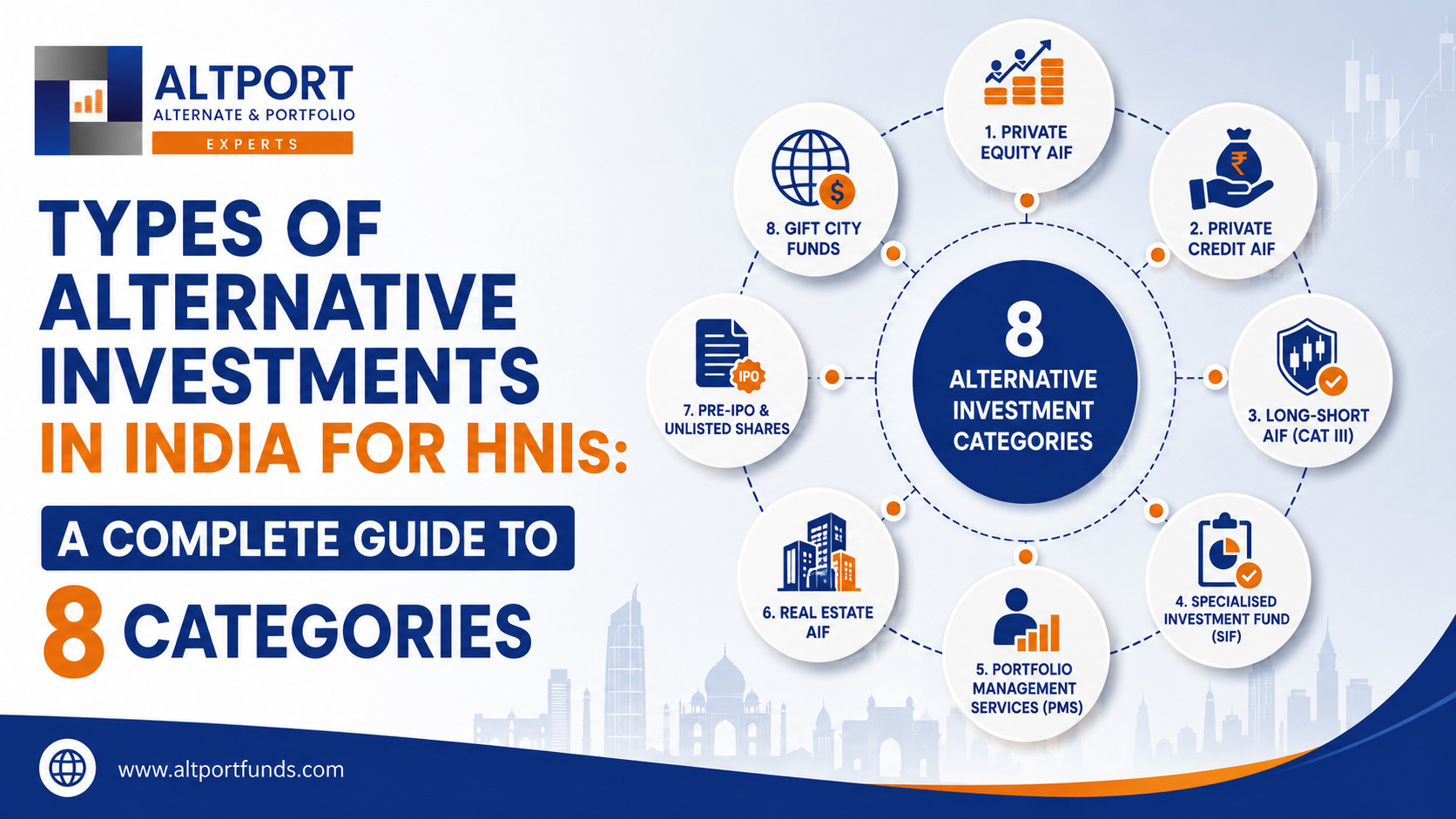
India's alternative investment landscape has expanded rapidly over the last few years, with the Alternative Investment Fund (AIF) industry alone crossing Rs 15.74 lakh crore in total commitments as of December 2025. As wealth grows, many High Net Worth Individuals (HNIs) are looking beyond listed equities, fixed deposits, and traditional mutual funds to build more diversified portfolios.
Today, the types of alternative investments India offers are broader than ever, ranging from private equity and private credit to GIFT City funds and SEBI's newly introduced Specialised Investment Funds (SIFs). Each comes with its own investment horizon, taxation, liquidity, and return potential. This guide explores the eight most relevant alternative investment options India HNI investors should understand before allocating capital.
1. Private Equity AIF (Category II)
Private equity is one of the most established alternative investments for HNI India. Instead of buying shares of companies listed on the stock exchange, investors participate in professionally managed Category II AIFs that invest in promising private businesses before they reach public markets.
Fund managers typically back companies with scalable business models, experienced management teams, and long-term growth potential. As these businesses expand or eventually get listed, investors may benefit from capital appreciation over several years.
| Parameter | Details |
| Investment Type | Category II AIF |
| Minimum Investment | Rs 1 crore |
| Typical Holding Period | 5-7 years |
| Expected Return Potential | Target IRR of 18-25%+ (not guaranteed) |
| Taxation | Pass-through taxation with capital gains taxed at investor level |
| Suitable For | UHNIs with long investment horizons seeking exposure to India's private economy |
Private equity investments are generally illiquid because portfolio companies are not publicly traded. Investors should therefore be comfortable locking capital away for several years in exchange for potentially higher long-term wealth creation.
For a deeper understanding of available strategies, investors can explore ALTPORT's dedicated Private Equity investment solutions.
2. Private Credit AIF (Category II)
While equity investments seek capital appreciation, private credit India focuses on generating income by lending to businesses through professionally managed Alternative Investment Funds.
These funds provide structured financing to established companies, real estate developers, infrastructure projects, and growing businesses that require capital outside traditional banking channels. Investors earn returns primarily through contractual interest payments rather than stock price appreciation.
| Parameter | Details |
| Investment Type | Category II AIF |
| Minimum Investment | Rs 1 crore |
| Lock-in | 3-5 years |
| Target Yield | 12-18% (not guaranteed) |
| Taxation | Pass-through structure; interest generally taxed at investor's slab rate |
| Suitable For | HNIs seeking regular income above traditional debt products |
Compared with fixed deposits and conventional bonds, private credit offers the potential for higher yields, although investors take on credit and liquidity risk in return.
Investors interested in understanding how this asset class works can refer to ALTPORT's Private Credit solutions and its detailed "What is Private Credit?" educational guide.
3. Long-Short and Hedge AIF (Category III)
A hedge fund India HNI investor typically seeks returns that are less dependent on the overall direction of equity markets. Category III AIFs pursue this objective using sophisticated investment strategies that combine long positions, short selling, derivatives, arbitrage, and, where permitted, leverage.
Unlike traditional equity funds that generally benefit only when markets rise, long-short funds attempt to generate returns across varying market environments through active risk management.
| Parameter | Details |
| Investment Type | Category III AIF |
| Minimum Investment | Rs 1 crore |
| Investment Universe | Primarily listed markets |
| Target Return Range | 15-22% net (not guaranteed) |
| Taxation | Fund-level taxation under prevailing Category III AIF rules |
| Suitable For | Sophisticated HNIs seeking absolute-return-oriented strategies |
These funds require investors to understand complex portfolio construction techniques and may experience periods of volatility depending on market conditions and manager strategy.
ALTPORT provides access to a range of Long-Short and Category III AIF strategies suited to experienced investors.
4. Specialised Investment Fund (SIF)
Introduced by SEBI from April 2025, the Specialised Investment Fund represents an important addition to India's alternative investment ecosystem. SIF investment India has attracted attention because it bridges the gap between mutual funds and AIFs.
SIFs can employ more flexible investment strategies, including long-short approaches, while continuing to operate within the mutual fund regulatory framework. This significantly lowers the entry barrier for affluent investors who may not yet qualify for a Rs 1 crore AIF allocation.
| Parameter | Details |
| Structure | SEBI Specialised Investment Fund |
| Minimum Investment | Rs 10 lakh |
| Taxation | Mutual fund taxation framework; equity-oriented SIFs currently eligible for 12.5% LTCG where applicable |
| Strategy | Long-short and specialised investment strategies |
| Suitable For | Investors with Rs 10 lakh-Rs 50 lakh seeking sophisticated strategies without AIF minimums |
For investors beginning their journey into alternative assets, SIFs provide access to professional portfolio management with considerably lower capital requirements than traditional AIFs.
ALTPORT offers dedicated resources and investment solutions covering the latest SIF opportunities.
5. Portfolio Management Services (PMS)
Portfolio Management Services occupy a unique position within the broader universe of alternative investment options India HNI investors consider.
Unlike pooled investment vehicles, PMS portfolios are held directly in the investor's own Demat account. A SEBI-registered portfolio manager makes investment decisions on behalf of the client while maintaining complete transparency over individual holdings.
| Parameter | Details |
| Structure | Portfolio Management Service |
| Minimum Investment | Rs 50 lakh |
| Portfolio Type | Direct equity securities |
| Strategy | Predominantly long-only |
| Taxation | Tax payable by investor based on individual transactions |
| Suitable For | HNIs seeking customised equity portfolios with direct ownership |
Because investors own the securities directly, they enjoy greater visibility into portfolio composition and corporate actions compared to pooled investment structures.
ALTPORT partners with leading PMS managers across multiple investment styles and philosophies.
6. Real Estate AIF (Category II)
For investors seeking property exposure without buying and managing physical assets, real estate AIF India provides an institutional alternative.
These funds generally follow one of two approaches. Real estate private credit funds lend capital to developers and earn contractual interest, while real estate equity funds invest directly in development or commercial real estate projects with the objective of long-term capital appreciation.
| Parameter | Credit Strategy | Equity Strategy |
| Minimum Investment | Rs 1 crore | Rs 1 crore |
| Target Returns | 12-16% yield* | 15-20%+ IRR* |
| Investment Style | Lending | Ownership |
| Suitable For | Income-focused HNIs | Growth-oriented HNIs |
*Target ranges are indicative and not guaranteed.
Real Estate AIFs eliminate many challenges associated with direct property ownership, including tenant management, maintenance, legal documentation, and operational oversight, while providing exposure to professionally managed institutional projects.
Investors with smaller investment amounts may also consider listed REITs, which provide exchange-traded exposure to commercial real estate with significantly lower entry requirements.
7. Pre-IPO and Unlisted Shares
Among the fastest-growing types of alternative investments India offers are pre IPO investment India opportunities and unlisted shares India.
These investments allow investors to acquire shares of companies before they are listed on stock exchanges or purchase equity in companies that continue to remain privately held.
The attraction lies in the possibility of significant value creation if the company successfully grows and eventually lists at a higher valuation.
| Parameter | Details |
| Investment Type | Pre-IPO and Unlisted Equity |
| Minimum Investment | Varies by company and transaction |
| Liquidity | Low |
| Taxation | Long-term capital gains taxed at 12.5% after 24 months (without indexation) |
| Suitable For | Investors with strong conviction in specific businesses |
The biggest consideration is liquidity. Unlike listed shares, investors cannot simply sell holdings on an exchange. Exits generally require finding another buyer through private transactions, making investment horizons less predictable.
ALTPORT provides educational resources on Pre-IPO investing along with curated access to select unlisted opportunities where available.
8. GIFT City Funds
GIFT City investment India has become increasingly relevant for globally minded investors, NRIs, and families seeking internationally structured investment solutions.
Funds established in India's International Financial Services Centre (IFSC) are typically USD-denominated and operate under a regulatory framework designed to attract global capital. Investors gain access to international markets, India-focused offshore strategies, and globally diversified portfolios through a single platform.
| Parameter | Details |
| Structure | IFSC-based Fund |
| Minimum Investment | USD 75,000 (for eligible AIFs) |
| Currency | US Dollar |
| Tax Benefits | Section 80LA benefits for eligible entities; certain Category III AIFs may offer zero Indian capital gains tax for eligible non-resident investors under prevailing regulations |
| Repatriation | Freely repatriable |
| Suitable For | NRIs and HNIs seeking global diversification and tax-efficient structures |
For internationally diversified families, GIFT City combines global investment access with an increasingly competitive regulatory and tax environment.
ALTPORT offers curated GIFT City investment opportunities across multiple global strategies.
All 8 Types at a Glance - Comparison Table
If you're comparing the types of alternative investments India offers, the table below provides a quick overview of the minimum investment, expected return potential, risk, liquidity, and the type of investor each category is generally suited for. While every investment serves a different purpose within a portfolio, the right choice ultimately depends on your financial goals, investment horizon, and risk tolerance.
| Type | Min. Investment | Target Return (Indicative)* | Risk Level | Liquidity | Best For |
| Private Equity AIF | Rs 1 crore | 18 to 25%+ IRR | High | Very low (5-7 year lock-in) | Long-horizon UHNI |
| Private Credit AIF | Rs 1 crore | 12 to 18% yield | Moderate | Very low (3-5 year lock-in) | Yield-seeking HNI |
| Long-Short AIF (Category III) | Rs 1 crore | 15 to 22% net | High | Low (typically 1-3 year lock-in) | Absolute-return-focused HNI |
| Specialised Investment Fund (SIF) | Rs 10 lakh | Market-linked | Moderate-High | Mutual fund-style redemption, subject to scheme terms | HNIs with Rs 10-50 lakh corpus |
| Portfolio Management Services (PMS) | Rs 50 lakh | 14 to 20% CAGR target | Moderate-High | No lock-in; exit load may apply | HNIs seeking direct equity portfolios |
| Real Estate AIF | Rs 1 crore | 12 to 20% | Moderate-High | Very low (3-7 year investment horizon) | Investors seeking institutional real estate exposure |
| Pre-IPO / Unlisted Shares | Varies by opportunity | High potential | Very High | Very low | Investors with strong IPO conviction |
| GIFT City AIF | USD 75,000 | Fund-dependent | Moderate-High | Depends on fund structure | NRIs and UHNIs seeking global diversification |
Note: All return figures are indicative targets or manager expectations and are not guaranteed. Actual returns may vary significantly depending on market conditions, fund strategy, and investment performance. Past performance is not indicative of future results.
How to Choose Which Alternative Investment to Start With
The right starting point depends largely on the size of your investment corpus and your financial objectives. Investors do not need to begin with every alternative asset class at once. A phased allocation often works better, allowing you to gain familiarity before expanding into more specialised strategies. As your investable surplus grows, additional opportunities become available across PMS, AIFs, and international investment structures.
| If your investable corpus is... | Consider starting with... | Why it fits |
| Under Rs 10 lakh | Specialised Investment Fund (SIF) | The only regulated alternative investment option with a relatively accessible entry threshold. |
| Rs 10 lakh to Rs 50 lakh | SIF + Select Unlisted Shares | Combines professionally managed strategies with selective high-growth opportunities. |
| Rs 50 lakh to Rs 99 lakh | PMS + SIF | Adds personalised direct equity management while continuing exposure to specialised strategies. |
| Rs 1 crore and above | All AIF Categories, PMS, Private Equity, Private Credit, Long-Short, Real Estate AIFs | Full access to the complete alternative investment universe for building a diversified portfolio. |
| NRI Investors | GIFT City AIF | Offers USD-denominated investing, global diversification, and potential tax efficiencies subject to applicable regulations. |
Frequently Asked Questions
What are alternative investments in India?
Alternative investments are assets that go beyond traditional investment options such as listed equities, debt instruments, and conventional mutual funds. In India's regulated investment framework, these include Alternative Investment Funds (AIFs) such as private equity, private credit, and hedge funds, along with Specialised Investment Funds (SIFs), Portfolio Management Services (PMS), unlisted shares, pre-IPO investments, and GIFT City funds. They are primarily designed for investors seeking greater diversification and access to opportunities not available in public markets.
What is the minimum investment for alternative investments in India?
The minimum investment depends on the product. Specialised Investment Funds (SIFs) require a minimum investment of Rs 10 lakh, Portfolio Management Services (PMS) require Rs 50 lakh, while all categories of Alternative Investment Funds (AIFs) have a minimum investment of Rs 1 crore under SEBI regulations. For eligible GIFT City AIFs, the minimum investment is generally USD 75,000, although individual fund requirements may differ.
Which alternative investment is best for HNIs in India?
There is no one-size-fits-all answer. The right investment depends on your investment corpus, financial goals, time horizon, and liquidity needs. Private Credit AIFs are often preferred by investors seeking regular income, Private Equity AIFs by those pursuing long-term capital appreciation, and PMS by investors who want a professionally managed direct equity portfolio. Many wealth advisors recommend combining multiple alternative investments to build a diversified portfolio.
Are alternative investments riskier than mutual funds?
In most cases, yes. Alternative investments typically involve higher market, credit, or liquidity risk than traditional mutual funds. However, they also provide access to private markets and specialised strategies that may improve diversification and long-term return potential. Investors should understand the risks, lock-in periods, and investment objectives before allocating capital.
How much of an HNI portfolio should be allocated to alternative investments?
There is no fixed percentage that suits every investor. The ideal allocation depends on factors such as your existing portfolio, income needs, investment horizon, and risk appetite. Many experienced advisors recommend gradually increasing exposure to alternative assets as wealth grows, using a diversified mix of private equity, private credit, PMS, long-short funds, and other regulated investment products rather than concentrating on a single strategy.
Conclusion
India's alternative investment ecosystem has evolved significantly, giving HNIs access to eight distinct regulated investment categories - from Rs 10 lakh Specialised Investment Funds (SIFs) and Rs 50 lakh Portfolio Management Services (PMS) to Rs 1 crore AIFs and USD-denominated GIFT City funds. Each serves a different purpose, whether it is generating income, pursuing long-term capital appreciation, accessing private markets, or building global diversification.
Rather than looking for a single "best" alternative investment, investors should focus on building a portfolio that aligns with their financial goals, investment horizon, and risk appetite. A thoughtful combination of complementary strategies can often provide better diversification than relying solely on traditional asset classes.
As a curated investment platform, ALTPORT provides access to a wide range of regulated alternative investment solutions, helping HNIs evaluate opportunities across AIFs, PMS, SIFs, GIFT City funds, private credit, and other specialised investment products.
Disclaimer: Alternative investments involve market risk, credit risk, liquidity risk, and other investment risks. Return figures mentioned in this article are indicative and should not be interpreted as guarantees or assurances of future performance. Investors should read all scheme-related documents carefully and consult a qualified financial advisor before making any investment decision.