

Category III Alternative Investment Funds (AIFs) have become an important part of India's alternative investment landscape. They provide access to investment strategies that go beyond conventional equity and debt portfolios. These funds can use listed securities, derivatives, leverage and complex trading strategies, subject to applicable regulations.
For investors exploring the Top Category III AIF Funds in India, understanding historical performance is only one part of the evaluation. Investment strategy, portfolio concentration, fund manager experience, fee structure, liquidity and risk management also matter.
Unlike conventional mutual funds, Category III AIFs can follow long-only, long-short, market-neutral and other complex investment approaches. Their performance can vary significantly depending on market conditions, portfolio positioning and the manager's execution.
This guide examines 10 Category III AIFs using the supplied performance dataset. It compares their reported returns across different periods and explains the factors investors should examine before evaluating these strategies.
The objective is to provide a structured overview of Category III AIF funds in India in 2026, rather than rank funds solely on recent returns or present historical performance as an indication of future results.
For a broader comparison across all three AIF categories, read our guide to Top 10 AIF Funds in India, which covers different AIF categories, investment strategies and fund-selection considerations.
Data note: The AUM figures and performance data below are reproduced from the supplied dataset. The dataset does not specify the AUM unit, reporting date, original data source or whether returns are absolute or annualised. These details should be verified before publication. NA indicates that the corresponding figure was unavailable in the supplied data. The figures should not be treated as independently verified or directly comparable until these details are confirmed.
Top 10 Category III AIF Funds in India (2026)
The following Category III AIF funds list covers 10 schemes across different investment managers. The comparison includes their reported AUM, historical returns, benchmark performance and investment categories.
The funds are presented using the supplied AUM and performance data. This is a comparative shortlist, not a definitive ranking of investment suitability. The order does not indicate an endorsement or an assessment of future performance.
Top 10 Category III AIFs: Fund and Manager Details
| No. | Fund name | Investment manager | AUM (as reported) | Category |
| 1 | SageOne Flagship Growth OE Fund | SageOne Investment Managers LLP | 1,913 | CAT III - Long Only |
| 2 | Motilal Oswal Founders Fund Series 1 | Motilal Oswal Asset Management Company Ltd | 1,890 | CAT III - Long Only |
| 3 | Enhanced Dynamic Growth Equity (EDGE) Fund | Nuvama Asset Management Limited | 1,677 | CAT III - Long Short |
| 4 | Emerging Leaders of Tomorrow | Alchemy Capital Management | 1,547 | CAT III - Long Only |
| 5 | India Equity Fund | Sameeksha Capital Pvt Ltd | 1,288 | CAT III - Long Only |
| 6 | Turnaround Opportunities Fund | 360 ONE Asset Management | 1,052 | CAT III - Long Only |
| 7 | Growth Opportunities Fund Scheme - I | Ampersand Capital Trust | 1,046 | CAT III - Long Only |
| 8 | Leaders of Tomorrow | Alchemy Capital Management | 1,015 | CAT III - Long Only |
| 9 | Negen Undiscovered Value Fund | Negen Capital Services Pvt Ltd | 996 | CAT III - Long Only |
| 10 | Multi Asset Strategy Return Fund (NARS+) | Nuvama Asset Management Limited | 931 | CAT III - Long Short - Conservative |
AUM units were not specified in the supplied dataset. Figures are reproduced without assuming a unit. The categories reflect the supplied classification.
For a broader understanding of Category III AIF funds in India, investors can examine the permitted investment strategies, scheme structures and relevant fund disclosures.
Category III AIF Returns: Performance Highlights
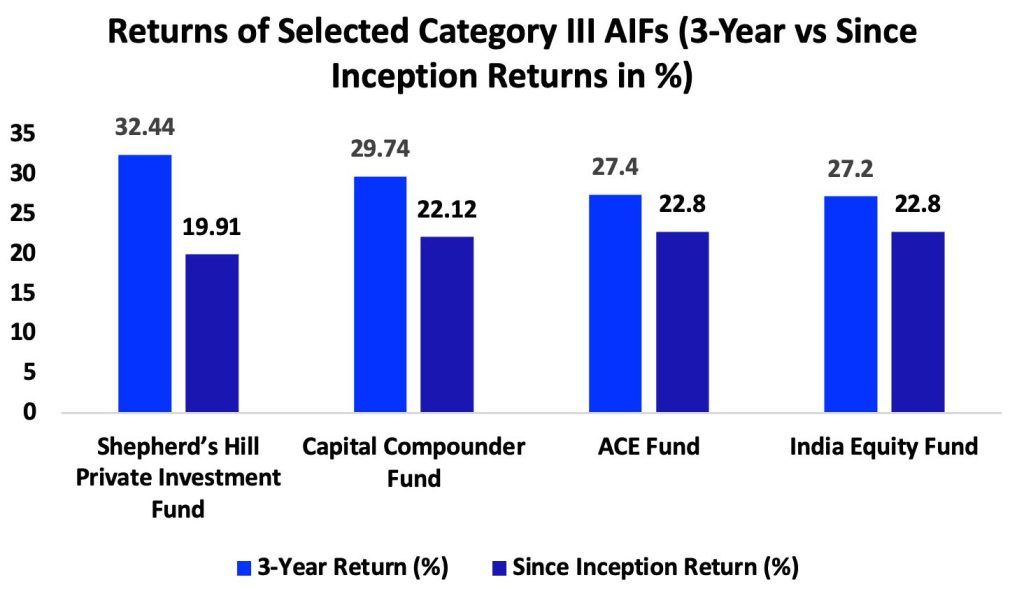
Historical returns provide a starting point for understanding how these schemes have performed over different periods.
Some notable observations from the dataset include:
- Emerging Leaders of Tomorrow: Reported a 28.47% one-year return and 23.95% three-year return.
- Leaders of Tomorrow: Recorded 29.64% over six months, 24.60% over one year and 19.64% over three years.
- Negen Undiscovered Value Fund: Reported 29.21% since inception and 27.64% over three years.
- Motilal Oswal Founders Fund Series 1: Recorded 25.48% since inception and 20.31% over three years.
- India Equity Fund: Reported 23.04% since inception and 20.53% over three years.
- Growth Opportunities Fund Scheme - I: Recorded 21.40% over three years and 19.97% since inception.
- SageOne Flagship Growth OE Fund: Reported 21% over one year, although its two-year and three-year figures are unavailable.
These figures highlight differences across investment managers and measurement periods. A strong six-month return does not necessarily indicate consistent long-term performance.
For investors assessing the Top Category III AIF Funds in India, longer observation periods can provide additional context. However, fund inception dates and available track records also need consideration.
Category III AIF Performance Comparison Across Different Periods
A meaningful Category III AIF fund comparison should consider performance across multiple periods rather than focusing on a single return figure.
The following table brings together the reported returns of all 10 schemes.
| Fund | 1M | 6M | 1Y | 3Y | Inception |
| SageOne Flagship Growth OE | 1.80% | 12.00% | 21.00% | NA | 7.70% |
| Motilal Oswal Founders Fund Series 1 | 6.25% | 22.62% | 16.22% | 20.31% | 25.48% |
| Enhanced Dynamic Growth Equity (EDGE) | 0.35% | 2.55% | 6.77% | 16.26% | 17.92% |
| Emerging Leaders of Tomorrow | 6.06% | 28.08% | 28.47% | 23.95% | 22.80% |
| India Equity Fund | -0.22% | 14.48% | 10.82% | 20.53% | 23.04% |
| Turnaround Opportunities Fund | 1.36% | 8.71% | 7.56% | 12.91% | 15.27% |
| Growth Opportunities Fund Scheme - I | 4.09% | 18.59% | 13.52% | 21.40% | 19.97% |
| Leaders of Tomorrow | 7.97% | 29.64% | 24.60% | 19.64% | 16.29% |
| Negen Undiscovered Value Fund | 5.21% | 29.07% | 13.47% | 27.64% | 29.21% |
| Multi Asset Strategy Return Fund (NARS+) | 0.47% | 3.01% | 9.04% | NA | 12.63% |
Returns are reproduced exactly as supplied. The source dataset does not specify whether all figures are absolute or annualised returns. Inception periods may differ between schemes. NA indicates unavailable data.
What Do Category III AIF Historical Returns Reveal?
Stronger recent performance
Leaders of Tomorrow and Negen Undiscovered Value Fund reported six-month returns of 29.64% and 29.07%, respectively. Emerging Leaders of Tomorrow followed at 28.08%.
These figures indicate strong performance over the reported six-month period. They do not establish whether the same performance can continue.
Longer-period performance
Negen Undiscovered Value Fund recorded 27.64% over three years. Emerging Leaders of Tomorrow reported 23.95%, while Growth Opportunities Fund Scheme - I delivered 21.40%.
These numbers offer a longer comparison window than recent monthly or quarterly returns.
Since-inception performance
Negen Undiscovered Value Fund recorded the highest reported inception return at 29.21%. Motilal Oswal Founders Fund Series 1 followed at 25.48%.
However, inception returns should be interpreted alongside the actual launch dates and the length of each fund's track record.
How to Compare Category III AIF Returns Against Benchmarks
Benchmark comparisons help investors understand how a fund has performed relative to its stated market reference.
The supplied dataset includes BSE 500 TRI, Nifty 50 TRI, BSE 200 TRI and Nifty 500 and Debt Composite Index.
However, benchmarks differ across schemes. Therefore, comparing every fund against one common index may produce misleading conclusions.
Investors should examine:
- Whether the benchmark reflects the fund's investment universe.
- Whether the benchmark is a total return index.
- Whether the fund and benchmark returns cover identical periods.
- Whether performance remains consistent across different market conditions.
- Whether the strategy's risk exposure is comparable with its benchmark.
A long-only equity fund and a long-short strategy may have different market exposures. Benchmark selection should reflect the investment mandate rather than rely on one common index for every scheme.
Long-Only vs Long-Short Category III AIF Strategies
Category III AIFs can follow different investment approaches depending on their mandate and portfolio construction. Long-only and long-short strategies are two important approaches used by these funds.
Long-Only AIF Investment Strategies
A long-only Category III AIF primarily invests in selected securities with the objective of benefiting from their potential price appreciation. The manager takes positions based on the investment outlook, company fundamentals, valuation and market conditions.
The portfolio generally maintains directional exposure to the market. Consequently, returns can be influenced by overall equity market movements, sector allocation and stock selection.
Investors exploring long-only investment strategies should examine portfolio concentration, investment horizon, stock selection methodology and downside risk management.
Long-Short AIF Investment Strategies
A long-short Category III AIF combines long positions with short positions. The strategy may seek to benefit from both positive and negative investment views while managing overall market exposure.
Managers can use short positions, derivatives and hedging techniques as permitted under the scheme mandate and applicable regulations.
These strategies may be designed to reduce directional market exposure, but they still carry market, derivatives, liquidity and execution risks.
Investors comparing long-short investment strategies should examine net market exposure, gross exposure, leverage, short-selling arrangements and risk management practices.
Long-Only vs Long-Short AIFs: Key Differences
| Parameter | Long-Only AIF | Long-Short AIF |
|---|---|---|
| Investment approach | Primarily takes long positions | Combines long and short positions |
| Market exposure | Usually directional | Can adjust net market exposure |
| Derivatives | Depends on the investment mandate | May use derivatives for short exposure or hedging |
| Return drivers | Stock selection and market movements | Stock selection, hedging and exposure management |
| Key risks | Equity market and concentration risk | Market, short-selling and derivatives risk |
Neither strategy is automatically superior. Investors should compare the underlying investment mandate, historical performance and risk characteristics before evaluating individual schemes.
Category III AIF Fees and Charges: What Investors Should Compare
Fees directly affect the investor's net returns. A Category III AIF fund comparison should therefore include the complete cost structure.
Common charges include:
| Fee component | What investors should examine |
| Management fee | Annual fee charged for managing the fund |
| Performance fee | Share of eligible profits payable to the manager |
| Hurdle rate | Minimum return threshold before performance fees apply |
| High-water mark | Mechanism preventing repeated performance fees on previously recovered losses |
| GST | Applicable tax on management and other taxable services |
| Exit load | Charge applicable when withdrawing within specified periods |
| Other expenses | Custody, administration, audit and transaction-related costs |
Management fees may be charged on committed capital, invested capital or AUM. The calculation method can change the actual cost considerably.
Performance fees may also follow different hurdle and high-water mark arrangements. Investors should examine whether fees are calculated before or after expenses.
There is no single standard fee applicable to every Category III AIF. The scheme's Private Placement Memorandum (PPM) contains the relevant disclosures. Investors can review ALTPORT's guide to the AIF Private Placement Memorandum (PPM) to understand the information disclosed in fund documents.
Investors should also examine the applicable distribution arrangements and Direct Plan provisions under the current SEBI framework rather than assume that every scheme follows the same fee structure.
How We Selected and Evaluated Category III AIF Funds
Evaluating the Top Category III AIF Funds in India requires more than sorting schemes by their latest returns.
The comparison uses the supplied performance dataset and considers several important parameters.
1. Historical Performance
We examined reported returns across 1M, 3M, 6M, 1Y, 2Y, 3Y, 4Y, 5Y and inception periods.
Multiple periods help identify differences between short-term performance and longer-term track records.
Missing values have been retained as NA rather than estimated.
2. Assets Under Management
AUM provides information about the reported size of a fund.
It can help investors understand the scale of operations. However, a larger AUM does not automatically indicate better investment management or stronger future returns.
3. Investment Category and Strategy
The dataset identifies long-only, long-short and conservative long-short classifications.
These categories provide an initial understanding of portfolio positioning. They do not disclose the complete investment methodology.
Investors should examine the PPM to understand individual security selection, derivatives exposure, leverage, concentration and portfolio construction.
4. Benchmark Comparison
Each scheme's stated benchmark has been considered separately.
A fund's return should be assessed against an appropriate benchmark over matching periods. A higher absolute return alone does not establish better risk-adjusted performance.
5. Availability of Track Record
The availability of performance data varies across schemes.
For example, SageOne Flagship Growth OE Fund has no reported two-year or three-year figures in the supplied dataset. NARS+ also has unavailable three-year performance.
These gaps matter when evaluating the consistency of a fund's historical results.
6. Fund Manager and Investment Team
The investment manager plays an important role in portfolio construction, execution and risk management.
Investors evaluating Category III AIF fund managers should examine:
- Professional experience and investment background.
- Previous fund management responsibilities.
- Strategy-specific investment experience.
- Performance across different market cycles.
- Risk management and decision-making processes.
- Changes in key investment personnel.
A fund's historical performance should not be attributed entirely to its current investment team without examining management changes. For a broader understanding of ALTPORT's investment selection process, investors can review the framework used to assess investment managers, portfolios and performance.
How to Select a Category III AIF Fund: Key Factors to Consider
Selecting from the Top Category III AIF Funds in India involves understanding how a strategy fits an investor's financial objectives, investment horizon and ability to absorb losses.
Category III AIFs can have significantly different portfolio structures. Two schemes within the same regulatory category may follow entirely different approaches to generating returns.
1. Understand the Investment Strategy
Category III AIF investment strategies can include:
- Long-only strategies: Primarily invest in securities with an expectation of capital appreciation.
- Long-short strategies: Take long positions in selected securities and short positions in others.
- Market-neutral strategies: Attempt to reduce broad market exposure through offsetting positions.
- Quantitative strategies: Use mathematical models, algorithms and statistical analysis to identify investment opportunities.
- Multi-asset strategies: Allocate capital across different asset classes depending on the investment mandate.
- Derivative-based strategies: Use futures, options and other derivatives for hedging, exposure management or return generation.
These approaches have different return drivers and risk characteristics. Investors should understand the actual strategy rather than relying only on its category label.
2. Examine the Minimum Investment Requirement
The Category III AIF minimum investment is generally ₹1 crore per investor under the AIF framework.
However, the regulations provide certain exceptions, including a lower threshold for eligible employees or directors of the AIF or its manager. Specific provisions also apply to accredited investors.
Investors should distinguish between the regulatory minimum and the minimum subscription specified by an individual scheme. A fund may have different investment plans or unit classes with varying commercial terms. Review the applicable AIF minimum investment requirements before evaluating a scheme.
3. Understand the Complete Fee Structure
The Category III AIF fees and charges can have a meaningful impact on the final investment outcome.
Consider the following before evaluating a scheme:
- Management fee percentage and calculation basis.
- Performance fee and applicable hurdle rate.
- High-water mark provisions.
- GST and other applicable taxes.
- Fund-level operating expenses.
- Entry or exit-related charges, where applicable.
Investors should compare net returns after all applicable expenses rather than relying exclusively on gross portfolio performance.
4. Examine Redemption and Liquidity Terms
The Category III AIF redemption terms differ between open-ended and close-ended schemes.
Open-ended structures may offer periodic redemption opportunities. However, these can be subject to notice periods, redemption gates, exit loads and other restrictions.
Close-ended structures generally restrict withdrawals until the end of their tenure, subject to the scheme documents and applicable provisions.
Investors should examine the following:
- Lock-in period, if applicable.
- Redemption frequency.
- Advance notice requirements.
- Settlement timelines.
- Redemption gates and suspension provisions.
- Exit loads and other deductions.
- Conditions applicable during exceptional market situations.
An open-ended structure does not necessarily mean immediate access to invested capital.
5. Assess Risk Management
A fund's ability to manage downside risk is an important part of its investment process.
Investors should understand how the manager handles market volatility, liquidity constraints, counterparty exposure and derivative positions.
For leveraged strategies, the level and source of leverage deserve particular attention.
6. Review the Private Placement Memorandum
The PPM is a key document for understanding a Category III AIF.
It contains information about the investment objective, strategy, manager, fees, expenses, risks, tenure and redemption conditions.
Investors should read the relevant disclosures and investment agreements before making an investment decision.
Category III AIF Taxation in India
Tax treatment is another important consideration when comparing the Top Category III AIF Funds in India.
Unlike Category I and Category II AIFs, Category III AIFs do not generally receive the same pass-through treatment under Section 115UB of the Income-tax Act.
The tax treatment depends on the fund's legal structure, income character, investor status and applicable provisions.
The Income Tax Department's published guidance distinguishes Category III AIF taxation from the pass-through treatment available to Category I and II AIFs. Certain IFSC-based Category III AIFs may have separate tax provisions.
Income Tax India
For investors, important considerations include:
- The tax treatment of income earned within the fund.
- Tax implications of distributions.
- Applicable provisions for capital gains and other income.
- Withholding tax, where relevant.
- Investor residency and treaty considerations.
- Tax reporting and documentation requirements.
Certain IFSC-based structures may have separate tax provisions. Investors should examine the scheme's tax disclosures and obtain professional advice before making an investment decision. For further details, refer to ALTPORT's guide to AIF taxation in India and the Income-tax Act, 2025.
Category III AIF Investment for NRIs: Eligibility and Tax Considerations
NRIs can invest in AIFs under the applicable regulatory framework, subject to FEMA, RBI, tax and other relevant requirements.
A Category III AIF for NRIs may provide access to Indian investment strategies through a regulated fund structure.
However, the investment process can involve additional considerations:
- Permitted investment routes and funding arrangements.
- KYC and FATCA requirements.
- Residential status and tax documentation.
- Repatriation conditions.
- Applicable withholding taxes.
- Tax treatment in India and the investor's country of residence.
The tax implications can differ between resident and non-resident investors. Individual circumstances and applicable tax treaties require consideration. NRIs exploring investment opportunities can refer to ALTPORT's guide to AIF investment for NRIs.
Category III AIF vs Category II AIF vs PMS: Key Differences
Investors often compare alternative investment products before allocating capital.
Understanding Category III AIF vs category ii aif and Category III AIF vs pms helps clarify differences in investment approach, regulatory structure and liquidity.
Category III AIF vs Category II AIF
Both belong to the SEBI-regulated AIF framework. However, their investment mandates and permitted activities differ.
| Parameter | Category III AIF | Category II AIF |
| Investment approach | Diverse or complex trading strategies | Private equity, private credit and other strategies |
| Leverage | Permitted subject to applicable conditions | Generally not permitted, except specified operational borrowing |
| Derivatives | May use listed and unlisted derivatives | Subject to applicable investment restrictions |
| Fund structure | Open-ended or close-ended | Generally close-ended |
| Return objective | May target short-term returns through active trading | Typically focuses on longer investment horizons |
| Liquidity | Depends on scheme structure | Generally limited during fund tenure |
| Risk profile | Can involve market, leverage and trading risks | Depends on underlying assets and investment strategy |
The principal difference is the investment approach. Category III AIFs can employ complex trading strategies and leverage, whereas Category II AIFs generally operate without leverage.
Securities and Exchange Board of India+1
Category III AIF vs PMS
Portfolio Management Services (PMS) and Category III AIFs offer different structures for managing investment portfolios.
| Parameter | Category III AIF | PMS |
| Investment structure | Pooled investment vehicle | Individually managed client portfolio |
| Minimum investment | Generally ₹1 crore | Generally ₹50 lakh |
| Portfolio ownership | Through fund units | Securities held in the client's designated account |
| Investment flexibility | Can use complex strategies and permitted leverage | Depends on PMS mandate and applicable regulations |
| Investor control | Limited to scheme-level rights | Greater visibility into individual holdings |
| Liquidity | Depends on fund documents | Depends on portfolio liquidity and agreement |
| Regulatory framework | SEBI AIF Regulations | SEBI PMS Regulations |
A Category III AIF pools capital from multiple investors. PMS manages a separate portfolio for each client.
Neither structure is automatically superior. The distinction lies in portfolio ownership, investment strategy, operational structure and liquidity arrangements.
Investors comparing these structures can explore Portfolio Management Services in India to understand PMS investment mandates and portfolio management arrangements.
For investors comparing the top Category III AIF funds in India, the choice between AIF and PMS should reflect the preferred investment structure and risk exposure.
Category III AIF Risks: What Investors Should Evaluate
Understanding the risks of investing in Category III AIF schemes is essential because these funds can use complex instruments and active trading strategies.
Higher return potential does not eliminate the possibility of substantial losses.
1. Market Risk
Market movements can affect equity, debt and derivative positions. Even diversified portfolios may experience losses during volatile market conditions.
2. Leverage Risk
Leverage can increase exposure beyond the capital invested.
While it can magnify gains, it can also amplify losses and create additional liquidity requirements.
3. Derivative Risk
Futures, options and other derivatives involve pricing, volatility and counterparty risks.
Complex positions may behave differently during sudden market movements.
4. Liquidity Risk
Some underlying securities may be difficult to sell quickly without affecting their prices.
This can influence the fund's ability to meet redemption requests.
5. Fund Manager Risk
Investment decisions, portfolio positioning and execution depend significantly on the manager's capabilities.
Changes in the investment team can also affect strategy continuity.
6. Concentration Risk
Exposure to a limited number of securities, sectors or investment themes can increase portfolio vulnerability.
7. Valuation Risk
The valuation of certain securities and complex instruments may involve assumptions and estimation methodologies.
Investors should understand the valuation process and frequency of NAV disclosures.
8. Tax and Regulatory Risk
Changes in taxation, market regulations or investment restrictions may affect the fund's operations and investor returns.
These risks should be assessed alongside historical performance. A strong return over one period does not eliminate the possibility of future losses.
How to Check SEBI Registration of a Category III AIF
Investors should distinguish between a fund's registration status and the credentials of its investment manager or sponsor.
A SEBI registered Category III AIF operates under the SEBI (Alternative Investment Funds) Regulations, 2012.
Investors can check registration details through SEBI's official intermediary database.
The verification process generally involves:
- Visit the SEBI website and open the Registered Alternative Investment Funds section.
- Search using the fund, trust or manager's registered name.
- Check the registration number and AIF category.
- Match the details against the scheme's PPM and investment documents.
- Review the manager and sponsor information.
SEBI registration establishes regulatory registration, not an assurance of investment performance, capital protection or guaranteed returns.
Exploring Category III AIF Opportunities with ALTPORT
Evaluating the Top Category III AIF Funds in India requires a detailed understanding of investment strategies, historical performance, fund managers and associated risks.
Investors should look beyond headline returns and examine how a scheme generates returns, manages downside exposure and handles liquidity across different market conditions.
ALTPORT is an APMI-registered investment platform and distributor of alternative investment products. It provides information and access to investment opportunities across AIFs, PMS and other alternative investment categories.
Through its investment research framework, ALTPORT focuses on three important areas:
- Investment Manager Style: Understanding the manager's investment philosophy, decision-making process and experience.
- Investment Portfolio Quality: Examining portfolio construction, underlying securities, diversification and risk exposure.
- Investment Performance Consistency: Studying historical returns across multiple periods and relevant benchmarks.
This 3Is framework provides a structured approach to examining investment opportunities.
Investors exploring the Top Category III AIF Funds in India can use ALTPORT's platform to understand available strategies and compare relevant fund information.
The objective is to support informed evaluation through transparent information and a clearer understanding of alternative investment products. Investment decisions remain subject to individual financial circumstances and risk considerations.
Disclaimer
This article is intended for informational and educational purposes only. It does not constitute investment advice, a recommendation, solicitation or an offer to invest in any particular AIF.
The historical performance figures presented are based on the supplied dataset. Past performance does not guarantee or indicate future results. Returns may fluctuate, and investors may lose part or all of their invested capital.
Category III AIFs involve market, liquidity, leverage, derivative, valuation and other investment risks. Fees, taxation, minimum investment requirements and redemption conditions vary across schemes.
Investors should read the relevant Private Placement Memorandum, investment agreement and risk disclosures before making an investment decision. They should also consult qualified financial, legal and tax professionals where required.
ALTPORT acts as an investment distributor and is not an investment adviser or portfolio manager. All investments are subject to market risks.