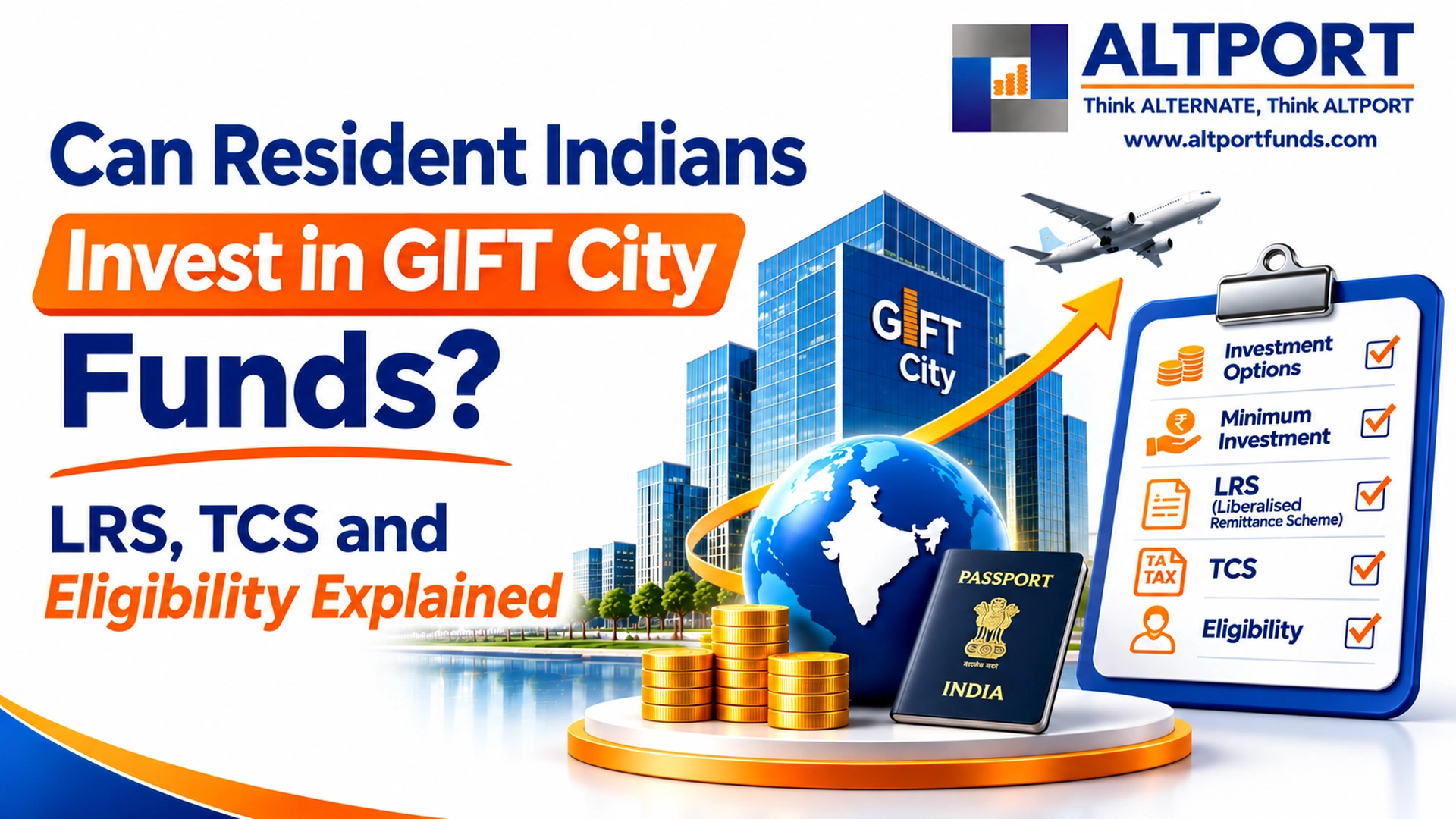
Yes, resident Indians can invest in certain GIFT City funds, subject to the fund's structure, eligibility criteria and applicable regulations. Investments may be made through permitted routes such as the Liberalised Remittance Scheme (LRS), subject to applicable limits and tax requirements.
GIFT City, or Gujarat International Finance Tec-City, is India's first operational International Financial Services Centre (IFSC). Located in Gandhinagar, Gujarat, it provides a regulated ecosystem for international financial services. The IFSC operates under the International Financial Services Centres Authority (IFSCA). It allows eligible financial institutions to offer products and services such as investment funds, portfolio management, banking, insurance and securities trading. Although GIFT City is physically located in India, transactions between resident Indians and IFSC entities are subject to specific foreign-exchange regulations. For resident individuals, the RBI's Liberalised Remittance Scheme provides the route for permitted investments.
This means an Indian resident can transfer money from an Indian bank account to an eligible IFSC institution and invest in permitted financial products. The investment is generally made in foreign currency, such as US dollars.
Can Resident Indians Invest in GIFT City?
Yes. Resident Indians can invest in eligible GIFT City funds through LRS, subject to the applicable FEMA, RBI and IFSCA rules.
The route is not restricted to NRIs or foreign investors. Resident individuals can access eligible IFSC products, including global mutual funds, ETFs, securities, bonds and certain alternative investment structures.
The important conditions are:
- The investor must qualify as a resident individual under the applicable foreign-exchange framework.
- The investment must be a permitted LRS transaction.
- The total remittance must remain within the annual USD 250,000 limit.
- The selected product and IFSC institution must accept resident Indian investors.
- The investor must complete the required KYC, tax residency and banking formalities.
- TCS and other applicable charges must be considered before transferring funds.
| Particulars | Details |
| Can resident Indians invest? | Yes, through permitted LRS transactions |
| Regulatory framework | FEMA, RBI's LRS directions and applicable IFSCA regulations |
| Annual LRS limit | USD 250,000 per resident individual |
| LRS period | Financial year, April to March |
| Investment currency | Generally USD or another permitted foreign currency |
| TCS on investment remittances | Generally 20% on the aggregate eligible LRS amount exceeding ₹10 lakh |
| Foreign currency account | Can be opened with an IFSC Banking Unit for permitted purposes |
| Eligible investor | Resident individual, including a minor through a natural guardian |
| HUFs and companies | Cannot use the individual LRS facility |
What Is the Liberalised Remittance Scheme (LRS)?
The Liberalised Remittance Scheme is an RBI framework that allows resident individuals to remit money outside India for permitted current and capital account transactions.
Introduced in 2004, the scheme provides a defined annual foreign-exchange remittance limit. It allows individuals to undertake eligible overseas transactions without obtaining prior RBI approval for each permitted remittance.
The LRS limit is currently USD 250,000 per resident individual per financial year.
The limit applies to the combined value of eligible remittances made during the financial year. It is not a separate allowance for every investment or financial institution.
For example, if an individual remits money for overseas shares, international travel and a GIFT City investment, all applicable LRS remittances count towards the same annual limit.
LRS Limit for GIFT City
The LRS limit for GIFT City investments is USD 250,000 per resident individual per financial year.
A resident Indian cannot use the entire USD 250,000 for one investment and then claim another USD 250,000 limit for a different GIFT City fund. The limit covers all permitted LRS transactions combined.
| Particulars | Limit or treatment |
| Annual LRS limit | USD 250,000 |
| Applicable period | April to March |
| Individual investor | Separate limit for each eligible resident individual |
| Multiple investments | Combined within the same annual limit |
| Overseas travel and other permitted remittances | Count towards the same limit |
| GIFT City investments | Count towards the LRS limit |
| Unused annual limit | Cannot be carried forward to the next financial year |
Example:
Suppose a resident Indian makes the following remittances during a financial year:
| Transaction | Amount |
| Investment in GIFT City mutual funds | USD 50,000 |
| Investment in overseas stocks | USD 20,000 |
| Overseas travel | USD 10,000 |
| Total LRS utilisation | USD 80,000 |
| Remaining LRS limit | USD 170,000 |
The investor has used USD 80,000 of the annual limit and can remit up to another USD 170,000 for other permitted purposes during that financial year.
The remaining limit is subject to all applicable LRS conditions. It does not represent an automatic approval for every type of investment. Learn How NRIs Can Benefit from Gift City Funds for Long-Term Wealth Planning.
Who Can Use LRS?
The LRS facility is available to resident individuals, including minors. A minor's remittance declaration must be countersigned by the natural guardian.
The scheme is not available to entities such as:
- Hindu Undivided Families (HUFs).
- Companies.
- Partnership firms.
- Trusts.
- Other non-individual entities.
These entities must evaluate their investments under the applicable overseas investment and FEMA frameworks rather than using the individual LRS facility.
How Does the GIFT City LRS Route Work?
The GIFT City LRS route allows resident Indians to transfer money from an onshore bank account to an eligible IFSC institution for permitted financial products and services.
The RBI expanded the permitted purposes for remittances to IFSCs through its July 2024 circular. Resident individuals can now use LRS remittances to access financial services and financial products permitted under the IFSCA Act, 2019.
They can also use an eligible Foreign Currency Account maintained in an IFSC for permitted transactions in other foreign jurisdictions.
How Money Moves from India to GIFT City
The investment process generally follows this route:
Resident Indian's Indian bank account → Authorised Dealer bank → Foreign currency remittance under LRS → IFSC Banking Unit or eligible IFSC institution → Investment in the selected product
The investor starts by selecting an eligible GIFT City product. The bank processes the outward remittance after completing the required documentation and LRS checks.
The funds are converted into the required foreign currency and transferred to the designated account. Once the funds are credited, the investor can subscribe to the selected investment product.
The exact route depends on the product, the fund manager, the banking arrangement and the institution handling the transaction.
RBI's July 2024 Circular: What Changed?
Earlier, remittances under LRS to IFSCs were restricted to specified investment transactions in securities and certain education-related payments.
The RBI revised the framework in July 2024. Authorised Dealer banks can now facilitate LRS remittances to IFSCs for:
- Accessing financial services and financial products permitted under the IFSCA Act, 2019.
- Permitted current account transactions in other foreign jurisdictions through an FCA maintained in an IFSC.
- Permitted capital account transactions in other foreign jurisdictions through an FCA maintained in an IFSC.
The change expanded the range of financial products and services that resident individuals can access through the IFSC route.
It also provided a clearer regulatory basis for resident Indians to use GIFT City as a channel for eligible international investments.
What Investment Options Are Available to Resident Indians in GIFT City?
GIFT City offers several investment products for eligible resident Indian investors. The actual availability depends on the IFSC institution, the product structure, minimum investment and investor eligibility.
GIFT City Mutual Funds
GIFT City mutual funds allow investors to access international markets through fund structures established in the IFSC.
These funds may invest in global equities, overseas indices, international debt instruments or other permitted securities.
Examples of investment themes include:
- US equity markets.
- S&P 500-linked investment strategies.
- Nasdaq 100-linked investment strategies.
- Developed international markets.
- Emerging market equities.
- Global fixed-income securities.
Some schemes offer fund-of-funds structures, where the GIFT City fund invests in units of an underlying overseas fund or ETF.
Minimum investment amounts vary by scheme. Certain retail funds have lower entry requirements, while specialised or non-retail structures may require significantly higher commitments.
Global Stocks and ETFs
Eligible IFSC brokers and investment platforms may provide access to overseas listed securities and exchange-traded funds.
Depending on the platform and applicable permissions, resident Indians may be able to invest in:
- US-listed companies.
- Global technology stocks.
- International equity ETFs.
- Broad-market index ETFs.
- Sector-specific ETFs.
- Other permitted overseas securities.
Some platforms may support fractional investing, allowing investors to purchase a portion of a share rather than an entire unit.
Investors should check whether the service has actually launched and accepts resident Indian clients. An institution receiving regulatory approval does not automatically mean that every product is available to all investors.
Dollar-Denominated Bonds
GIFT City also provides access to eligible foreign-currency debt instruments.
Dollar-denominated bonds may appeal to investors who want foreign-currency income or exposure to international fixed-income markets.
However, investors must assess the issuer's credit quality, interest rate sensitivity, maturity, liquidity and currency exposure.
A dollar-denominated bond is not risk-free merely because its interest payments are made in US dollars.
Alternative Investment Funds
Eligible resident Indians can also access certain GIFT City Alternative Investment Funds through the LRS route.
These may include private equity, venture capital, hedge fund and other permitted alternative investment strategies.
AIFs generally have higher minimum investment requirements and may involve longer holding periods, limited liquidity and more complex fee structures.
Investors should review the fund's placement memorandum, investment strategy, risk factors, redemption terms and applicable eligibility requirements.
Portfolio Management Services
Eligible IFSC-registered Fund Management Entities can offer Portfolio Management Services.
Under PMS, the portfolio manager manages a client-specific portfolio according to an agreed investment mandate.
The investment strategy may include eligible Indian or overseas securities, depending on the mandate and applicable regulations.
PMS has a separate regulatory minimum investment requirement. Investors should not confuse it with the entry requirements for retail GIFT City mutual funds.
GIFT City Investment Products: Comparison
| Investment product | What it offers | Minimum investment |
| Retail mutual funds | Diversified exposure to global markets through fund structures | Scheme-specific |
| Global stocks | Direct exposure to eligible overseas listed companies | Broker and security-specific |
| ETFs | Exposure to global indices, sectors or asset classes | ETF and platform-specific |
| Dollar bonds | Foreign-currency fixed-income exposure | Issue-specific |
| AIFs | Alternative strategies such as private equity and hedge funds | Regulatory and scheme-specific |
| PMS | Individually managed investment portfolios | Subject to the applicable IFSCA minimum and manager terms |
The minimum investment is not uniform across GIFT City products. Investors should check the latest scheme documents and onboarding terms before transferring money.
What Is a Foreign Currency Account for Resident Indians?
A Foreign Currency Account (FCA) allows an eligible resident individual to hold permitted foreign-currency funds with an IFSC Banking Unit.
The RBI's July 2024 circular permits resident individuals to open an FCA in an IFSC for specified LRS-related purposes. This facility makes it possible to maintain foreign currency within the IFSC banking framework for eligible investments and transactions.
An FCA is particularly relevant to investors who want to invest in more than one eligible product or use the permitted funds for transactions in other foreign jurisdictions.
How Can Resident Indians Open an FCA in GIFT City?
The investor generally needs to approach an IFSC Banking Unit and complete the prescribed onboarding and compliance process.
The broad process includes:
- Selecting an IFSC Banking Unit that offers FCA services to resident individuals.
- Submitting identity, address and PAN details.
- Providing the required LRS declaration and remittance information.
- Completing KYC and tax residency documentation.
- Transferring funds through an Authorised Dealer bank.
- Declaring the intended purpose and ensuring the funds are used for permitted transactions.
The banking unit may request additional documents depending on the investor's profile and intended transactions.
Important Rules for an FCA
An FCA is not an unrestricted foreign bank account. It operates under specific RBI and IFSCA directions.
| Particular | Requirement or condition |
| Account holder | Eligible resident individual |
| Account location | IFSC Banking Unit in GIFT City |
| Funding route | Permitted LRS remittances and other eligible funds |
| Currency | Permitted foreign currency |
| Purpose | Permitted financial products and transactions |
| Remittance compliance | Must be routed through an Authorised Person where required |
| Use of funds | Must follow the declared and permitted purpose |
| Unused funds | Subject to applicable repatriation and account-operation rules |
Under the IFSCA directions governing these accounts, the banking unit must obtain the relevant LRS declarations and ensure that funds are used for the declared purposes.
Resident individuals should not use the FCA to settle ordinary domestic transactions with other Indian residents. The account is intended for permitted foreign-currency transactions under the applicable framework.
An FCA also does not increase the investor's annual LRS limit. The amount remitted into it from India continues to count towards the USD 250,000 limit.
What Is TCS on GIFT City Investment?
TCS stands for Tax Collected at Source. It is an amount collected by the authorised bank or other applicable collector when a resident individual makes specified remittances under LRS.
For investment-related LRS remittances, the applicable TCS rate is generally 20% on the aggregate amount exceeding ₹10 lakh during a financial year.
The threshold applies to the relevant LRS remittances combined. It is not a separate ₹10 lakh exemption for each GIFT City fund, broker or investment.
TCS is not an additional tax on investment returns. It is a tax collection mechanism. The amount collected can be adjusted against the investor's final tax liability or claimed as a refund, depending on their overall tax position.
Current TCS Rates on LRS Remittances
The applicable TCS treatment depends on the purpose of the remittance.
| LRS remittance purpose | TCS treatment from 1 April 2026 |
| Investment and other specified purposes | 20% on the amount exceeding ₹10 lakh |
| Medical treatment | 2% on the amount exceeding ₹10 lakh |
| Education funded through an eligible education loan | No TCS |
| Other eligible education remittances | 2% on the amount exceeding ₹10 lakh |
For GIFT City fund investments, the remittance generally falls under the investment or other applicable LRS category. Therefore, the 20% rate is relevant once the aggregate eligible remittances cross the ₹10 lakh threshold.
The applicable classification should be confirmed with the Authorised Dealer bank based on the actual transaction purpose.
TCS on GIFT City Investment: Example
Consider an investor who remits ₹18 lakh under LRS during a financial year for an eligible GIFT City investment.
The calculation would be:
| Particulars | Amount |
| Total eligible LRS remittance | ₹18,00,000 |
| TCS threshold | ₹10,00,000 |
| Amount subject to TCS | ₹8,00,000 |
| Applicable TCS rate | 20% |
| TCS collected | ₹1,60,000 |
| Total bank remittance amount, excluding other charges | ₹19,60,000 |
The bank collects ₹1.60 lakh as TCS on the amount above the threshold.
The investor can claim the TCS credit in their income tax return. If the amount collected exceeds their final tax liability, they may be eligible for a refund.
However, the TCS amount can remain unavailable until the investor adjusts it against tax payable or receives the refund. This creates a cash-flow consideration even though TCS is not an additional tax on the investment.
Does TCS Apply Separately to Every GIFT City Investment?
No. The ₹10 lakh threshold is not available separately for each investment.
The applicable remittances under LRS are considered together during the financial year.
For example, if an investor remits ₹6 lakh for a GIFT City mutual fund and ₹8 lakh for overseas stocks, the aggregate eligible remittance is ₹14 lakh.
The amount exceeding ₹10 lakh is ₹4 lakh. At a 20% rate, the TCS would be ₹80,000, assuming the entire amount falls under the investment category and no other relevant adjustment applies.
Can Investors Claim a Refund of TCS?
Yes. TCS collected under LRS is available as a tax credit against the investor's final income tax liability.
If the total TCS credit exceeds the final tax payable, the investor can claim the eligible refund while filing the income tax return.
The investor should maintain:
- Bank remittance statements.
- TCS certificates and tax credit records.
- Investment account statements.
- Transaction confirmations.
- Relevant tax return disclosures.
TCS should be considered while planning the remittance amount because it affects the immediate cash required for the transaction.
What Are the Other Costs of Investing in GIFT City?
TCS is not the only cost associated with investing through GIFT City. Investors should calculate the complete cost of funding, purchasing, holding and redeeming an investment.
| Cost component | How it affects the investor |
| TCS | Upfront tax collection on eligible LRS remittances above the applicable threshold |
| Currency conversion | Bank margin and conversion charges when converting INR into foreign currency |
| Bank remittance charges | Fees for processing outward remittances |
| Fund management fee | Charges levied by the selected investment fund |
| Brokerage | Charges for buying and selling securities |
| Platform fees | Account maintenance or transaction charges, where applicable |
| Custody and administration | Charges associated with holding and administering investments |
| Exit or redemption charges | Scheme-specific charges, where applicable |
| Tax on income and gains | Depends on the product structure and applicable tax provisions |
Currency conversion costs vary by bank and transaction size. Investors should compare the exchange rate and total charges rather than looking only at the advertised remittance fee.
For funds, the expense ratio or management fee should be assessed alongside the underlying investment costs. For direct securities, brokerage and custody charges may also apply.
How Are GIFT City Investments Taxed for Resident Indians?
GIFT City is not automatically tax-free for resident Indian investors.
Several tax concessions are available to qualifying IFSC entities and specified transactions. However, these benefits do not automatically extend to every resident individual investing through the IFSC.
A resident Indian generally remains subject to Indian tax rules on their income, including applicable foreign income. The tax treatment depends on the investment structure, asset type, income category and relevant provisions.
Tax Treatment of Different GIFT City Investments
| Investment type | Tax consideration |
| Direct foreign shares | Capital gains and dividend income are subject to applicable Indian tax provisions |
| Foreign ETFs | Treatment depends on the security, holding period and applicable tax classification |
| GIFT City mutual funds | Depends on the legal structure and scheme-specific tax treatment |
| AIFs | Depends on the fund category, legal structure and applicable pass-through or fund-level taxation provisions |
| PMS | Depends on the securities held, transaction type and applicable tax rules |
| Dollar bonds | Interest and capital gains are subject to the applicable provisions |
Investors should not assume that all GIFT City funds follow the same tax structure. Some funds may pay tax at the fund level, while others may have a different treatment.
The scheme's tax note and offering documents should be reviewed before investing.
Do GIFT City Tax Benefits Apply to Resident Indians?
GIFT City offers tax incentives to eligible IFSC entities and certain qualifying transactions.
For example, Section 80LA provides a tax deduction to eligible IFSC units for qualifying income. It allows a 100% deduction of eligible business income for 10 consecutive assessment years out of the prescribed 15-year period, subject to the statutory conditions.
Other provisions, including Section 10(4D), provide exemptions for specified income earned by qualifying funds and entities.
These provisions are not blanket exemptions for resident individuals investing in GIFT City funds.
The following distinction is important:
| Tax benefit | Who may qualify? | Does it automatically apply to resident investors? |
| Section 80LA deduction | Eligible IFSC units | No |
| Section 10(4D) exemption | Specified qualifying funds and income | No |
| Specified IFSC transaction exemptions | Eligible transactions and entities | No |
| Investor-level tax treatment | Depends on the investor and investment structure | Must be assessed individually |
The absence of certain transaction taxes on eligible IFSC exchange transactions also does not mean that all investment income is tax-free.
Do Resident Indians Need to Report GIFT City Investments in Their ITR?
Resident Indians should review their income tax return disclosure requirements for GIFT City investments.
Directly held foreign shares and other foreign assets may require disclosure under the applicable foreign asset reporting provisions. The reporting treatment of GIFT City fund units can depend on the legal structure and the nature of the holding.
Investors should maintain records of:
- Foreign currency remittances.
- Investment account statements.
- Purchase and redemption confirmations.
- Dividend and interest income.
- Capital gains and losses.
- TCS collected.
- Foreign taxes paid, where applicable.
The correct ITR form and schedules depend on the investor's income profile and the nature of the assets held. Investors with foreign income or assets should review the applicable reporting requirements with a tax professional.
GIFT City vs Domestic International Mutual Funds vs Overseas Brokers
Resident Indians have more than one route to access international markets. GIFT City is one option, alongside domestic international mutual funds and direct overseas brokerage accounts.
The right route depends on the investment product, currency requirement, costs, regulatory structure and availability. Let's learn about GIFT City AIF vs Domestic AIF in our blog.
| Parameter | GIFT City investments | Domestic international mutual funds | Overseas broker through LRS |
| Regulatory framework | IFSCA | SEBI | Applicable foreign regulator |
| Investment currency | Generally foreign currency | Indian rupees | Foreign currency |
| Uses LRS limit | Yes, for qualifying resident outward investments | No | Yes |
| TCS on eligible remittances | Generally applicable above the threshold | Not applicable to domestic fund subscriptions | Generally applicable above the threshold |
| Investment options | Funds, eligible securities, bonds, AIFs and PMS | International mutual funds and fund-of-funds | Overseas stocks, ETFs and other permitted securities |
| Account requirement | IFSC account or product-specific onboarding | Domestic mutual fund account | Overseas brokerage account |
| Tax reporting | Depends on investment structure | Generally domestic fund reporting | Foreign asset and income reporting may apply |
| Minimum investment | Product-specific | Scheme-specific | Broker and security-specific |
| Currency exposure | Generally foreign-currency exposure | INR-denominated fund units, with underlying global exposure | Foreign-currency exposure |
Domestic international mutual funds may remain simpler for investors who want global exposure without using LRS. GIFT City may be relevant when an investor wants to hold foreign-currency investments or access products not readily available through domestic mutual funds.
What Are the Benefits of Investing in GIFT City from India?
GIFT City provides resident Indians with a regulated route to access eligible international financial products. It can help investors diversify beyond domestic markets, subject to their investment objectives and risk tolerance.
Access to Global Markets
Investors can explore eligible overseas stocks, ETFs, funds and debt instruments through the IFSC ecosystem.
This can provide exposure to markets and companies that may not be represented in a domestic portfolio.
Foreign-Currency Exposure
GIFT City investments are generally structured in foreign currencies.
This can be relevant for investors who have future expenses linked to a foreign currency, such as overseas education, international travel or retirement abroad.
However, foreign-currency exposure can increase or reduce returns when measured in Indian rupees.
Multiple Investment Structures
The IFSC ecosystem includes mutual funds, AIFs, PMS, securities and other permitted financial products.
Investors can compare different structures based on investment size, liquidity requirements and risk appetite.
Regulated Investment Ecosystem
IFSCA supervises eligible financial institutions and products operating in the IFSC.
The regulatory framework includes registration, operational and disclosure requirements for regulated entities.
Access Through an IFSC Account
Resident individuals can use permitted foreign currency account arrangements with IFSC Banking Units.
This provides a route for holding and deploying foreign currency for eligible transactions without opening a conventional bank account in another country.
What Are the Risks of Investing in GIFT City?
International diversification can provide access to different markets, but it also introduces risks that investors must understand.
| Risk | What it means |
| Currency risk | A stronger rupee can reduce the rupee value of foreign-currency returns |
| Market risk | Overseas equity and debt markets can experience significant price fluctuations |
| Liquidity risk | Some funds, AIFs and bonds may have limited redemption or resale options |
| Tax complexity | Tax treatment depends on the product structure and applicable provisions |
| Regulatory changes | Product availability and compliance rules can change |
| Cost risk | Currency conversion, remittance, management and transaction charges can reduce returns |
| Fund manager risk | Investment outcomes depend on the manager's strategy and execution |
| Reporting obligations | Foreign asset and income disclosures may apply depending on the holding |
Currency Risk
A GIFT City fund may deliver positive returns in US dollars but lower returns when converted into Indian rupees if the rupee strengthens against the dollar.
Similarly, rupee depreciation can increase the value of foreign-currency assets when measured in INR.
Investors should assess currency exposure based on their future spending requirements and overall portfolio.
Liquidity Risk
Not all GIFT City products offer daily liquidity.
Retail funds may have periodic redemption facilities, while AIFs and certain debt investments can have lock-ins, limited exit windows or long investment horizons.
Investors should review redemption conditions before committing money.
No DICGC Insurance on IFSC Bank Deposits
Foreign-currency deposits maintained with IFSC Banking Units are not covered by DICGC deposit insurance.
This is relevant when an investor maintains an FCA or leaves funds idle in an IFSC bank account.
An investment fund or PMS portfolio is not a bank deposit in the first place. Investors should distinguish between the risks of holding money in an IFSC bank account and the market risks of investment products.
How to Invest in GIFT City from India: Step-by-Step Process
Resident Indians can invest through an eligible IFSC institution after completing the required eligibility, KYC and remittance formalities.
The process generally involves the following steps.
Step 1: Check Your LRS Eligibility
Confirm that you qualify as a resident individual and have sufficient LRS headroom.
Include other remittances made during the financial year when calculating the remaining limit.
Step 2: Select an Investment Product
Decide whether you want to invest in a mutual fund, ETF, overseas stock, bond, AIF or PMS.
Compare the investment strategy, minimum amount, risk profile, fees and liquidity terms.
Step 3: Select an Eligible IFSC Institution
Choose an IFSC-registered fund manager, broker or financial institution that offers the selected product to resident Indian investors.
Check its regulatory status and the specific permissions applicable to the service.
Step 4: Complete Account Opening and KYC
The institution may require a separate IFSC account even if you already hold a domestic account with the same financial group.
Common documents include:
- PAN card.
- Aadhaar or passport.
- Address proof.
- Indian bank account details.
- FATCA and CRS declarations.
- Tax residency information.
- Additional declarations required by the fund manager or broker.
Step 5: Submit LRS Documentation to Your Bank
Approach your Authorised Dealer bank to process the remittance.
The bank may require Form A2, an LRS declaration, the transaction purpose and supporting investment documents.
Confirm the correct purpose classification with the bank before initiating the transfer.
Step 6: Account for TCS and Conversion Charges
Calculate the applicable TCS based on your aggregate eligible LRS remittances for the financial year.
Also check the exchange rate, bank margin, remittance fee and any intermediary charges.
Step 7: Transfer Funds and Complete the Investment
The bank converts the required INR amount into the selected foreign currency and processes the remittance.
Once the money is credited to the designated account, complete the subscription or securities purchase.
Step 8: Maintain Records and Review Tax Reporting
Save remittance confirmations, investment statements, TCS certificates, transaction records and redemption documents.
Review the applicable income tax return and foreign asset disclosure requirements each year.
Is GIFT City Suitable for Every Resident Indian Investor?
GIFT City can be useful for investors who want to diversify beyond domestic markets or hold part of their portfolio in foreign currency.
However, it should generally complement an investor's existing financial plan rather than replace domestic investments.
It may be worth evaluating if:
- You have an established emergency fund and adequate insurance.
- Your domestic investment portfolio is already reasonably diversified.
- You have a long investment horizon.
- You have future expenses linked to foreign currencies.
- You understand international market and currency risks.
- You can manage the documentation, tax and reporting requirements.
It may not be suitable if you need the money in the short term, have limited risk capacity or have not yet established a basic domestic investment portfolio.
The LRS limit is a regulatory ceiling, not an investment target. An investor does not need to use the entire USD 250,000 allowance.
Conclusion
Resident Indians can invest in eligible GIFT City funds and financial products through the RBI's Liberalised Remittance Scheme.
The USD 250,000 annual LRS limit covers permitted remittances across investment and other eligible purposes. Investment-related remittances generally attract 20% TCS on the aggregate amount exceeding ₹10 lakh during the financial year.
Resident individuals can also open a Foreign Currency Account with an IFSC Banking Unit for permitted transactions. However, the account does not provide an additional remittance limit or remove FEMA and tax compliance requirements.
Before investing, compare GIFT City funds with domestic international mutual funds and overseas brokerage options. Review the product structure, costs, liquidity, currency exposure and tax treatment. The right allocation depends on your financial goals, investment horizon and ability to manage international market risks.
Explore Investment Opportunities Through ALTPORT
ALTPORT provides information on PMS, AIFs and specialised investment opportunities for investors evaluating different portfolio allocation structures.
Explore available investment strategies, understand fund structures and review the relevant terms and risks before making an investment decision.
Disclaimer
This article is for informational and educational purposes only. It does not constitute investment, legal, tax or foreign-exchange advice, or a recommendation to invest in any financial product. GIFT City investments are subject to market, currency, liquidity and regulatory risks. LRS limits, TCS provisions and tax treatment may change under applicable laws. Investors should assess their eligibility and consult qualified financial, tax and legal professionals before investing. ALTPORT is an APMI-registered investment platform and distributor, not an investment adviser or portfolio manager. It does not guarantee returns or provide portfolio management services.