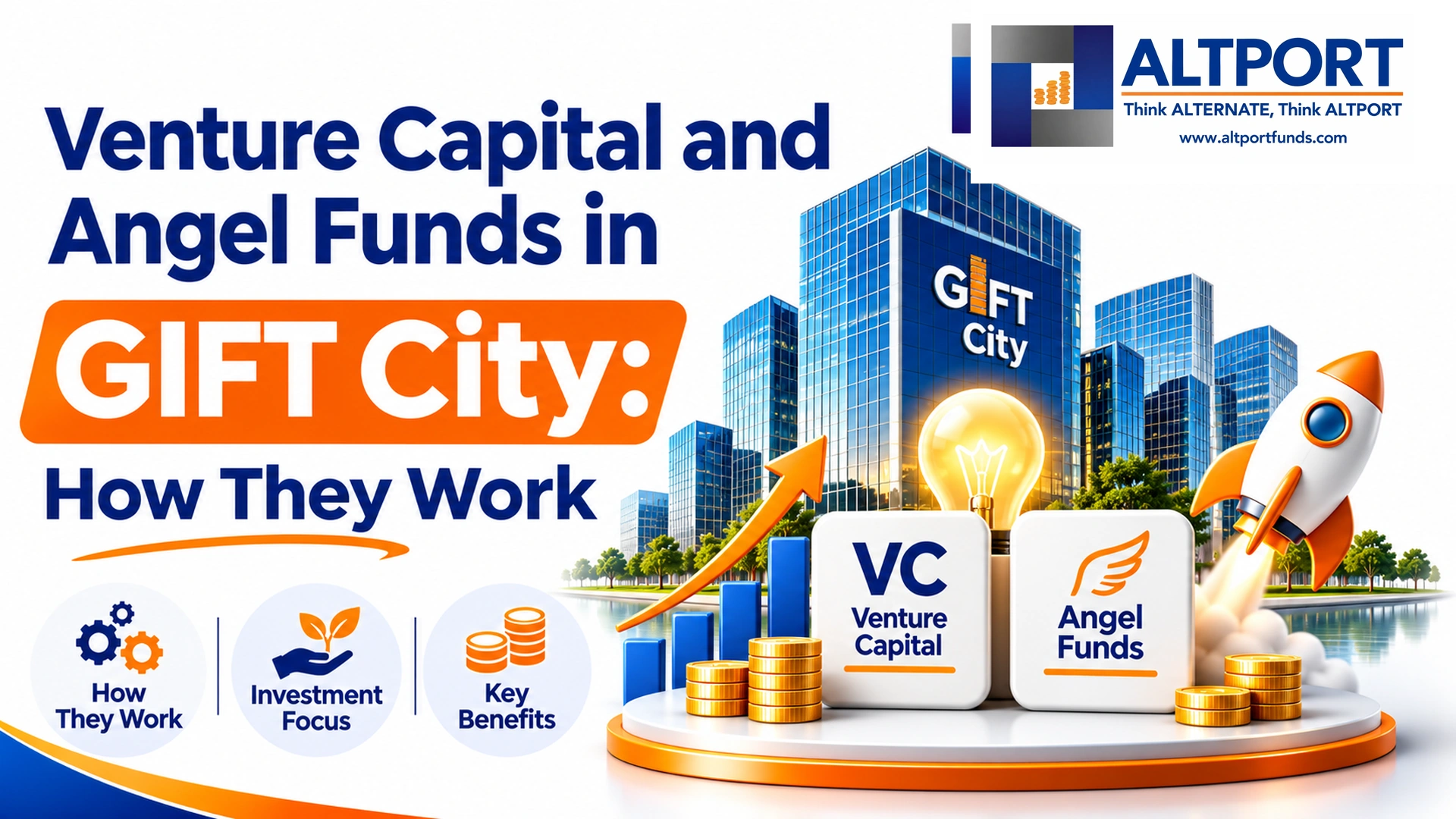
GIFT City is creating an international investment route for accessing India's startup and early-stage business ecosystem. Through its International Financial Services Centre (IFSC), investors can participate in venture capital and angel investment structures under a dedicated regulatory framework.
For investors looking beyond listed equities, Gift City Venture Capital Funds provide access to unlisted startups, emerging businesses and early-stage companies. These investments can offer exposure to business growth before companies enter public markets.
The International Financial Services Centres Authority (IFSCA) regulates these fund structures. Its framework covers fund managers, venture capital schemes, angel schemes, investor eligibility and investment conditions.
However, venture capital is a high-risk, long-term investment category. Returns depend on the success of underlying startups, business execution, valuations and eventual exits.
This guide explains how Gift City Venture Capital Funds work, how angel funds differ from conventional VC schemes, what minimum investments apply and what investors should evaluate.
What Are Gift City Venture Capital Funds and How Do They Work?
Gift City Venture Capital Funds are investment schemes established in GIFT IFSC to invest primarily in unlisted securities of startups and emerging or early-stage businesses.
Under the IFSCA (Fund Management) Regulations, 2025, a Venture Capital Scheme invests primarily in unlisted securities of:
- Startups and emerging businesses.
- Early-stage venture capital undertakings.
- Businesses developing new products or services.
- Technology and intellectual property-based ventures.
- Companies operating through innovative business models.
- Other schemes investing in eligible businesses.
The regulatory definition also includes angel funds specified by IFSCA.
The investment process generally involves four stages:
- Capital commitment: Eligible investors commit capital to a fund or scheme.
- Startup evaluation: The fund manager evaluates businesses based on their business models, market potential, financial position and growth prospects.
- Investment deployment: The scheme invests in eligible startup securities according to its disclosed mandate.
- Exit and distribution: The fund seeks to realise investments through strategic acquisitions, secondary transactions, buybacks or public listings, where available.
Unlike listed equity funds, venture capital schemes invest in businesses that may not have an established public market valuation.
How Is an IFSC venture capital scheme Structured?
An IFSC venture capital scheme operates through a Fund Management Entity (FME) registered with IFSCA.
The regulatory framework allows three categories of FMEs to establish venture capital schemes:
| FME Category | Permitted Activities |
| Authorised FME | Venture Capital Schemes, including Angel Schemes |
| Registered FME (Non-Retail) | Venture Capital Schemes and Restricted Schemes |
| Registered FME (Retail) | Venture Capital Schemes, Restricted Schemes and Retail Schemes |
The fund can be established as a company, Limited Liability Partnership (LLP) or trust under applicable Indian laws.
How Does a Fund Manager Launch a VC Scheme?
The process generally follows these steps:
- The FME prepares a Private Placement Memorandum (PPM) explaining the fund's investment strategy, risks, fees and terms.
- It files the placement memorandum with IFSCA along with the applicable fee.
- Once IFSCA communicates that the PPM has been taken on record, the scheme can open for subscriptions.
- The manager raises commitments and deploys capital according to the disclosed investment mandate.
This follows a filing-based mechanism commonly referred to as the green-channel process. Taking a PPM on record should not be interpreted as an IFSCA endorsement of the fund's investment merits.
What Is a GIFT City angel fund and How Does It Work?
A GIFT City angel fund pools capital from eligible angel investors to invest in early-stage businesses. It allows investors to participate in specific startup investment opportunities through an IFSC-regulated fund structure.
Unlike a conventional venture capital scheme that may deploy capital across a portfolio, an angel scheme uses segregated portfolios for individual investments.
The process works differently:
- The fund manager identifies an eligible early-stage company.
- It presents the investment opportunity to eligible angel investors.
- Each investor provides express consent before contributing to that investment.
- The FME creates a separate, close-ended segregated portfolio.
- Investors receive separate classes of units for that portfolio.
- Assets and liabilities remain ring-fenced between different segregated portfolios.
This structure allows investors to participate in selected startup opportunities rather than automatically sharing exposure across every investment made by the angel scheme.
Which Startups Can a GIFT City angel fund Invest In?
IFSCA specifies eligibility conditions for early-stage venture capital undertakings.
| Parameter | Regulatory Requirement |
| Company age | Incorporated not more than 10 years before investment |
| Annual turnover | Not more than USD 20 million |
| Business focus | Innovation, product development or improvement of processes and services |
| Industrial group connection | Cannot be promoted, sponsored or related to an industrial group with turnover above USD 50 million |
| Investment limit | USD 1.5 million per investment |
| Minimum investment lock-in | One year from investment date |
An angel scheme cannot invest in associates of its FME or in an eligible startup connected to the angel investors investing in that startup.
What Are the Minimum Investment and Corpus Requirements for venture capital funds in GIFT City?
The minimum investment depends on whether an investor participates in a conventional VC scheme or an angel scheme.
The two structures have different investor eligibility and corpus requirements.
Minimum Investment in a Venture Capital Scheme
| Parameter | Requirement |
| Minimum investor commitment | USD 250,000 |
| Accredited investor threshold | No prescribed minimum |
| FME employee/director investment | USD 60,000 |
| Minimum scheme corpus | USD 3 million |
| Maximum scheme corpus | USD 200 million |
| Maximum number of investors | 50 |
| Minimum fund tenure | 3 years |
| Permitted tenure extension | Up to 2 years, subject to investor approval |
A VC scheme must invest at least 80% of its corpus in eligible companies incorporated within the preceding 10 years or other qualifying schemes.
The placement memorandum remains valid for 12 months to achieve the minimum corpus. A six-month extension may be available under the prescribed conditions.
Minimum Investment in a GIFT City angel fund
| Parameter | Requirement |
| Angel investor commitment | USD 40,000 over 5 years |
| Accredited investor commitment | No prescribed minimum |
| Minimum angel scheme corpus | USD 1 million |
| Maximum investors per segregated portfolio | 200 |
| Maximum individual startup investment | USD 1.5 million |
| Minimum investment lock-in | 1 year |
The USD 40,000 requirement applies to the investor's commitment over five years, not necessarily to every individual startup investment.
Also, the USD 1 million corpus requirement is calculated collectively across the segregated portfolios created under the angel scheme.
What Are the Key IFSCA VC scheme regulations Investors Should Know?
The IFSCA VC scheme regulations establish the operating conditions for fund managers and investment schemes.
The current framework is governed by the IFSCA (Fund Management) Regulations, 2025, notified on February 19, 2025, with subsequent amendments.
Important provisions include:
- Investment allocation: At least 80% of a VC scheme's corpus must be invested in eligible companies or qualifying schemes.
- Fund tenure: VC schemes must be close-ended with a minimum tenure of three years.
- Independent valuation: Scheme assets must be valued by an eligible independent service provider.
- NAV calculation: Net Asset Value must be calculated at least annually.
- Manager contribution: The FME or its associate must generally contribute 2.5% of the targeted corpus, subject to prescribed limits and exemptions.
- Leverage: Borrowing is permitted subject to disclosure, investor consent requirements and an appropriate risk management framework.
- Related-party investments: Investments involving associates require prescribed investor approvals.
These requirements provide a regulatory framework for investment management, valuation and investor protection. They do not eliminate startup investment risks.
For the complete regulatory framework, refer to the official IFSCA Fund Management Regulations and circulars.
What Is the Difference Between a GIFT City Startup fund and a Traditional VC Fund?
A GIFT City startup fund is a broad description of an investment vehicle targeting startup opportunities. Its actual regulatory classification depends on its structure and investment mandate.
| Parameter | GIFT City VC Scheme | Angel Scheme |
| Investment approach | Portfolio-based startup investments | Investor-approved individual opportunities |
| Investor commitment | USD 250,000 generally | USD 40,000 over five years generally |
| Minimum corpus | USD 3 million | USD 1 million |
| Investor participation | Through scheme subscriptions | Through segregated portfolios |
| Maximum investors | 50 | 200 per segregated portfolio |
| Investment lock-in | Based on scheme terms | At least one year per investment |
| Fund tenure | Minimum three years | Individual portfolios are close-ended |
The distinction is important when evaluating Gift City Venture Capital Funds because the investment structure affects diversification, capital deployment and investor participation.
A conventional VC scheme may spread investments across several startups. An angel scheme allows investors to select specific opportunities through separate investment portfolios.
What Are the Major Risks of Gift City Venture Capital Funds?
Startup investing offers growth potential, but it carries substantial risks. Investors should understand the following before committing capital.
Business failure risk: Early-stage companies may struggle with product development, customer acquisition, competition or funding requirements. Some may fail completely.
Illiquidity risk: Unlisted startup shares do not have continuous exchange trading. Investors may have to wait several years for an exit.
Valuation risk: Private companies are valued using financial models, comparable transactions and business assumptions. Their valuations may not reflect the price achievable during an actual sale.
Dilution risk: Subsequent funding rounds can reduce existing shareholders' ownership percentages if they do not participate proportionately.
Concentration risk: Angel investments can expose investors to individual startups rather than diversified portfolios. One unsuccessful investment can significantly affect returns.
Exit risk: An IPO, acquisition or secondary sale may not happen within the expected timeframe.
Fund manager risk: Investment outcomes depend on the manager's ability to evaluate businesses, negotiate investment terms and monitor portfolio companies.
For Gift City Venture Capital Funds, investors should assess the manager's previous investments, realised exits, write-offs and portfolio construction rather than relying only on targeted returns.
How Should Investors Evaluate Gift City Venture Capital Funds Before Investing?
Investors should conduct due diligence at both the fund and startup levels.
| Evaluation Parameter | What to Examine |
| Fund manager | Startup investing experience and realised exits |
| Investment thesis | Sector focus, business stage and geographic exposure |
| Portfolio | Number of startups and allocation per company |
| Startup financials | Revenue, cash burn, profitability and funding runway |
| Valuation | Entry valuation and comparable transactions |
| Ownership rights | Equity rights, liquidation preferences and anti-dilution provisions |
| Exit strategy | IPO, acquisition and secondary sale possibilities |
| Fund expenses | Management fees, performance fees and other charges |
| Regulatory status | FME registration and scheme filing status |
| Reporting | NAV methodology, portfolio updates and financial disclosures |
Investors should also review the PPM for capital call provisions, investment restrictions, extension clauses and distribution waterfalls.
For Gift City Venture Capital Funds, the ability to evaluate startup quality and fund manager execution is particularly important because private investments offer limited liquidity and price transparency.
Are Gift City Venture Capital Funds Suitable for HNIs and NRIs?
These funds may suit investors who have sufficient capital, a long investment horizon and the ability to absorb losses.
Potential investor categories include:
- HNIs and UHNIs: Investors seeking exposure to unlisted businesses and emerging sectors.
- NRIs: Eligible overseas investors looking to access startup investment opportunities through IFSC structures.
- Family offices: Investors allocating a portion of their portfolios to private market opportunities.
- Accredited investors: Investors meeting IFSCA's prescribed financial eligibility criteria.
NRIs should also consider their country of residence, tax residency, reporting obligations and the fund's subscription conditions.
Resident Indian investors must examine applicable FEMA and RBI requirements before making an investment. The permitted investment route and funding conditions should be checked for the specific scheme.
For a broader understanding of the IFSC framework, read ALTPORT's guide to what GIFT City is and how it works for investors.
Final Thoughts: Are Gift City Venture Capital Funds Worth Exploring?
GIFT City provides a regulated framework for accessing startup and early-stage investment opportunities through venture capital and angel schemes.
The availability of different structures allows investors to evaluate portfolio-based VC investments or participate in specific startup opportunities through angel schemes.
However, Gift City Venture Capital Funds are long-term, high-risk investments. Their outcomes depend on startup execution, valuations, capital requirements and successful exits.
Explore Venture Capital and Angel Investment Opportunities with ALTPORT
Interested in exploring startup and early-stage investment opportunities through GIFT City funds?
ALTPORT provides information about alternative investment opportunities, including GIFT City funds, for HNIs, UHNIs, NRIs and family offices.
Understand the investment structure, fund manager, minimum commitment, investment strategy and associated risks before evaluating a venture capital or angel investment opportunity.
Explore the GIFT City fund range available through ALTPORT to understand the investment products and structures listed on the platform.
Disclaimer
This article is intended solely for educational and informational purposes and does not constitute investment advice, a solicitation or an offer to invest. Venture capital and angel investments involve significant business, valuation, liquidity, dilution and exit risks. Investors may lose part or all of their invested capital. Returns are not guaranteed, and past performance does not indicate future results. Investors should review the relevant fund documents and consult qualified financial and tax professionals before investing.
ALTPORT Experts Private Limited is an APMI-registered investment distributor (Registration No. APRN00074). ALTPORT does not manage funds or provide investment advisory services.