
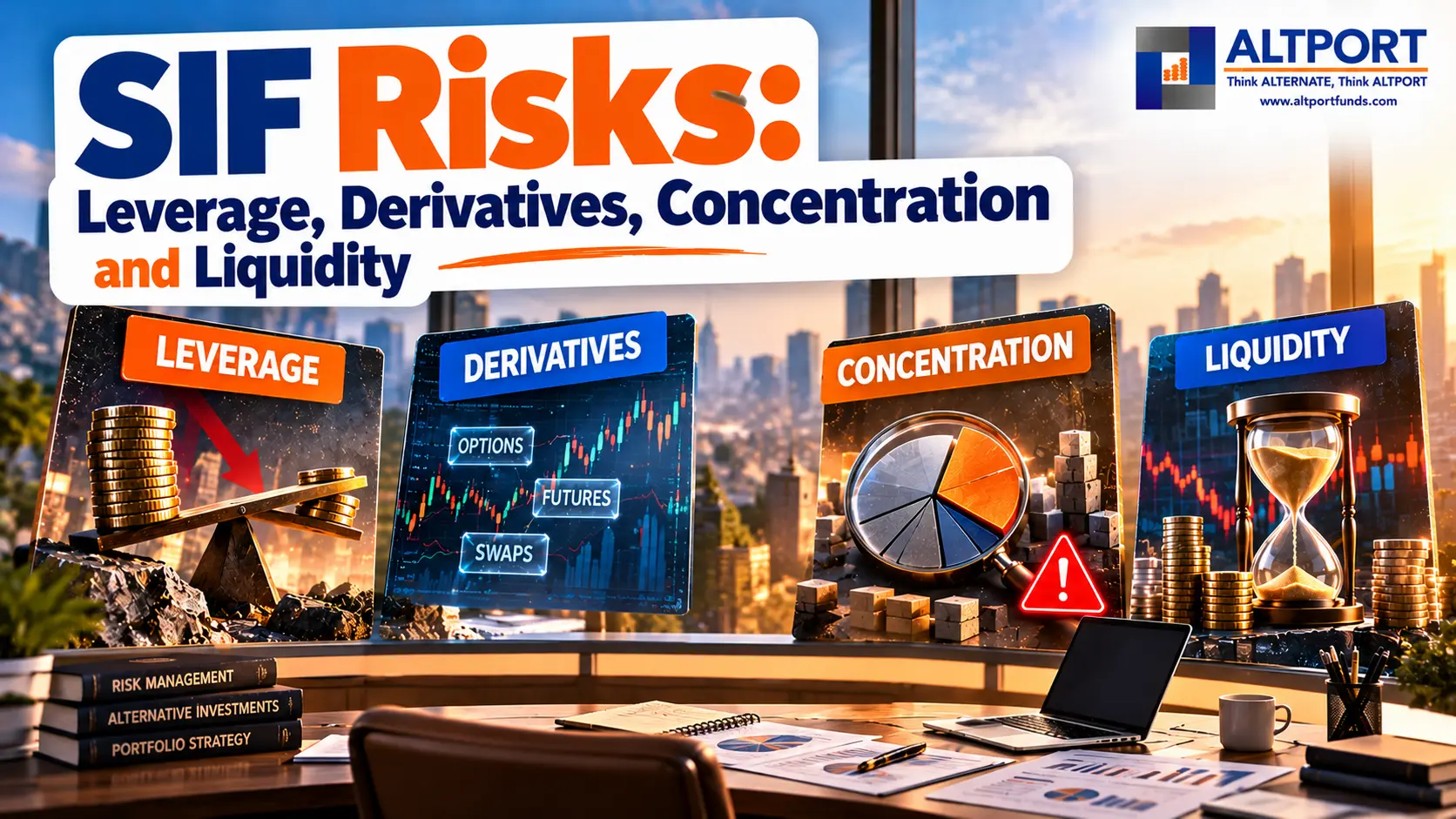
Specialized Investment Funds (SIFs) were introduced by SEBI to bridge the gap between traditional mutual funds and more flexible investment products such as PMS and AIFs. They are designed for investors seeking more sophisticated strategies, but greater flexibility can also mean greater complexity and risk. SEBI’s framework specifically recognises that SIF strategies can carry relatively higher risk and requires strategy-level risk disclosure through a standardized risk-band framework.
That makes understanding SIF risks essential before investing. The important question is not simply, “Are SIFs risky?” Every market-linked investment carries risk. The more useful question is: Which risks does a particular SIF take, how much of each risk does it take, and how effectively does the investment strategy manage them?
This article examines the major SIF investment risks, with particular focus on leverage, derivatives, short exposure, concentration and liquidity.
What Are the Main SIF Risks?
The main SIF risk factors can broadly be grouped into:
- Market and capital-loss risk
- Leverage risk
- Derivatives risk
- Short-exposure risk
- Concentration risk
- Liquidity and redemption risk
- Credit risk
- Counterparty risk
- Operational risk
- Strategy-specific and execution risk
Unlike a conventional diversified mutual fund, a SIF can offer investment strategies with greater portfolio flexibility. SEBI's SIF framework was specifically introduced to create a product between mutual funds and PMS in terms of portfolio flexibility.
That flexibility is useful—but investors need to understand what they are giving up in exchange for it.
Watch this video - SEBI’s New SIF Framework Explained | How Specialised Investment Funds Help MF Investors Diversify
This video provides a broader introduction to SIF strategies, portfolio diversification and their role in an investor’s portfolio. It complements the discussion below but does not replace scheme-specific risk disclosures.
SIF Risks: Market and Capital-Loss
The first and most obvious risk is SIF market risk.
If a SIF invests in equities, bonds, derivatives or other market-linked securities, changes in market prices can reduce the portfolio's NAV. SIF volatility can become particularly significant when a strategy has concentrated exposure to a sector, theme, asset class or specific market factor.
This leads directly to SIF capital loss.
There is no assurance that an investor will receive the amount originally invested. Depending on the strategy, adverse market movements can result in substantial declines in NAV.
Investors should therefore avoid evaluating a SIF only on its historical returns. A strategy that generated strong returns during a favourable market environment may also experience sharper drawdowns when the underlying market regime changes.
The relevant question is not just “How much did it make?” but also “How much did it lose during difficult periods, and how quickly did it recover?”
SIF Leverage and Derivatives Risk
SIF leverage is an important risk consideration because leverage can magnify both gains and losses.
When exposure is created through derivatives or other permitted mechanisms, the economic exposure of the portfolio can become larger than the amount of capital directly invested in an instrument. A relatively small movement in the underlying asset can therefore have a disproportionately large impact on the strategy.
SIF derivatives can include instruments such as futures and options, depending on the investment strategy and applicable regulatory limits.
Derivatives are not inherently bad. They can be used for hedging, efficient portfolio management, arbitrage or gaining targeted market exposure. However, they introduce additional considerations such as basis risk, volatility, margin requirements, time decay for options and model or execution risk.
SEBI's SIF framework places specific exposure restrictions on investment strategies, while applicable mutual-fund investment restrictions continue to apply unless specifically modified
Therefore, investors should examine why derivatives are being used—not simply whether they are being used.
SIF Short-Exposure and Strategy Risk
Some SIF strategies can use SIF short selling or unhedged short exposure through permitted instruments. This creates a fundamentally different risk profile from simply buying an asset and waiting for it to appreciate.
With a conventional long position, the maximum loss on an individual investment is generally limited to the capital invested. Short exposure introduces a different payoff profile because losses can increase when the underlying security rises.
For example, if a strategy takes a short position expecting a stock to decline and the stock instead rises sharply, the position can generate significant losses.
This is why investors should understand whether a SIF is:
- predominantly long-only;
- long-short;
- hedged;
- market-neutral;
- derivative-driven; or
- opportunistic.
The strategy's investment philosophy can be as important as the fund manager's historical returns.
SIF Concentration and Sector Risk
SIF concentration risk occurs when a meaningful portion of the portfolio is exposed to a limited number of securities, sectors, themes or market factors.
Concentration can improve returns when the manager's thesis is correct. But it can also magnify losses when the thesis fails.
Consider a strategy with significant exposure to one sector. A regulatory change, commodity-price shock, demand slowdown or earnings disappointment affecting that sector could impact multiple holdings simultaneously.
This is why investors should look beyond the number of securities in a portfolio. A portfolio holding 25 companies may still have significant concentration if most holdings are exposed to the same sector or economic driver.
When assessing SIF risks, review both security-level and sector-level concentration.
SIF Risks: Liquidity and Redemption
SIF liquidity risk is another important consideration.
Liquidity refers to how easily portfolio securities can be bought or sold without materially affecting their prices. It also affects how efficiently a fund can meet redemption requests.
A strategy investing primarily in highly liquid large-cap securities may have a different liquidity profile from one investing in smaller companies, specialised securities or instruments that trade less frequently.
During stressed markets, liquidity can deteriorate quickly. Bid-ask spreads may widen, trading volumes may fall and selling a position without significant price impact can become difficult.
Investors should therefore understand:
- redemption frequency;
- applicable exit loads;
- settlement timelines;
- portfolio liquidity;
- potential gates or restrictions, where applicable; and
- whether the strategy could face liquidity pressure during stressed markets.
A high historical return does not compensate for a liquidity mismatch if an investor needs the money at the wrong time.
SIF Credit, Counterparty and Operational Risk
Not all SIF risk factors come from stock-market movements.
SIF credit risk arises when an issuer or borrower fails to meet its financial obligations. This is particularly relevant for strategies holding debt and money-market instruments.
SIF counterparty risk arises when another party to a transaction fails to perform its contractual obligation. Derivatives, securities lending, repo transactions and other financial arrangements can create counterparty exposures.
Then there is SIF operational risk.
Operational risk can arise from errors in trade execution, valuation, settlement, technology, internal processes, cybersecurity or other administrative functions.
Strong governance, risk controls, independent oversight and robust operational infrastructure can reduce these risks—but cannot eliminate them completely.
This is why an investor should assess the AMC, fund manager, custodian, risk-management framework and operational processes alongside the investment strategy.
How SIF Risks Compare With PMS and AIF Risks
The comparison of SIF risks vs AIF or SIF risk vs PMS should begin with the understanding that these are different structures with different regulatory frameworks.
A SIF is a mutual-fund product introduced to provide greater portfolio flexibility within a regulated framework. SEBI described it as a product intended to bridge the flexibility gap between mutual funds and PMS.
An AIF, by contrast, is a privately pooled investment vehicle intended for sophisticated investors and can pursue strategies involving relatively higher investment risk.
PMS provides portfolio management at the individual-client level, whereas a SIF pools investor money into an investment strategy.
Similarly, SIF risk vs mutual fund should not be viewed simply as “safe versus risky.” Traditional mutual funds can also invest in volatile equities, derivatives or concentrated themes. The difference is the flexibility and sophistication of the strategy.
So, is a SIF inherently riskier than every mutual fund? No.
Is it appropriate to assume that it carries the same risk as a conventional diversified mutual fund? Also no.
The answer depends on the individual strategy.
SIF Risks Checklist Before Investing
Before investing, use this SIF investment safety checklist:
- Understand the strategy:
What exactly is the fund trying to achieve? - Check the risk band:
SEBI requires SIF strategies to have a standardized risk-band framework. Risk bands range from Level 1 to Level 5, with Level 5 representing the highest risk. - Examine drawdowns:
Look at the strategy's worst periods—not only its best returns. - Understand leverage:
Find out whether leverage or derivatives materially contribute to portfolio exposure. - Review short exposure:
If the strategy uses short positions, understand how those positions affect downside risk. - Analyse concentration:
Check security, sector and thematic exposure. - Assess liquidity:
Understand how frequently you can redeem and whether the underlying portfolio can support that liquidity. - Review costs:
Compare management fees, transaction costs and other expenses against expected returns. - Read the risk disclosures:
The SIF risk disclosure should be treated as an investment document, not a formality. - Match risk with your portfolio:
A high-risk SIF may make sense as one component of a diversified portfolio—but may be inappropriate if it represents an excessive share of your overall wealth.
Conclusion: Don't Ask Only “Are SIFs Risky?”
So, are SIFs risky? They can be. But the more useful question is which risks are you taking to pursue the expected return?
SIF risks can come from market movements, leverage, derivatives, short positions, concentration, illiquidity, credit events, counterparty failures and operational issues. These risks vary substantially from one strategy to another.
The right approach is therefore not to label every SIF as high-risk or low-risk. Instead, understand the strategy, study its risk band, examine its portfolio construction and evaluate how its risk fits into your broader asset allocation.
At ALTPORT, we believe alternative and sophisticated investment products should be evaluated beyond headline returns. Before investing in a SIF, understand the strategy, the risks and the role it is expected to play in your portfolio.
Think ALTERNATE, Think ALTPORT.
Disclaimer: This article is for educational purposes only and should not be considered investment, legal or tax advice. SIF regulations, permitted strategies and risk-management requirements may change. Investors should review the latest fund documents and consult a qualified investment professional before investing.