
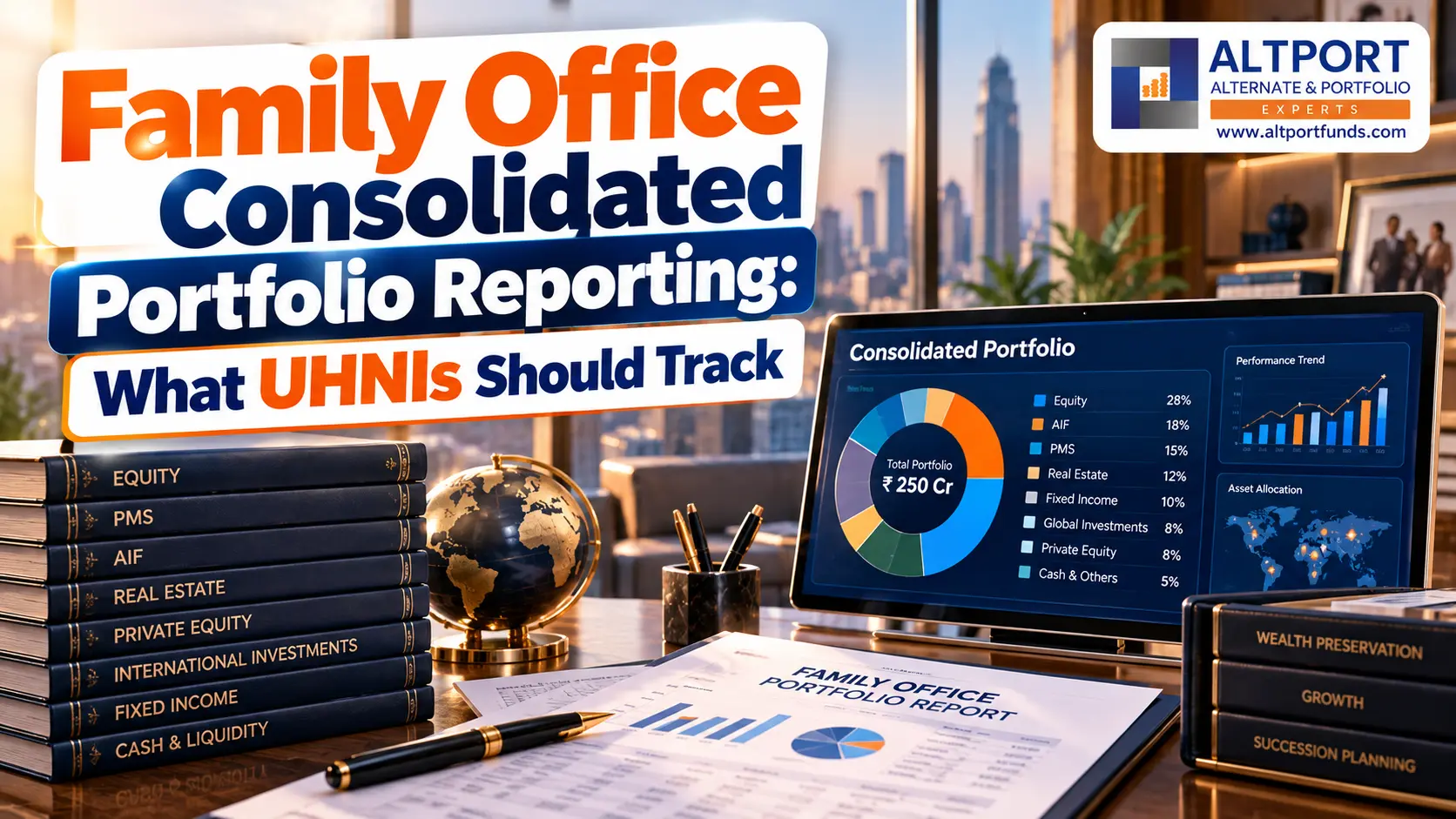
Managing substantial family wealth is no longer simply about selecting investments and monitoring returns. For Ultra-High-Net-Worth Individuals (UHNIs), wealth can be spread across PMS portfolios, AIFs, mutual funds, direct equities, bonds, private equity, private credit, real estate, businesses, cash, and other assets.
As the number of investments grows, so does the complexity of understanding the family's overall financial position.
This is where family office portfolio reporting becomes important.
A well-designed family office portfolio reporting framework brings investments, liabilities, liquidity, performance and risk into a consolidated view. Instead of reviewing individual statements from different managers, the family can understand its overall wealth through a structured consolidated investment portfolio.
For a modern family office India setup, effective reporting is therefore not merely an administrative exercise. It can become an important part of UHNI wealth management, decision-making and long-term family office investment management.
Family Office Portfolio Reporting Explained
Family office portfolio reporting is the systematic process of collecting, consolidating, validating and presenting information about a family's investments and financial assets.
The objective is to answer fundamental questions such as:
- What does the family own?
- Where is the wealth invested?
- What is the current value of each asset?
- How much liquidity is available?
- What liabilities exist?
- What is the family's total net worth?
- How have investments performed?
- Where are the major risks and concentrations?
Unlike a single investment statement, family office portfolio reporting looks across the entire family balance sheet.
A comprehensive report may include:
- PMS investments
- AIF investments
- Direct equities
- Mutual funds
- Bonds and fixed income
- Private equity
- Private credit
- Real estate
- Business interests
- Cash and bank balances
- Loans and liabilities
- Capital commitments
This makes family office portfolio reporting particularly valuable for families with complex and diversified wealth structures.
Why UHNIs Need a Consolidated View of Family Wealth
A UHNI family can have relationships with multiple banks, wealth managers, PMS providers, AIF managers, private equity funds and other investment platforms.
Each institution may provide its own statement.
The problem is that individual statements do not necessarily provide a consolidated picture.
For example, one manager may report PMS holdings, another may report AIF investments, while another provides information about bonds or mutual funds.
Without consolidated portfolio reporting, the family may struggle to understand its actual exposure.
Effective family office portfolio reporting combines these separate sources into one framework.
This can help identify:
- Overall asset allocation
- Duplicate exposure
- Concentration
- Liquidity requirements
- Investment performance
- Unfunded commitments
- Debt exposure
- Cash requirements
For HNI wealth management, this consolidated perspective can be equally valuable even when the overall portfolio is smaller than that of a traditional UHNI family office.
The goal is not simply to produce a larger report. The goal is to make wealth easier to understand and manage.
Assets and Liabilities to Include in a Family Office Report
A robust family office portfolio reporting framework should ideally cover both assets and liabilities.
Financial Assets
The report may include:
- Listed equity
- Mutual funds
- PMS
- AIFs
- Bonds
- Structured products
- Fixed deposits
- Cash
- International investments
Alternative Investments
A sophisticated family office may also track:
- Private equity
- Venture capital
- Private credit
- Real estate funds
- Infrastructure investments
- Other alternative investments
Physical and Strategic Assets
Depending on the family's reporting requirements, the consolidated view can include:
- Residential property
- Commercial property
- Land
- Operating businesses
- Strategic holdings
Liabilities
Net-worth reporting should also capture:
- Home loans
- Business loans
- Investment-related borrowing
- Personal loans
- Other significant obligations
This distinction is important because family office net worth reporting should not simply represent gross assets.
A family's financial position is better understood by considering both assets and liabilities.
Reporting PMS, AIFs and Direct Investments in One Portfolio
One of the most important functions of family office portfolio reporting is bringing different investment formats into one consolidated structure.
A family may have:
- PMS Portfolio A
- PMS Portfolio B
- Multiple AIFs
- Direct equity holdings
- Mutual funds
- Fixed income
- Private investments
Each investment may have a different reporting format.
PMS portfolio reporting may provide security-level holdings and performance.
AIF portfolio reporting may provide NAV, commitments, distributions and fund-level information.
Direct investments may be tracked through brokerage statements.
A good investment portfolio reporting system standardises these different data sources and presents them within one consolidated portfolio.
For example, the dashboard could show:
| Investment Category | Current Value | Portfolio % | Return | Liquidity |
| PMS | ₹X Cr | XX% | XX% | High |
| AIF | ₹X Cr | XX% | XX% | Medium/Low |
| Direct Equity | ₹X Cr | XX% | XX% | High |
| Fixed Income | ₹X Cr | XX% | XX% | High |
| Private Investments | ₹X Cr | XX% | XX% | Low |
| Real Estate | ₹X Cr | XX% | — | Low |
The exact categories and metrics can be customised according to the family's requirements.
This is one of the core benefits of family office portfolio reporting.
Liquidity, Capital Calls and Cash-Flow Tracking
Investment value alone does not tell the complete story.
For UHNIs, liquidity management can be equally important.
Private equity, venture capital, private credit and certain AIF structures may involve capital commitments or delayed liquidity.
A family may therefore have significant wealth on paper while having relatively limited immediately available cash.
A good family office portfolio reporting system should distinguish between:
- Liquid assets
- Semi-liquid assets
- Illiquid assets
- Committed capital
- Expected capital calls
- Expected distributions
- Upcoming liabilities
For private market investments, family office investment reporting should ideally track both committed capital and the amount already called.
For example:
Committed: ₹10 crore
Called: ₹6 crore
Uncalled: ₹4 crore
The uncalled amount represents a future cash requirement.
Tracking these commitments through family office portfolio reporting can help the family prepare for upcoming capital calls without having to liquidate investments at an inconvenient time.
Cash-flow tracking can also include:
- Dividend income
- Interest income
- Rental income
- Business distributions
- Capital gains
- Investment expenses
- Tax payments
- Loan repayments
This makes consolidated wealth reporting more useful for real-world financial planning.
Risk Metrics for UHNI Portfolios
Performance reporting is only one part of family office portfolio reporting.
Risk should receive equal attention.
A family office risk reporting dashboard can include:
Concentration Risk
How much of the portfolio is exposed to a single:
- Company
- Sector
- Manager
- Asset class
- Investment strategy
Liquidity Risk
How much of the portfolio can realistically be converted into cash quickly?
Market Risk
How sensitive is the portfolio to market movements?
Credit Risk
What is the family's exposure to issuers, borrowers and credit instruments?
Manager Risk
How much capital is dependent on one PMS manager, AIF manager or investment team?
Currency Risk
For families with international assets, foreign-currency exposure may also need to be monitored.
A structured family office portfolio reporting process can make these risks easier to identify before they become significant portfolio issues.
Private Equity and Private Credit Valuation Reporting
Private investments require additional reporting discipline because they are not always marked to market in the same way as listed securities.
Private equity investments may be valued using periodic fund valuations, transaction benchmarks or other valuation methodologies.
Private credit portfolios may require monitoring of:
- Principal outstanding
- Accrued interest
- Repayment schedules
- Credit quality
- Security/collateral
- Defaults or delays
- Expected maturity
A family office should clearly distinguish between reported valuation and realised cash proceeds.
This is an important part of wealth management reporting, particularly for families with significant allocations to private markets.
The report should also clearly identify valuation dates and, where relevant, the methodology used.
What a Monthly Family Office Portfolio Dashboard Should Include
A monthly family office portfolio reporting dashboard should ideally be concise enough for decision-makers while containing sufficient detail for portfolio oversight.
1. Executive Summary
A one-page summary could include:
- Total net worth
- Total investable assets
- Monthly change
- Year-to-date performance
- Liquidity
- Major portfolio movements
2. Asset Allocation
Show allocation across:
- Equity
- Fixed income
- PMS
- AIF
- Private markets
- Real estate
- Cash
- Other assets
3. Performance
Family office performance reporting should ideally show:
- Absolute return
- Time-weighted return where appropriate
- Benchmark comparison where relevant
- Asset-class performance
- Manager-level performance
Performance should be viewed alongside risk and liquidity rather than in isolation.
4. Manager Exposure
Track exposure to:
- PMS managers
- AIF managers
- Banks
- Wealth managers
- Fund managers
This helps identify excessive dependency on a particular manager or institution.
5. Liquidity Dashboard
Show:
- Cash available
- Liquid investments
- Upcoming liabilities
- Capital calls
- Expected distributions
6. Risk Dashboard
Include:
- Top holdings
- Sector concentration
- Asset-class concentration
- Illiquid exposure
- Leverage
- Credit exposure
7. Net-Worth Statement
The family office net worth reporting section should consolidate assets and liabilities and show changes over time.
This provides a broader picture than investment performance alone.
Building a Practical Family Office Reporting Framework
A robust family office reporting framework should be designed around the family's actual decision-making requirements.
The framework should answer three broad questions:
Where are we today?
This requires accurate valuation, asset allocation and net-worth information.
What changed?
This requires performance, transactions, cash flows and portfolio movements.
What requires attention?
This requires risk indicators, upcoming capital calls, liquidity requirements and significant portfolio events.
Technology can help automate data collection and dashboard generation, but data quality remains critical.
The family office should establish processes for:
- Data collection
- Data validation
- Valuation updates
- Reconciliation
- Performance calculation
- Risk monitoring
- Report generation
This makes family office portfolio reporting more reliable and repeatable.
How Consolidated Reporting Supports Family Office Investment Management
Family office investment management becomes more effective when decision-makers have access to consolidated information.
For example, before approving a new ₹5 crore allocation to an AIF, the family office investment committee can assess:
- Existing AIF exposure
- Total private-market allocation
- Available liquidity
- Upcoming capital calls
- Manager concentration
- Overall risk
- Portfolio objectives
Similarly, before adding another PMS, the family office can review existing PMS portfolio reporting and determine whether the new strategy adds genuine diversification.
This makes family office portfolio reporting an input into investment decisions rather than simply a historical record.
The Difference Between Portfolio Reporting and Net-Worth Reporting
These two concepts are related but different.
Portfolio reporting primarily focuses on investments and their performance, allocation and risk.
Net-worth reporting takes a broader view and includes assets and liabilities.
For example, a family may have:
₹100 crore of investment assets
₹30 crore of real estate
₹10 crore of business interests
₹15 crore of liabilities
Investment portfolio reporting may focus primarily on the ₹100 crore investment portfolio.
Family office net worth reporting would consider the broader financial position.
Both should ideally work together within a comprehensive consolidated wealth reporting framework.
Conclusion
For modern UHNIs, managing wealth is increasingly about managing complexity.
A family may have multiple PMS accounts, AIFs, direct investments, private equity holdings, real estate and operating businesses spread across several institutions.
Without a consolidated view, important information can remain fragmented.
Effective family office portfolio reporting brings this information together and transforms individual statements into a structured view of family wealth.
The objective of family office portfolio reporting is not simply to show how much money the family has. It should help answer where the wealth is invested, how it is performing, what risks exist, how much liquidity is available and what financial commitments are approaching.
For a family office India setup, a well-designed reporting framework can therefore become an important foundation for disciplined UHNI wealth management.
If your family has investments spread across PMS, AIFs, direct securities and private markets, consider creating a consolidated investment portfolio and reviewing it regularly.
The better the family's information architecture, the easier it becomes to make informed decisions about allocation, diversification, liquidity and long-term wealth preservation.
Disclaimer: The information provided in this article is for educational and informational purposes only and should not be construed as investment advice, a recommendation, solicitation, or an offer to buy or sell any security, investment product, PMS, AIF, or other financial instrument. Portfolio reporting, wealth management and investment decisions should be evaluated based on individual financial objectives, risk appetite, investment horizon, liquidity requirements and applicable tax considerations. Past performance is not indicative of future results. Investors should conduct appropriate due diligence and consult a SEBI-registered investment adviser or other qualified financial professional before making investment decisions. ALTPORT does not guarantee any specific investment outcome or return.