
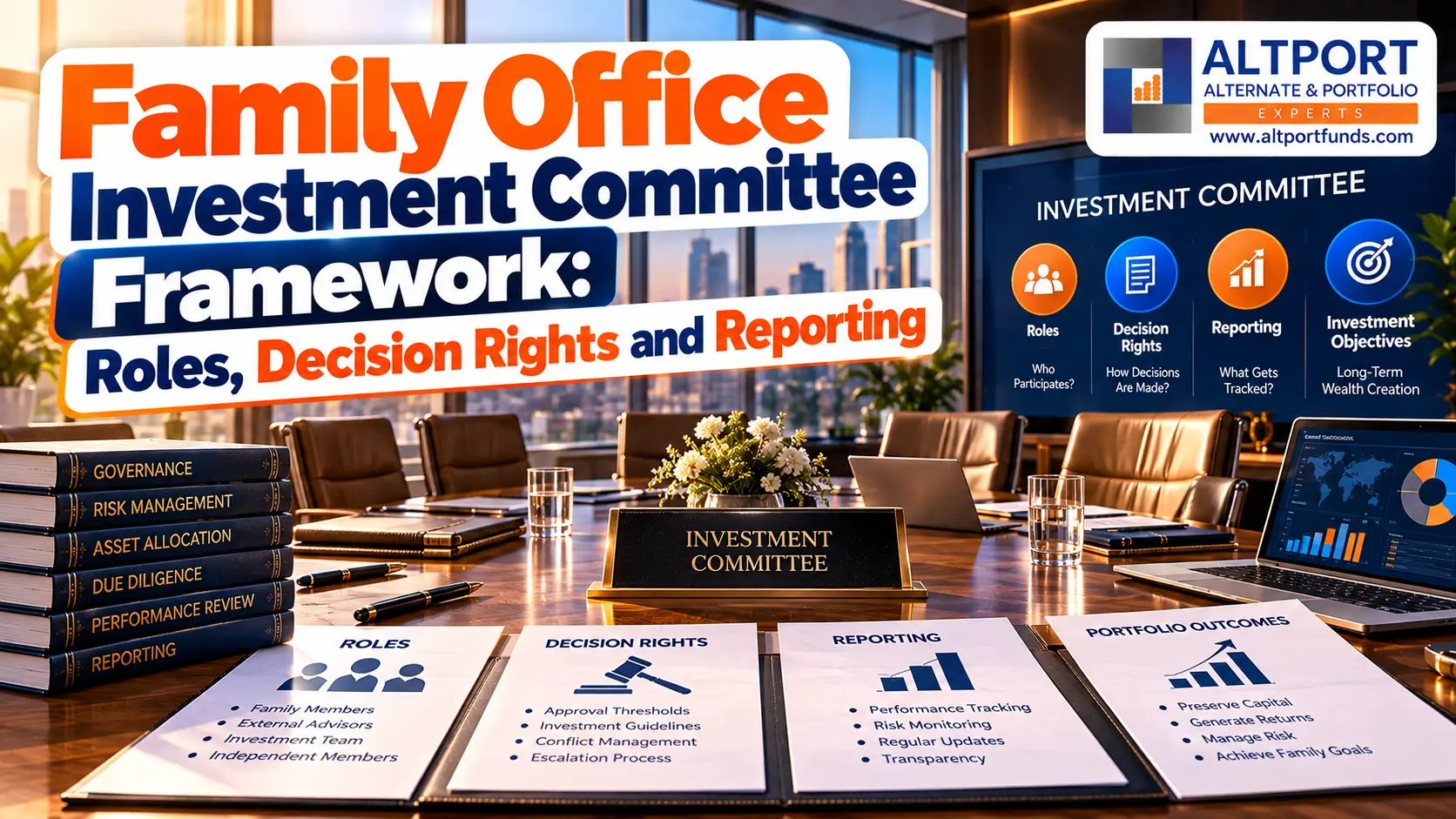
As Indian family wealth becomes more diversified, investment decisions are becoming harder to manage informally. A family may have operating businesses, listed investments, real estate, PMS portfolios, AIF commitments, private investments and international exposure - all carrying different levels of liquidity and risk.
That is where a family office investment committee becomes useful.
A properly designed family office investment committee does not exist simply to approve investments. Its larger purpose is to create a repeatable decision-making system around capital, risk, governance and accountability.
This matters particularly for a family office India setup where investment decisions may involve multiple family members, professional advisors and external investment managers.
A good framework defines who can recommend an investment, who can approve it, what information must be reviewed, what risks are acceptable and how decisions are documented.
This article explains how a family office investment committee can be structured, including roles, decision rights, investment mandates, reporting, conflicts and portfolio controls.
Family Office Investment Committees Explained
A family office investment committee is the body responsible for overseeing major investment decisions within the family's broader governance framework.
The committee may include family principals, a CIO or investment head, finance professionals and selected external specialists.
The exact structure varies. A single-family office with a large internal team may have a formal committee with dedicated investment professionals. A smaller setup may use a leaner family investment committee supported by external research, tax, legal and investment specialists.
The key is not the number of members. It is clarity.
A family office investment committee should know:
- What decisions fall within its authority
- Which decisions remain with family principals
- Which decisions can be delegated
- What investment mandate applies
- What risk limits must be followed
- What information is required before approval
- How decisions are recorded
- How approved investments are monitored
For families evaluating different operating models, ALTPORT's resources on types of family offices can provide additional context.
The Purpose of Investment Governance
Investment governance is essentially about preventing important decisions from becoming ad hoc.
A family office investment committee gives the family a formal forum where opportunities can be challenged before capital is committed.
This is especially important when the family has significant exposure to its own operating business. A new investment may appear attractive on a standalone basis but could increase sector, geography, liquidity or promoter concentration at the total-family level.
Good family office governance therefore connects individual investment decisions with the family's broader balance sheet.
A useful governance system generally covers:
- Investment objectives
- Strategic asset allocation
- Liquidity requirements
- Risk limits
- Manager selection
- Due diligence
- Approval authority
- Monitoring
- Reporting
- Conflict management
- Review procedures
The family office investment committee becomes the bridge between these policies and actual investment decisions.
It should not replace professional analysis. Instead, it should ensure that professional analysis reaches the right decision-makers in a consistent format.
Family Office Investment Committee Structure and Membership
There is no single mandatory investment committee structure for every family office.
The structure should reflect the family's size, complexity, investment activity and degree of professionalisation.
A practical model could look like this:
| Member | Primary role |
| Family principal | Defines family objectives and provides strategic oversight |
| CIO / Investment Head | Leads investment analysis and portfolio implementation |
| Family office finance professional | Reviews cash flows, reporting and financial controls |
| External investment specialist | Provides independent investment expertise where required |
| Legal / tax specialist | Advises on structural, legal and tax considerations |
| Committee secretary | Maintains agendas, minutes, decisions and action items |
The family office investment committee does not necessarily need every specialist at every meeting. Experts can be brought in when a particular transaction requires specialist input.
For example, an international investment may require tax and regulatory input, while a private equity transaction may require legal and commercial due diligence.
The committee should also define whether members have voting rights or advisory roles.
That distinction becomes important when establishing family office decision rights.
Roles of Family Principals, CIOs and Investment Professionals
A family office investment committee works best when responsibility is divided clearly.
Family principals
Family principals generally establish the family's broad objectives, risk preferences and long-term priorities.
They may decide matters such as:
- Long-term wealth objectives
- Business-related investment restrictions
- Philanthropic priorities
- Succession considerations
- Major strategic investments
- Changes to the investment mandate
The family does not necessarily need to conduct every investment analysis itself.
CIO or investment head
The family office CIO responsibilities can include:
- Translating family objectives into an investment framework
- Implementing the investment strategy
- Reviewing portfolio risk
- Leading manager evaluation
- Coordinating due diligence
- Monitoring investment performance
- Preparing committee materials
- Escalating material risks
The CIO may also be responsible for ensuring that the portfolio remains within approved parameters.
Investment professionals
Investment professionals generally conduct detailed analysis and support the manager selection process.
They may evaluate:
- Investment philosophy
- Track record
- Portfolio construction
- Team stability
- Risk controls
- Fees
- Liquidity
- Operational infrastructure
- Alignment of interests
ALTPORT also covers the broader subject of how to select a PMS provider in India, which can be useful when developing a manager evaluation process. For AIFs, the private placement memorandum (PPM) is usually the starting point for due diligence.
Investment Decision Rights and Approval Limits
One of the most important functions of a family office investment committee is defining who can approve what.
Without clear authority, even a sophisticated family office can develop bottlenecks or inconsistent decisions.
An investment approval process can divide decisions into several levels.
For example:
| Decision | Possible authority |
| Routine portfolio rebalancing within approved limits | CIO / investment team |
| New manager within approved mandate | CIO or committee, depending on threshold |
| Material AIF or PMS allocation | Investment committee |
| Large direct investment | Committee + designated family principal |
| Investment outside approved mandate | Full committee / family approval |
| Major strategic transaction | Family principals / governing body |
These are illustrative governance arrangements, not regulatory requirements.
The family office investment committee should establish actual limits based on the family's circumstances.
An investment mandate can specify permissible asset classes, allocation ranges, liquidity requirements, risk limits and delegation authority.
The objective is simple: a person should not have unlimited authority over a decision that could materially affect family wealth.
Building an Investment Policy Statement
An investment policy statement, commonly called an IPS, converts the family's investment philosophy into a written framework.
A strong IPS can address:
- Investment objectives
- Time horizon
- Liquidity needs
- Strategic asset allocation
- Risk tolerance
- Permitted investments
- Restricted investments
- Concentration limits
- Leverage restrictions
- Manager-selection standards
- Reporting requirements
- Rebalancing guidelines
- Governance responsibilities
For a family office investment committee, the IPS is one of the most important reference documents because it provides a common standard for evaluating opportunities.
For example, if a proposed private investment exceeds the family's approved illiquidity range, the committee can identify the issue before discussing whether the underlying opportunity is attractive. Illiquidity limits should account for AIF lock-in periods as well as direct holdings.
The IPS should not be treated as a document that is written once and forgotten.
Changes in family wealth, business ownership, liquidity requirements or succession objectives may require the IPS to be reviewed.
Portfolio Risk and Asset-Allocation Controls
A family office investment committee should evaluate portfolio risk at the total-family level.
This is particularly important because a family can appear diversified across investment products while remaining highly concentrated economically.
For example, the family may own several equity funds, a PMS strategy and an AIF while also holding a large promoter stake in the same sector. Checking for PMS and AIF portfolio overlap is one way to surface this hidden concentration.
A portfolio review should therefore consider:
- Asset-class concentration
- Manager concentration
- Sector exposure
- Geography
- Currency
- Liquidity
- Leverage
- Private-market commitments
- Direct business exposure
- Real estate concentration
This is where family office risk governance becomes practical.
The committee can establish risk thresholds and escalation triggers rather than waiting for a portfolio problem to become obvious.
For broader context on allocation, see ALTPORT's family office asset allocation guide.
A family office investment committee can then review actual exposure against the approved strategic allocation at regular intervals.
Family Office Investment Committee Meeting Agenda
A well-run family office investment committee meeting should not become a presentation marathon.
The agenda should focus on decisions, exceptions and material changes.
A practical meeting could include:
1. Portfolio snapshot
Review total assets, allocation, liquidity and major movements.
2. Risk review
Discuss concentration, leverage, liquidity and breaches of approved limits.
3. Existing manager review
Evaluate material changes in PMS, AIF and other external managers.
4. New opportunities
Review only investments that meet the family's preliminary screening criteria.
5. Decisions required
Clearly identify matters requiring approval.
6. Follow-up actions
Assign owners and deadlines for unresolved items.
7. Conflicts
Record any actual, potential or perceived conflict connected with a decision.
A family office investment committee should ideally receive materials before the meeting rather than seeing important information for the first time in the room.
That gives members time to challenge assumptions and request additional analysis.
Reporting Requirements for the Investment Committee
A family office reporting framework should make the family's financial position understandable without requiring members to reconstruct it from multiple manager statements.
Reports can cover:
- Total portfolio value
- Strategic versus actual allocation
- Performance
- Liquidity
- Cash balances
- Capital commitments
- Capital calls
- Manager exposure
- Asset-class exposure
- Concentration
- Risk-limit breaches
- Recent investment decisions
- Pending approvals
Reporting frequency can vary by family and asset class.
A monthly dashboard may be appropriate for portfolio monitoring, while a quarterly committee pack may provide a more detailed review.
The family office investment committee should also distinguish between performance reporting and decision reporting.
A strong report should not merely say what happened. It should highlight what requires attention.
ALTPORT's detailed resource on family office portfolio reporting in India covers the reporting side in greater depth.
Conflict-of-Interest Management
A conflict-of-interest policy should be part of the family's governance framework, particularly when family businesses, investment managers and related parties overlap.
Potential conflicts can arise when:
- A family member has an interest in the investment opportunity
- A manager has a relationship with the family
- A proposed investment involves a related business
- An investment professional receives an external benefit
- A transaction involves connected parties
The family office investment committee should require disclosure of relevant conflicts before a decision is made.
SEBI's AIF framework provides an example of why documented conflict procedures matter. The AIF regulations require managers to establish and implement written policies and procedures to identify, monitor and appropriately mitigate conflicts of interest. SEBI's code of conduct for investment committee members also addresses disclosure of conflicts and recusal where necessary.
These requirements apply to regulated AIF structures and should not be confused with a universal legal requirement for every family office. However, the governance principle is useful.
A family office investment committee can adopt similar internal discipline by requiring disclosure, independent review and recusal where appropriate.
Reviewing and Updating the Governance Framework
Governance should evolve with the family.
A family office investment committee may need to revisit its structure when:
- Family wealth changes materially
- A new generation becomes involved
- The family establishes a dedicated family office
- Investment activity expands into private markets
- International investments increase
- A new CIO joins
- The family changes its risk tolerance
- A major business sale or liquidity event occurs
The investment committee charter should document the committee's purpose, membership, authority, meeting procedures, voting arrangements, conflict requirements and reporting responsibilities.
The charter and IPS should work together.
The charter answers:
Who has authority and how does the committee operate?
The IPS answers:
What investment framework should that authority follow?
A family office investment committee should periodically test whether both documents still reflect how the family actually operates.
Family Office Management: Bringing the Framework Together
Strong family office management is not about adding layers of paperwork.
It is about reducing ambiguity.
A mature family office investment committee should make it easier to answer:
- Who made this investment decision?
- Under what mandate?
- What analysis was reviewed?
- Which risks were identified?
- Was the investment within approved limits?
- Were conflicts disclosed?
- What happens if the investment moves outside expectations?
- When will it be reviewed again?
This becomes increasingly relevant as a family office India structure expands beyond traditional listed investments.
PMS and AIF investments, private equity, private credit, real estate, direct investments and international assets can all have different liquidity and risk characteristics.
A family office investment committee provides a common governance layer across these different exposures.
It also supports family office investment strategy by keeping the focus on portfolio objectives rather than individual product pitches.
Family Office Investment Committee vs Family Council
These two bodies can have overlapping family members but serve different purposes.
A family council generally deals with broader family matters, communication, values, succession and family participation.
An investment committee focuses specifically on investment governance and capital allocation.
For larger families, separating the two can make decision-making clearer.
The family council may establish broad family priorities, while the family office investment committee translates the investment-related priorities into policies, mandates and decisions.
This separation can become particularly useful for family office governance when several generations are involved.
A Practical Investment Committee Framework
For families building or reviewing their governance model, the following sequence provides a practical starting point:
- Define the family's objectives
- Document the investment mandate
- Prepare the investment policy statement
- Create the investment committee charter
- Assign family office decision rights
- Set approval thresholds
- Establish risk and concentration limits
- Create the manager selection process
- Standardise family office due diligence
- Define reporting requirements
- Document conflict procedures
- Review the framework periodically
The family office investment committee should sit at the centre of this system, but it should not become the only control point.
Delegation matters.
Routine decisions can be handled by the CIO or investment team when they fall within approved limits. Significant decisions can be escalated to the committee. Decisions that materially affect family strategy can remain with the family principals.
That structure keeps governance disciplined without making every portfolio adjustment a family meeting.
Conclusion: Building Better Investment Decisions Through Governance
A family office investment committee is ultimately a decision-making framework, not simply a group of people sitting around a table.
The strongest structures establish clear responsibilities, written mandates, measurable risk limits and consistent reporting.
For Indian families, this becomes particularly relevant as portfolios become more complex and include PMS, AIFs, private markets, real estate, direct investments and international assets.
A well-designed family office investment committee can help separate strategic decisions from routine implementation, while ensuring that major investments are reviewed against the family's overall objectives.
The framework should also evolve. Wealth changes. Businesses change. Family members change. Investment opportunities change.
Good family office governance therefore needs periodic review rather than a one-time policy exercise.
For families looking to build a more structured approach to investment selection, portfolio oversight and alternative investments, ALTPORT provides research-led access and investment-selection resources for HNI and UHNI investors.
Explore ALTPORT's resources on setting up a family office in India and family office structures to understand the broader framework.
ALTPORT is an APMI-registered investment platform/distributor. The information provided is for educational purposes only and does not constitute investment, tax or legal advice. Investments, including PMS and AIFs, involve risks and may involve loss of capital and limited liquidity. Investors should review relevant documents and independently evaluate suitability with qualified professionals.