
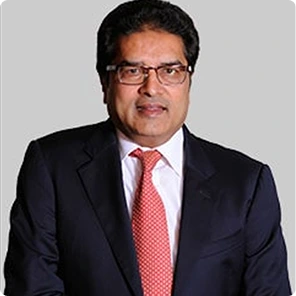
A Chartered Accountant, Raamdeo Agrawal has been studying Indian equity markets since the early 1980s. He has led the Wealth Creation Study since its first edition in 1996 and authored two books on investing and financial analysis: Corporate Numbers Game and The Art of Wealth Creation. His work focuses on identifying quality businesses, understanding their growth potential and assessing the price paid for them.
Key Details About Raamdeo Agrawal
| Parameter | Details |
| Name | Raamdeo Agrawal |
| Current Role | Chairman and Co-founder, Motilal Oswal Financial Services Limited |
| Other Role | Chairman, Motilal Oswal Asset Management Company |
| Co-founder Since | 1987 |
| Industry | Financial services and Indian equity markets |
| Market Experience | Over four decades in equity investing |
| Qualification | Chartered Accountant |
| Other Professional Association | National Committee on Capital Markets, Confederation of Indian Industry (CII) |
| Investment Framework | QGLP - Quality, Growth, Longevity and Favourable Price |
| Investing Principle | Buy Right, Sit Tight |
| Research Initiative | Motilal Oswal Wealth Creation Study, started in 1996 |
| Books | Corporate Numbers Game and The Art of Wealth Creation |
Who Is Raamdeo Agrawal?
Raamdeo Agrawal is an Indian financial services entrepreneur and equity market investor. Along with Motilal Oswal, he co-founded the Motilal Oswal Group in 1987. The business began in the Indian broking market and expanded into institutional equities, asset management, investment banking, private wealth, private equity and other financial services.
As Chairman of MOFSL and Motilal Oswal AMC, Raamdeo Agrawal has played a significant role in shaping the group's research-led approach to investing. He is particularly associated with QGLP, an investment framework built around business quality, earnings growth, longevity and valuation.
His role is strategic and institutional. Raamdeo Agrawal is not the named portfolio manager of individual Motilal Oswal PMS strategies. Those portfolios have designated investment professionals responsible for their respective mandates. His association with the investment philosophy should not be confused with day-to-day management of a particular PMS portfolio.
Raamdeo Agrawal's Experience and Career
Raamdeo Agrawal's career spans the development of India's modern equity market and the growth of Motilal Oswal into a diversified financial services group.
| Year / Period | Career Milestone |
| 1986 | Co-authored Corporate Numbers Game with Ram K Piparia. |
| 1987 | Co-founded Motilal Oswal with Motilal Oswal. |
| 1990 | Motilal Oswal became a member of the Bombay Stock Exchange (BSE), following its initial years as a sub-broker. |
| 1996 | Began authoring the annual Motilal Oswal Wealth Creation Study. |
| 2010 onwards | Developed and articulated the QGLP investment philosophy. |
| Current | Chairman of MOFSL and Motilal Oswal AMC; associated with the group's investment framework and research initiatives. |
Raamdeo Agrawal has also been associated with the Confederation of Indian Industry's National Committee on Capital Markets. His work has included research-led analysis of listed businesses and long-term changes in India's capital markets.
The annual Wealth Creation Study has become a central part of his professional work, providing a recurring analysis of how Indian companies create shareholder wealth over five-year periods.
Raamdeo Agrawal's Education and Qualifications
Raamdeo Agrawal is a qualified Chartered Accountant and an Associate of the Institute of Chartered Accountants of India (ICAI). His academic background also includes a Bachelor of Commerce (B.Com) degree from the University of Mumbai.
His accounting education provides a foundation for the financial statement analysis and business valuation principles associated with his investment approach.
Raamdeo Agrawal's Investment Philosophy: QGLP
QGLP is the central element of Raamdeo Agrawal's investment philosophy. The framework stands for Quality, Growth, Longevity and Favourable Price. It provides a structured way to evaluate a business before considering it for long-term investment.
The four elements work together:
Quality
The first step is to understand the quality of the business and its management. This involves examining the company's business model, financial strength, competitive position and management practices. A strong business should have characteristics that allow it to operate sustainably across different market conditions.
Growth
A quality business also needs the ability to grow. Raamdeo Agrawal's framework places importance on earnings growth because it can contribute to the long-term increase in a company's intrinsic value. Investors need to understand what drives revenue and profit growth rather than relying only on recent share-price movement.
Longevity
Growth is more meaningful when it can be sustained. Longevity examines how long a company can maintain its business quality, competitive advantage and earnings growth. A temporary increase in profits is different from a business capable of compounding earnings over an extended period.
Favourable Price
The final element is valuation. Even a good company may not be an attractive investment at every price. The investor must compare the price of a share with the underlying value and future earning potential of the business.
QGLP is therefore not simply a search for companies with high growth rates or low valuations. It combines business quality, growth potential, durability and the price paid.
What Does Buy Right, Sit Tight Mean?
Buy Right, Sit Tight is the investing principle associated with QGLP. The idea is to identify a business after careful research and hold it for an appropriate long-term period, provided its underlying investment case remains intact.
It discourages frequent trading based only on short-term market movements. However, holding a stock for a long time does not mean ignoring changes in its fundamentals, valuation or business outlook. The investment thesis still needs periodic review.
Raamdeo Agrawal's Investment Strategy
Raamdeo Agrawal's investment strategy places greater emphasis on the underlying business than on short-term market predictions. The approach begins with identifying companies that have sound businesses, capable management and the potential to grow earnings over time.
The next step is to assess whether the company's growth and quality can last. Investors then consider valuation to determine whether the current share price offers a reasonable entry point.
This approach is closely linked to the idea of earnings compounding. When a business can reinvest capital productively and increase earnings over several years, its value may grow over time. The investor's holding period becomes important because the benefits of compounding generally require patience.
The framework does not remove the possibility of losses. Business performance, management decisions, competition, economic conditions and the price paid can all affect investment outcomes.
Raamdeo Agrawal and the Motilal Oswal Wealth Creation Study
The Motilal Oswal Wealth Creation Study is one of the group's long-running equity research initiatives. Raamdeo Agrawal has authored the annual study since its inception in 1996. Each edition examines wealth creation by listed Indian companies over a five-year period and analyses the businesses and sectors contributing to that outcome.
The 30th Motilal Oswal Wealth Creation Study, covering 2020-2025, was released on 11 December 2025. It reported that India's top 100 wealth creators added ₹148 trillion in market wealth during the five-year period.
Key findings included:
| Study Finding | 2020-2025 Result |
| Wealth created by the top 100 companies | ₹148 trillion |
| Wealth creation CAGR | 38% |
| BSE Sensex CAGR | 21% |
| Biggest wealth creator | Bharti Airtel |
| Fastest wealth creator | BSE |
| Most consistent wealth creator | Hindustan Aeronautics Limited (HAL) |
The study identified Bharti Airtel as the biggest wealth creator, BSE as the fastest and HAL as the most consistent. Financials remained the largest wealth-creating sector, followed by Industrials, Capital Markets, Technology and Utilities.
The 30th edition also examined India's long-term economic opportunity through the theme India - The Multi-Trillion Dollar Opportunity: Compounding Economy, Compounding Stocks. It explored how economic expansion and business growth could influence the next phase of wealth creation.
For investors, the Motilal Oswal Wealth Creation Study offers a historical way to examine how businesses have created wealth. Its findings are not a list of guaranteed future winners; past wealth creation does not assure similar results in subsequent periods.
Raamdeo Agrawal's Books
Raamdeo Agrawal's books bring together his interest in financial analysis, business fundamentals and long-term investing.
| Book | Details |
| Corporate Numbers Game | Published in 1986 and co-authored with Ram K Piparia. The book focuses on understanding corporate financial information and the numbers behind businesses. |
| The Art of Wealth Creation | Compiles insights from 20 Motilal Oswal Wealth Creation Studies authored by Raamdeo Agrawal. It brings together observations on business performance, stock selection and long-term wealth creation. |
The Art of Wealth Creation by Raamdeo Agrawal
The Art of Wealth Creation brings together key ideas from two decades of the annual Wealth Creation Study. It explores how companies build value, how investors can assess business performance and why long-term thinking matters in equity investing.
For readers interested in Raamdeo Agrawal's investment philosophy, the book offers a consolidated view of the ideas behind QGLP and the group's research-led approach.
Corporate Numbers Game, written with Ram K Piparia, reflects an earlier part of his work, with an emphasis on understanding corporate numbers and financial information.
Raamdeo Agrawal's Latest Market Views
Raamdeo Agrawal's market views have often focused on the role of market reforms, wider investor participation and the development of India's capital market infrastructure.
24 September 2026: NSE and India's capital market reforms
In an interview published on 24 September 2026, Raamdeo Agrawal described the establishment of the National Stock Exchange (NSE) as the biggest reform in India's capital markets. He highlighted the importance of screen-based trading, dematerialisation and the expansion of retail participation.
He also identified the adoption of eKYC in 2020 as a major turning point for investor onboarding. According to his comments, the industry added 10 million customers that year, and the number had crossed 200 million by FY2026. He discussed how digital processes had changed the scale and accessibility of India's capital markets.
13 June 2026: Growth of passive investing
In an interview published on 13 June 2026, Raamdeo Agrawal discussed the growing role of passive investing in India. He estimated that passive strategies accounted for around 15% of the country's mutual fund industry and expected their share to increase as institutional participation and market maturity improved.
11 December 2025: Findings from the Wealth Creation Study
At the release of the 30th Wealth Creation Study, the key observation was the record ₹148 trillion created by the top 100 wealth creators between 2020 and 2025. The study also highlighted the contribution of financials, industrials, capital markets, technology and utilities to wealth creation.
These comments provide a dated view of his thinking. They should be read in the context of the market and economic conditions prevailing when they were made.
Motilal Oswal Strategies That Follow QGLP
QGLP is associated with the investment philosophy of Motilal Oswal. It provides a broad framework for assessing business quality, earnings growth, longevity and valuation. Individual PMS strategies, however, have separate mandates, portfolios and designated fund managers.
The following Motilal Oswal strategies are available for investors to explore through ALTPORT:
| PMS Strategy | Designated Fund Manager(s) |
| Motilal Oswal NTDOP Strategy | Vaibhav Agrawal |
| Motilal Oswal Value Migration Strategy | Abhishek Anand, Dhaval Mehta and Vaibhav Agrawal |
| Motilal Oswal Founders Portfolio | Dhaval Mehta, Abhishek Anand and Vaibhav Agrawal |
| Motilal Oswal Mid to Mega Strategy | Vaibhav Agrawal and Dhaval Mehta |
These are not funds personally managed by Raamdeo Agrawal. The named investment professionals are responsible for their respective strategies. Investors can explore the ALTPORT fund managers directory for more information about individual managers.
How to Invest in Motilal Oswal PMS via ALTPORT
The minimum investment amount for PMS in India is ₹50 lakh. Before selecting a strategy, investors should understand its investment objective, portfolio construction, designated fund manager, benchmark, fee structure, liquidity terms and associated risks.
ALTPORT provides information and access to investment strategies from Motilal Oswal and other investment managers. To explore available options, contact the ALTPORT team.
Manage By : Raamdeo Agrawal