

About Company
ICICI Prudential AMC Ltd.
Icici Prudential is a major asset management company in the country, focusing on bridging the gap between saving and investing and building long-term wealth for investors through a variety of easy and relevant investment solutions. The AMC is a joint venture between ICICI Bank and Prudential plc, one of the major financial services companies in the United Kingdom.
About ICICI Prudential Asset Management Company Ltd.
ICICI Prudential Asset Management Company Ltd is the investment management company behind the PIPE Strategy. The AMC is a joint venture between ICICI Bank and Prudential Plc, a UK-based financial-services group.
The partnership combines ICICI Bank's presence in India's financial-services ecosystem with Prudential's international investment-management heritage. ICICI Prudential AMC manages mutual fund and portfolio-management products across different asset classes and investment styles.
For investors evaluating the ICICI Prudential small cap PMS and ICICI Prudential midcap PMS offerings, the PIPE Strategy represents the AMC's dedicated mid- and small-cap approach, with a focus on companies where business fundamentals, management quality and valuation can create opportunities over a longer holding period. Investors comparing investment styles offered by the same portfolio manager may also review the ICICI Prudential Contra Strategy PMS. It follows a contrarian multi-cap approach, compared with the PIPE Strategy’s predominant focus on mid- and small-cap companies
What Is ICICI Prudential PMS PIPE Strategy?
ICICI Prudential PMS PIPE Strategy is a discretionary Portfolio Management Service from ICICI Prudential Asset Management Company Ltd that predominantly invests in Indian mid- and small-cap companies. The strategy looks for businesses with an identifiable economic moat, companies undergoing special situations, or businesses operating through an unfavourable business cycle.
The ICICI Prudential PMS PIPE Strategy was launched on 5 September 2019 and uses the S&P BSE 500 TRI as its benchmark. Its stated investment horizon is 5 years and above, reflecting the time that may be required for businesses undergoing a turnaround, special situation or earnings expansion to realise their potential.
The strategy follows a fundamental approach centred on business quality, management capability and valuation. It seeks long-term capital appreciation rather than attempting to predict short-term market movements. Returns are market-linked and are not guaranteed.
Since-inception CAGR should be evaluated alongside benchmark-relative performance, drawdowns, portfolio concentration, fees and an investor’s actual entry date. Investors can review how to interpret PMS returns before comparing this strategy with other portfolios. As of 30 June 2026, the strategy had an AUM of approximately ₹7,829.58 crore and reported a 25.05% CAGR since inception, compared with 16.20% for the S&P BSE 500 TRI over the same period.
ICICI Prudential PIPE Strategy Snapshot
| Parameter | Details |
| Strategy Name | ICICI Prudential PMS PIPE Strategy |
| Portfolio Manager | ICICI Prudential Asset Management Company Ltd |
| Strategy Type | Equity PMS |
| Category | Small and Mid Cap |
| Inception Date | 5 September 2019 |
| Investment Horizon | 5 years and above |
| Benchmark | S&P BSE 500 TRI |
| Minimum Investment | ₹50 lakh |
| AUM | ₹7,829.58 crore |
| AUM Data As Of | 30 June 2026 |
| Stocks | Mid- and small-cap portfolio; current exact count can vary |
| Since-Inception CAGR | 25.05% |
| Benchmark CAGR Since Inception | 16.20% |
| 1-Year Turnover | 0.41 |
| 1-Month Turnover | 0.04 |
APMI currently reports the fixed fee structure, variable fee structure and exit load for the strategy as NA. These commercial terms should therefore be sourced from the latest ICICI Prudential PMS disclosure document or client agreement before publication rather than inferred from third-party databases.
The PIPE Strategy Investment Philosophy: Moats, Management, Valuation
The core belief behind the strategy is straightforward: companies create wealth, not markets. The PIPE Strategy looks for businesses that can potentially compound value over time because of their competitive advantages, improving earnings potential or favourable changes in their business circumstances. Its investment philosophy can be understood through a three-filter BMV framework: Business, Management and Valuation.
1. Business
The strategy looks for companies that can grow faster than their industry, while the industry itself has the potential to grow faster than the broader market.
The assessment also considers economic moats - characteristics that can help a company sustain superior returns on capital over time. Businesses undergoing special situations or temporary unfavourable cycles may also enter the opportunity set.
2. Management
Management quality is evaluated through factors such as growth orientation, margin improvement, capital allocation and track record. The strategy also considers corporate governance and whether management's interests remain aligned with shareholders.
3. Valuation
A strong business is not automatically a good investment at any price. The PIPE Strategy therefore places emphasis on cash flows, valuation and the margin of safety available at the time of investment. The objective is to find a better risk-reward balance between the quality of the business and the price paid for it. This combination of economic moat investing, special situations investing and valuation discipline differentiates the strategy from a simple market-cap-based portfolio.
How the PIPE Strategy Investment Process Works
The PIPE Strategy PMS follows a combination of top-down sector assessment and bottom-up stock selection. Its process can broadly be understood in six stages.
Step 1: Identify Attractive Businesses
The process begins by identifying businesses with favourable long-term characteristics, attractive industry dynamics or opportunities created by temporary business-cycle weakness.
Step 2: Assess the Business and Its Moat
Companies are examined for competitive advantages, market position, growth potential and the possibility of sustaining superior returns on capital. The strategy may also consider businesses where temporary market concerns have created a potentially attractive entry point.
Step 3: Evaluate Management
Management is assessed for its ability to execute the business strategy, improve profitability, allocate capital prudently and maintain appropriate governance standards.
Step 4: Determine Valuation
Cash-flow potential, valuation and downside protection are considered before capital is committed. The strategy looks for a sufficient margin of safety, rather than relying only on earnings growth to justify an investment.
Step 5: Construct the Portfolio
The selected businesses are combined into a concentrated portfolio of mid- and small-cap companies. The strategy predominantly invests in listed equity and equity-related securities. Derivatives may be used for hedging, while debt, money-market instruments, mutual funds or debt ETFs may be used for liquidity, defensive positioning or pending deployment.
Step 6: Monitor and Reassess
Portfolio companies continue to be monitored for changes in business fundamentals, management quality, valuation and the original investment thesis. A special situation may take longer than expected to play out. Similarly, a business that no longer meets the investment thesis may require reassessment.
Potential Benefits of ICICI Prudential PIPE Strategy
The ICICI Prudential PIPE Strategy is designed around several potential sources of long-term alpha.
Access to Future Large-Cap Businesses
Mid- and small-cap companies can have greater room to expand compared with already-established large businesses. The strategy seeks companies that could potentially become market leaders in their respective industries.
Potential Earnings Growth Opportunities
Companies with underutilised capacity, improving demand or expanding margins may experience earnings growth faster than the broader market expects.
Potential for P/E re-rating
When revenue and profit growth accelerate beyond historical levels, investor perception can change. This can potentially result in a PE re-rating, in addition to earnings growth.
Special-Situations Opportunity
The strategy can invest in companies affected by temporary business-cycle weakness or special situations where the market valuation may not fully reflect the potential change in fundamentals.
Active Portfolio Construction
The strategy does not simply replicate its benchmark. It applies fundamental stock selection and can take meaningful active positions based on its investment thesis. These potential benefits come with corresponding risks, particularly small-cap volatility, liquidity risk, concentration risk and special-situations risk.
Fees, Minimum Investment and Exit Load
The minimum investment for the PIPE Strategy is ₹50 lakh. APMI currently reports the fixed fee structure, variable fee structure and exit load as “NA.” Investors should therefore refer to the latest AMC disclosure document and client agreement for the applicable fees, charges and exit terms.
Risks of Investing in PIPE Strategy
The ICICI Prudential PMS PIPE Strategy carries the risks associated with concentrated exposure to mid- and small-cap equities. These companies can offer higher growth potential, but their businesses and stocks can also be more vulnerable to market, liquidity and operational shocks.
Small-Cap Volatility
Small-cap and mid-cap stocks can experience sharper price movements than large-cap stocks. Market corrections can therefore have a significant effect on portfolio value.
Liquidity Risk
Trading volumes in smaller companies may be lower. During stressed market conditions, exiting a position may take longer or require accepting an unfavourable price.
Special-Situations Risk
A special situation may take considerably longer than anticipated to produce the expected outcome. The investment thesis may also fail to materialise.
Governance Risk
Smaller businesses may have less established governance systems, limited management depth or weaker disclosure standards than larger companies.
Business-Cycle Risk
Companies operating through unfavourable business cycles may experience prolonged pressure on earnings, cash flows or valuations.
Concentration Risk
A concentrated portfolio can be more sensitive to the performance of individual companies and sectors than a broadly diversified index portfolio.
Derivative and Debt Risks
The strategy may use exchange-traded derivatives for hedging and may hold debt, money-market instruments, mutual funds or debt ETFs for liquidity, defensive positioning or pending deployment. These instruments carry their own market and credit-related risks.
Investors should read the applicable disclosure document and client agreement for the complete risk factors before investing.
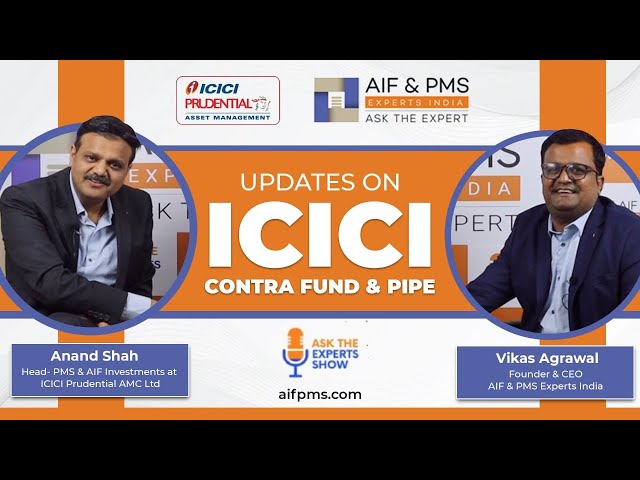
Listen to expert conversations and investment insights anytime on Spotify.

Track how the fund has performed against its benchmark over time through a comparative line graph analysis.
ICICI Prudential PMS PIPE Strategy
Benchmark: BSE 500 TRI
Compare fund returns and benchmark performance across multiple investment periods using a visual bar graph.
Review and compare fund returns against benchmark performance across different investment periods in a detailed tabular format.
ICICI Prudential Asset Management Company Ltd
| AUM(Cr.) | 1M | 3M | 6M | 1Y | 2Y | 3Y | 4Y | 5Y | Ince. | |
| Performance | ₹8401.85 | 3.18 | 6.91 | 10.33 | 12.88 | 4.76 | 16.20 | 22.04 | 21.51 | 24.95 |
| Benchmark | NA | -0.09 | 3.86 | 1.43 | 4.72 | -0.11 | 12.09 | 11.90 | 10.91 | 16.12 |
Learn about the experienced fund managers responsible for investment decisions, portfolio strategy, and long-term fund performance.

Anand Shah
Anand Shah is the CIO, Alternates at ICICI Prudential AMC and has more than two decades of experience in asset management. His previous roles include CEO of NJ Asset Management and Deputy CEO and Head of Investments at BNP Paribas AMC India.
View Profile →
Chockalingam Narayanan
Chockalingam Narayanan is a Senior Fund Manager for PMS and AIF strategies. He has more than 17 years of experience across fund management, investment research and market analysis, with previous experience at Baroda BNP Paribas AMC, Deutsche Equities India and Batlivala & Karani Securities. APMI's current PIPE Strategy registry specifically lists Anand Shah as the fund manager, while third-party PMS industry sources identify the broader investment team associated with the strategy.
View Profile →
Geetika Gupta
Geetika Gupta is a Fund Manager for PMS and AIF strategies at ICICI Prudential AMC. She has more than a decade of experience spanning sell-side equity research and buy-side investing, with previous experience at First Voyager Advisors and coverage of BFSI, consumer and technology businesses.
View Profile →Our Investment Experts
Our experts will understand your goals, map the right strategy across AIFs, PMS, Mutual Funds and Wealth Solutions, and guide you through every step.
Find answers to common questions about fund investments, performance, portfolio strategy, and investor services.
ICICI Prudential PMS PIPE Strategy is an equity PMS focused predominantly on mid- and small-cap companies. It seeks businesses with economic moats, companies undergoing special situations and businesses facing temporary unfavourable cycles. The strategy began on 5 September 2019 and uses the S&P BSE 500 TRI as its benchmark.
The PIPE Strategy predominantly invests in mid- and small-cap companies with identifiable economic moats, businesses undergoing special situations, or companies passing through temporarily unfavourable business cycles. The approach evaluates business quality, management capability and valuation, but positive outcomes are not guaranteed.
BMV refers to Business, Management and Valuation. The framework evaluates the quality and growth potential of the business, the capability and governance of its management, and the valuation and margin of safety available when investing. The BMV framework is described as an indicative investment framework rather than a rigid model applied under every market condition.
The PIPE Strategy can consider companies undergoing special situations or experiencing unfavourable business cycles. These situations can create temporary mispricing or changes in business fundamentals. However, the expected outcome may take longer than anticipated, and a special situation may not develop as expected.
The strategy invests in mid- and small-cap businesses where earnings growth, business improvements, margin expansion or special situations may require several years to play out. A five-year-plus horizon gives the investment thesis more time to develop, although it does not guarantee positive returns.
Key risks include small-cap volatility, liquidity risk, concentration risk, governance risk, business-cycle risk and special-situations risk. Smaller companies can have lower trading liquidity and less management depth, while special situations can take longer than expected to produce the anticipated outcome.
Anand Shah is identified as the CIO, Alternates at ICICI Prudential AMC. Geetika Gupta and Chockalingam Narayanan are senior PMS and AIF investment professionals at the AMC. Current public sources should be checked alongside the latest AMC disclosure for the exact strategy-level manager designation.
The PIPE Strategy minimum investment is ₹50 lakh. APMI currently reports fixed fees, variable fees and exit load as NA. The applicable fee structure should therefore be confirmed from the latest ICICI Prudential PMS disclosure document and client agreement before investment.
Subscribe to the ALTPORT newsletter
Join HNIs, family offices and NRI investors reading with us.
You're on the list
Thanks — we've added your email to the ALTPORT newsletter.