
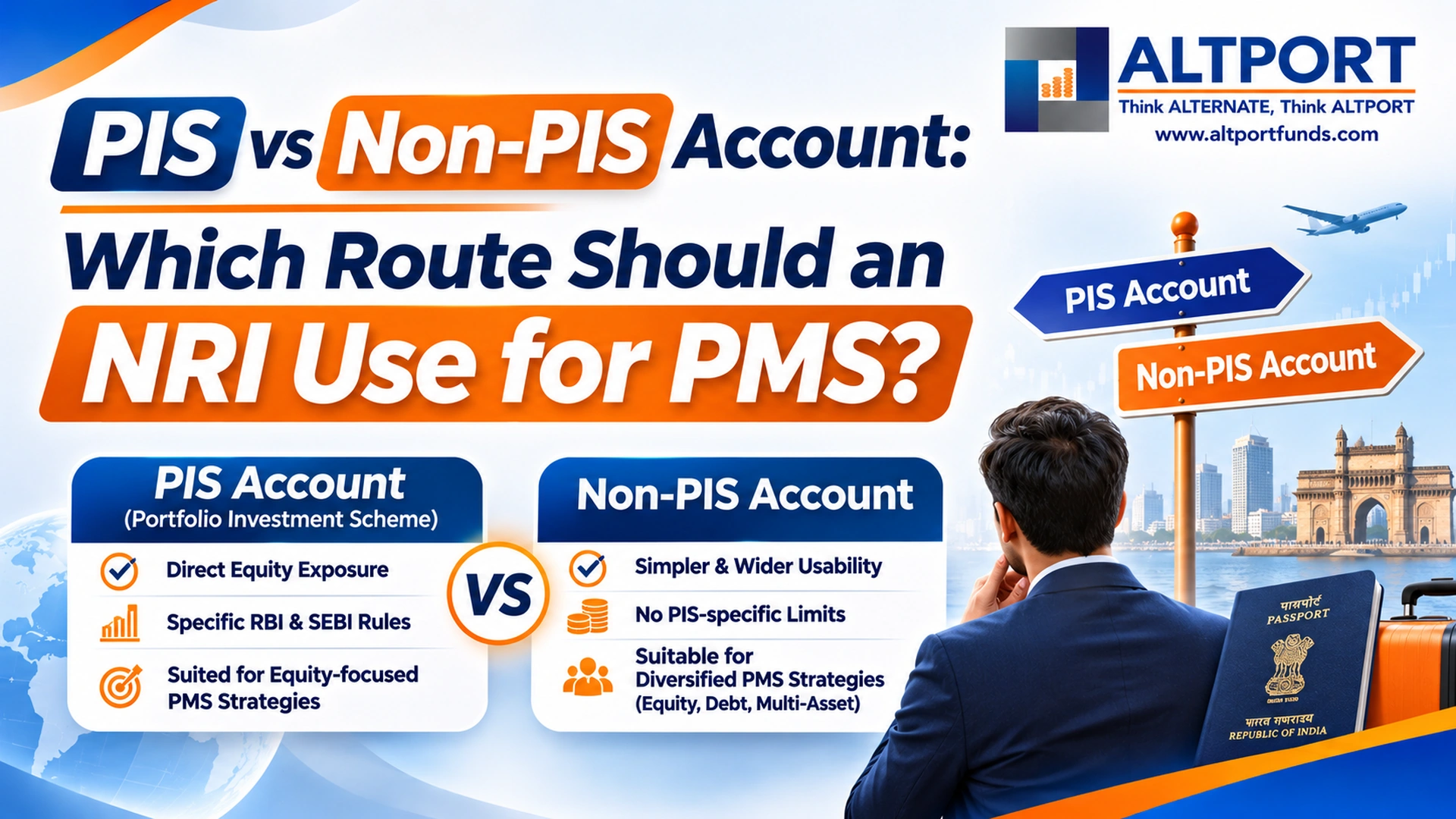
PIS vs Non-PIS Account: Understanding the difference is important for Non-Resident Indians (NRIs) investing in the Indian financial market. These account arrangements determine how eligible investments are funded, processed and repatriated, particularly when considering Portfolio Management Services (PMS).
A PIS account is associated with the Reserve Bank of India's (RBI) Portfolio Investment Scheme, while a non-PIS account generally refers to an NRI investment arrangement that does not use the PIS mechanism. Understanding the distinction helps investors identify the appropriate investment route and avoid unnecessary onboarding delays.
However, the right choice depends on the investment structure, funding source, underlying securities and repatriation requirements. NRIs considering PMS should understand how the portfolio manager executes transactions and how the bank and custodian process settlements.
NRIs exploring professionally managed portfolios can also read our guide to PMS for NRIs in India to understand the investment and onboarding process.
What Is a PIS Account for NRIs?
PIS account meaning: PIS stands for Portfolio Investment Scheme. It is an RBI-regulated mechanism that allows eligible NRIs to purchase and sell specified Indian securities through recognised stock exchanges using a registered stockbroker.
Under this arrangement, an NRI approaches an authorised dealer bank to obtain the required permission and establish the designated banking arrangement.
A PIS account is generally linked to an NRE or NRO banking relationship, depending on whether the investment follows a repatriation or non-repatriation route.
Here is how it works:
- The NRI approaches a bank authorised to administer PIS transactions.
- The bank completes the required documentation and issues the applicable permission.
- The investor opens the associated banking and trading arrangements.
- Eligible purchase and sale transactions are routed through the designated banking mechanism.
- The investor's securities are held in an NRI demat account.
An important point is that PIS primarily concerns eligible investments in listed securities through stock exchanges. It should not be confused with a general NRI investment account in India.
When is a PIS account relevant?
It is particularly relevant when an NRI directly purchases or sells eligible listed Indian shares through a stockbroker.
For PMS investors, the requirement needs separate consideration because transactions are executed under a portfolio management arrangement. The bank, custodian and PMS provider determine the applicable operational structure.
What Is a Non-PIS Account for NRIs?
Non-PIS account meaning: A non-PIS account is a commonly used industry term for an NRI investment arrangement that operates outside the Portfolio Investment Scheme mechanism.
It is not a separate RBI investment scheme with one universal account structure. Its meaning depends on the product, transaction type and banking arrangement.
NRIs may encounter non-PIS arrangements when investing in certain permitted financial products, including mutual funds and other investments that do not require PIS routing.
A typical non-PIS arrangement may involve:
- An NRO or NRE bank account for funding, depending on the permitted investment route.
- An NRI demat account where the investment structure requires securities to be held in dematerialised form.
- A trading account where applicable.
- Product-specific KYC, documentation and regulatory compliance.
For example, eligible NRI investments in Indian mutual funds generally do not require a PIS account. However, this does not mean every investment involving listed shares can automatically use a non-PIS arrangement.
The practical distinction in the PIS vs non-PIS account comparison is the regulatory and operational route through which eligible transactions are processed.
A non-PIS arrangement may be simpler for certain investments, but it is not automatically more flexible or suitable for every NRI PMS investor.
PIS vs Non-PIS Account: Key Differences at a Glance
The following comparison explains the major differences NRIs should understand before selecting an investment route.
| Comparison factor | PIS account | Non-PIS account |
| Meaning | Account arrangement under RBI's Portfolio Investment Scheme | General term for investment arrangements outside PIS |
| Regulatory framework | PIS provisions under FEMA and RBI directions | Applicable product-specific FEMA and RBI provisions |
| Typical application | Eligible listed equity transactions through recognised stock exchanges | Permitted investments that do not require PIS |
| Bank involvement | Designated authorised dealer bank | Bank account and settlement arrangements depend on the product |
| Funding | NRE or NRO-linked PIS arrangement, as applicable | Eligible NRE or NRO funding route |
| Trading | PIS-compliant trading arrangement | Product-specific trading or investment arrangement |
| Demat requirement | Required when securities are held in dematerialised form | Depends on the investment |
| Repatriation | Depends on the underlying investment and funding route | Depends on the underlying investment and funding route |
| Documentation | PIS permission and associated banking documents | Product-specific KYC and banking documents |
| PMS suitability | Depends on the PMS execution and custody structure | Depends on the PMS provider's permitted operating structure |
The PIS vs non-PIS account decision is therefore not simply about choosing between two types of bank accounts.
Investors must establish whether the proposed PMS strategy involves eligible listed equity transactions, how the custodian processes them, and which account arrangement supports the intended repatriation status.
The choice of account is one part of the broader NRI investment options in India, which also depend on funding sources, investment eligibility and repatriation requirements.
Does a PIS Account Always Cost More?
Not necessarily. PIS account charges vary across banks.
Some banks may charge account opening fees, annual maintenance charges, transaction charges, brokerage-related fees and other service costs.
Non-PIS arrangements may avoid certain PIS-specific charges, but they can still involve demat, trading, custody and transaction-related expenses.
NRIs should request a complete fee schedule instead of comparing only the account opening charge.
Does an NRI Need a PIS Account to Invest Through PMS?
This is one of the most important questions during NRI PMS onboarding.
Can NRI invest in PMS without PIS? The answer depends on the PMS provider's investment structure, the securities involved, the transaction mechanism and the bank or custodian's requirements.
A PMS provider manages a client's portfolio under a formal agreement. Depending on the strategy, the portfolio may include listed equities, debt securities, cash equivalents and other permitted instruments.
Unlike direct stock market investing, the investor does not personally execute every purchase and sale. The portfolio manager handles investment decisions and transactions within the agreed mandate.
However, this does not automatically exempt the underlying transactions from applicable FEMA and RBI requirements.
Consider two situations:
Situation 1: PMS investing in listed equities
If the PMS strategy involves secondary-market equity transactions, the bank and custodian may require a PIS-linked arrangement or applicable PIS permission.
For instance, some banks provide PIS facilities specifically for NRI PMS clients. These arrangements help connect the investor's banking, trading and custody accounts.
Situation 2: PMS operating through a permitted non-PIS arrangement
Some investment structures may support non-PIS funding and settlement arrangements, subject to the applicable regulations and the provider's operating model.
The investor should obtain written confirmation explaining how the portfolio transactions will be executed and reported.
Therefore, the PIS vs non-PIS account decision for PMS cannot be made using a universal rule.
What Does PIS Requirement for PMS Actually Mean?
A PIS requirement for PMS refers to the banking permission or transaction arrangement needed to execute eligible investments under the applicable regulatory framework.
It does not mean every PMS product automatically requires the same account structure.
Before opening an account, ask the PMS provider:
- Does the strategy invest directly in listed Indian equities?
- Does the custodian require PIS permission?
- Can the investment be funded through an NRO non-PIS arrangement?
- Will the portfolio operate on a repatriable or non-repatriable basis?
- Which bank account will receive dividends and sale proceeds?
This clarification can prevent investors from opening unnecessary accounts or selecting an unsuitable funding route.
For a broader understanding of the available investment structures, read our NRI Guide to Investing in PMS and AIF.
NRE vs NRO Account for PMS: Funding and Repatriation
Choosing between NRE and NRO funding is another important part of the PIS vs non-PIS account decision.
Both accounts serve different purposes under FEMA. Their treatment of funds and repatriation is not identical.
| Factor | NRE account | NRO account |
| Full form | Non-Resident External | Non-Resident Ordinary |
| Primary purpose | Holding overseas earnings in India | Managing Indian income and eligible domestic receipts |
| Funding | Foreign inward remittances and permitted transfers | Indian income and permitted transfers |
| Repatriation | Generally freely repatriable, subject to applicable rules | Repatriation subject to applicable limits and conditions |
| PMS suitability | Suitable for eligible repatriable investments | Suitable for eligible non-repatriable investments |
| Tax treatment | Interest generally exempt from Indian income tax, subject to eligibility | Interest taxable in India |
For a detailed explanation of account eligibility, funding and repatriation, read our guide to NRE and NRO account differences.
NRE Account for PMS
An NRE account is generally suitable for NRIs who want to invest overseas earnings in India while retaining repatriation flexibility.
Eligible funds can be transferred through permitted banking channels. Investment proceeds may be repatriated according to the applicable investment and account rules.
For a repatriable investment for NRI, the funding route and underlying investment must satisfy the relevant FEMA conditions.
NRO Account for PMS
An NRO account is commonly used for managing Indian income, including rent, dividends, pension and other permitted receipts.
NRIs can use eligible NRO funds for investments on a non-repatriation basis, subject to the applicable rules.
A non-repatriable investment for NRI does not mean the money can never leave India. Eligible NRO balances and proceeds can generally be remitted abroad within the prescribed conditions and limits.
For qualifying NRO balances, repatriation is generally permitted up to USD 1 million per financial year, subject to applicable documentation, taxes and authorised dealer bank procedures. For more information, read our detailed guide on NRI repatriation rules.
NRE vs NRO for PMS: Which Should You Choose?
The right choice depends on where your investment money originates and what you expect to do with the proceeds.
- Choose the eligible NRE route when you intend to invest overseas earnings and retain repatriation flexibility.
- Consider the NRO route when investing eligible Indian income or following a non-repatriation structure.
- Confirm whether the PMS provider supports the selected funding route.
The PIS vs non-PIS account decision should always be aligned with the funding account and intended repatriation treatment.
One important distinction: NRE or NRO funding does not, by itself, determine whether PIS is required. The investment route and transaction structure must also be considered.
Documents and Checks Before Opening an NRI PMS Account
Opening an NRI PMS account involves banking, investment and regulatory documentation. Requirements may differ between banks, custodians and portfolio managers.
The following documents are commonly requested:
| Document | Purpose |
| PAN card | Indian tax identification |
| Passport | Identity and nationality verification |
| Overseas address proof | Confirmation of residential address |
| Visa, residence permit or OCI card | Verification of overseas status, where applicable |
| Recent photographs | KYC documentation |
| NRE/NRO bank statement | Verification of funding account |
| Cancelled cheque or bank proof | Bank account verification |
| FATCA and CRS declarations | Tax residency and reporting compliance |
| KYC and CKYC documents | Investor identification and due diligence |
| PIS permission letter, where required | Confirmation of applicable PIS arrangement |
| Demat account details | Securities holding and custody |
| Power of Attorney, where applicable | Authorised operation of the account |
PIS Account Opening Documents
For PIS onboarding, banks may additionally request prescribed application forms, declarations, account opening documents, overseas address proof and other supporting records.
Some banks may require notarised or attested copies depending on the investor's country of residence.
PIS Account Charges and Other Costs
Before proceeding, request details of:
- PIS account opening and annual maintenance charges.
- NRI trading account charges.
- Demat account maintenance fees.
- Brokerage and transaction charges.
- Custodian and settlement-related expenses.
- PMS management and performance fees.
- Applicable taxes and statutory charges.
A clear understanding of the PIS vs non-PIS account cost structure helps investors compare the overall expense rather than focusing on one account fee.
Regulatory Checks
The onboarding process should also address the following:
- FEMA rules for NRI investments.
- RBI PIS guidelines applicable to the investment.
- Applicable investment limits and sector restrictions.
- Tax residency and withholding tax requirements.
- NRI investment repatriation rules.
- Restrictions applicable to the investor's country of residence.
An NRI should also understand that regulatory requirements can change. The bank and PMS provider must confirm the applicable framework at onboarding.
Questions to Ask Your Bank and PMS Provider
Before finalising the PIS vs non-PIS account route, discuss the following points with your bank and portfolio manager:
- Does the selected PMS strategy require a PIS account?
- Can the PMS accept funding through an NRO non-PIS account?
- Is the investment classified as repatriable or non-repatriable?
- Which bank will handle the investment and settlement transactions?
- Is a separate NRI trading account required?
- Does the investor need a new demat account or can an existing account be used?
- What are the total PIS, demat, trading and custody charges?
- How will dividends, sale proceeds and uninvested balances be credited?
- What are the applicable tax deductions and reporting requirements?
- What happens to the investment account if the investor returns to India permanently?
These questions help establish whether the proposed structure is operationally convenient and compliant.
Choose the Right NRI PMS Route with ALTPORT
Selecting a PMS strategy is only one part of investing in India as an NRI. The banking structure, funding source, transaction mechanism and repatriation requirements deserve equal attention.
At ALTPORT, we help investors explore PMS and alternative investment opportunities through an informed, structured investment selection process.
Our approach focuses on understanding the investment manager's style, portfolio quality and performance consistency before evaluating an investment opportunity.
NRIs exploring professionally managed investments can also visit our NRI Corner to explore relevant investment information and opportunities.
If you are exploring PMS opportunities in India, connect with ALTPORT to understand the available investment options and their onboarding requirements.
Explore PMS investment opportunities with ALTPORT and take a more informed approach to building your Indian investment portfolio.
Disclaimer
This article is intended for educational and informational purposes only. It does not constitute investment, legal, tax or financial advice. Investment eligibility, account requirements and repatriation conditions are subject to applicable RBI, FEMA, SEBI and other regulatory provisions.
PMS investments involve market risks, and returns are not guaranteed. Investors should consult their authorised dealer bank, tax professional and relevant service providers before making investment decisions. ALTPORT acts as an investment distributor and does not provide personalised investment advisory services.