
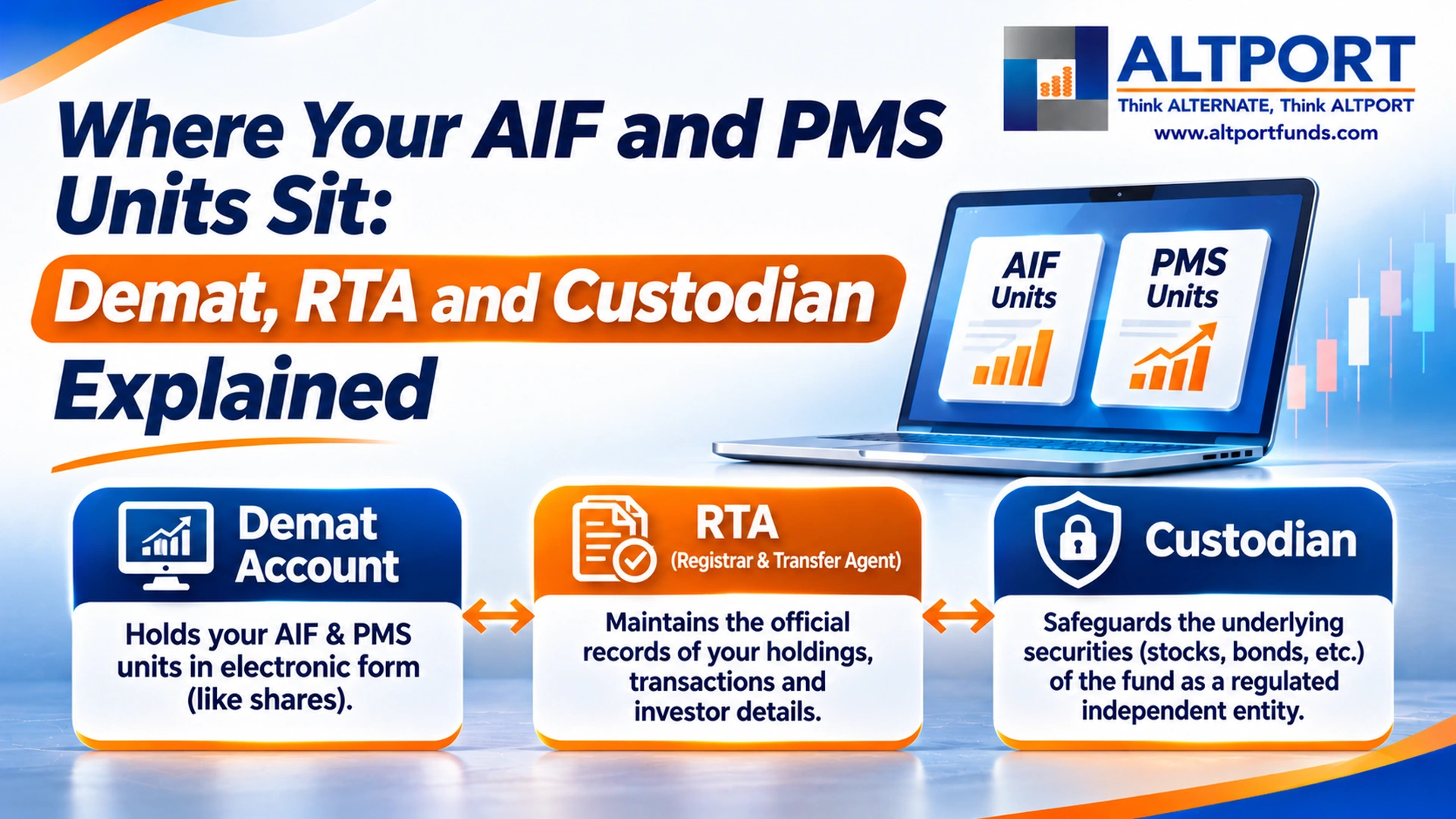
When investors put money into an Alternative Investment Fund (AIF) or Portfolio Management Services (PMS), they often focus on the fund manager, investment strategy and expected returns. However, another important question deserves attention: Where are the investments actually held, and whose records establish ownership?
This is where demat accounts, Registrars and Transfer Agents (RTAs), custodians and depositories come into the picture.
An AIF investor owns units issued by the fund, while the fund holds the underlying investments. In PMS, the client generally owns the securities in their individual portfolio. These are two different ownership structures with different record-keeping arrangements.
Understanding the AIF demat account structure, the role of an RTA and the responsibilities of a custodian helps investors track their holdings and understand how their assets are safeguarded.
SEBI has introduced specific dematerialisation, custody and reporting requirements for AIFs. These provisions make it increasingly important for investors to understand how their holdings are recorded, monitored and reported.
To understand the broader differences between these investment products, explore our guide to AIF and PMS investment structures.
How Are AIF Units Held in India?
An AIF pools capital from multiple investors and invests it according to a defined investment strategy. Investors receive units representing their ownership interest in the fund.
An AIF demat account is the electronic account arrangement through which an investor's AIF units are held.
Here is how the structure generally works:
- The investor commits capital to an AIF scheme.
- The AIF issues units against the eligible investment or capital contribution.
- The units are credited to the investor's demat account.
- The RTA maintains investor and unit-related records.
- The custodian oversees custody-related activities for the fund's securities and supports relevant monitoring and settlement functions.
For example, suppose an investor commits ₹1 crore to a Category II AIF. The fund issues units corresponding to the investor's contribution, based on the applicable issue price and fund documentation.
These units represent the investor's interest in the AIF. They do not represent direct ownership of every individual security held by the fund.
The AIF demat account therefore records the investor's interest in the fund, while the custodian's records relate to the fund's underlying securities and applicable custody arrangements.
What Do SEBI's AIF Dematerialisation Rules Say?
SEBI introduced mandatory dematerialisation requirements through its circular dated June 21, 2023.
Under the framework, all AIF schemes were required to dematerialise their existing units within prescribed timelines.
| Scheme category by corpus | Deadline for dematerialising existing units | Demat-only issuance |
|---|---|---|
| Corpus of ₹500 crore or more | October 31, 2023 | November 1, 2023 onwards |
| Corpus below ₹500 crore | April 30, 2024 | May 1, 2024 onwards |
Schemes whose tenure, excluding permitted extensions, ended on or before April 30, 2024, were exempt from these requirements.
This made the AIF demat account an important part of the investor onboarding and holding process.
SEBI subsequently introduced requirements for AIFs to hold their underlying investments in dematerialised form.
Under the January 12, 2024 circular and subsequent February 14, 2025 relaxation, investments made by AIFs on or after July 1, 2025, must be held in dematerialised form, subject to the applicable provisions and exceptions. Certain investments made before this date are also covered by specified conditions.
This distinction matters because dematerialising AIF units and dematerialising the securities held by an AIF are two separate regulatory requirements.
Investors can also read our guide to SEBI regulations governing AIFs and PMS to understand the regulatory responsibilities of these investment structures.
What Happens If an AIF Investor Has Not Provided Demat Account Details?
SEBI's framework provides for an Aggregate Escrow Demat Account to hold certain AIF units belonging to existing investors who have not provided their demat account details.
The AIF opens this separate account specifically to hold dematerialised units on behalf of those investors. New units issued to such investors are also credited to the Aggregate Escrow Demat Account under the applicable framework.
Once an investor provides the required demat account details, the units held in the Aggregate Escrow Demat Account must be transferred to the investor's own demat account within five working days.
Units held in this account may also be redeemed, with the proceeds distributed to the respective investors' bank accounts and supported by an appropriate audit trail.
The AIF manager must maintain investor-wise KYC details and transaction records for these holdings and follow the prescribed reporting requirements.
This arrangement helps maintain dematerialised records even when an investor has not yet completed the demat account information process.
What Does Dematerialisation Mean for AIF Investors?
Dematerialisation means converting physical securities or investment units into electronic form.
Instead of receiving physical certificates, investors hold their securities electronically through a depository system.
For AIF investors, the AIF demat account offers a structured way to record unit ownership and track holdings.
The process involves three important participants:
- Depository: Maintains the central electronic infrastructure for holding securities.
- Depository Participant (DP): Provides investors access to the depository through their demat accounts.
- RTA: Maintains issuer-level records and processes transactions relating to AIF units.
India has two principal depositories: National Securities Depository Limited (NSDL) and Central Depository Services (India) Limited (CDSL).
An investor's demat account is maintained through a DP connected to one of these depositories.
Benefits of Dematerialisation
The AIF demat account structure offers several practical benefits:
- Electronic ownership records: Investors can access unit-holding information without relying entirely on physical certificates.
- Reduced paperwork: Electronic records simplify the holding and transfer process.
- Better transaction tracking: Unit credits and debits can be reflected through the depository system.
- Improved transparency: Investors can access holding information through depository statements.
- Centralised records: Electronic records make it easier to track eligible holdings across investment schemes.
However, dematerialisation does not automatically make AIF units liquid or freely transferable.
AIF unit transfers remain subject to the fund's Private Placement Memorandum (PPM), contribution agreement, investor eligibility conditions and applicable regulatory requirements.
Investors should review the fund's AIF Private Placement Memorandum (PPM) to understand the applicable transfer restrictions, investor rights, fund terms and other important disclosures.
What Is an RTA and What Does It Do?
An RTA, or Registrar and Transfer Agent, is an entity responsible for maintaining investor records and handling administrative activities relating to securities or investment units.
In the AIF industry, the AIF registrar and transfer agent plays an important role in maintaining accurate records of investors and their unit holdings.
AIF RTA Meaning and Responsibilities
The AIF RTA meaning becomes clearer when we examine the activities performed by an RTA.
Its responsibilities generally include:
- Investor registration: Maintaining investor information and onboarding records.
- Unit allotment: Processing unit issuance following subscription and allotment instructions.
- Holding records: Maintaining details of investor-wise unit balances.
- Transaction processing: Handling eligible transfers, redemptions and other unit-related transactions.
- Statement generation: Providing investor holding statements and transaction information.
- Corporate and fund communications: Supporting investor communication and administrative processes.
- Reconciliation: Reconciling unit balances and related records with the depository system.
- NAV reporting: Uploading the latest available NAV corresponding to each AIF unit ISIN into the depository system within the prescribed timeline.
For instance, when an investor subscribes to an AIF, the RTA processes the relevant investor and allotment information.
The units are then credited to the investor's demat account through the applicable depository mechanism.
The AIF demat account and RTA records work together to maintain an accurate picture of unit ownership.
The AIF manager remains responsible for ensuring the accuracy and timely reporting of NAV information, even though the upload is carried out through the RTA.
What Is an RTA in Investments Beyond AIFs?
RTAs also work with mutual funds, listed companies and other securities issuers.
Their functions may differ depending on the product and regulatory framework.
For AIF investors, the most important responsibility is maintaining accurate investor and unit-related records and supporting the prescribed transaction and reporting processes.
However, an RTA does not independently manage the fund's investment portfolio or make investment decisions.
What Does a Custodian Do for an Investment Fund?
An AIF custodian is responsible for providing custody-related services for the fund's securities.
These responsibilities can include safekeeping, settlement monitoring, transaction verification, asset records and corporate action processing, depending on the nature of the assets and the applicable custody arrangements.
A custodian helps ensure that the fund's securities are appropriately recorded and monitored.
For example, consider an equity-focused AIF that invests in listed Indian companies.
The fund purchases shares of several companies. These securities form part of the AIF's investment portfolio.
The custodian maintains the relevant custody-related records and performs applicable monitoring and settlement functions.
AIF Investment Custody: Why Does It Matter?
AIF investment custody is important because the fund's securities must be identifiable and appropriately safeguarded.
Under the current SEBI AIF framework, the sponsor or manager of an AIF must appoint a custodian registered with SEBI for safekeeping the fund's securities. The custodian must be appointed before the scheme makes its first investment.
The custodian's responsibilities may include:
- Monitoring securities and asset positions.
- Maintaining custody-related records.
- Supporting settlement and reconciliation.
- Monitoring investment transactions.
- Processing corporate actions and entitlements.
- Supporting applicable regulatory reporting and compliance.
The AIF demat account should not be confused with the custodian's account arrangements.
The investor's demat account records the units issued by the fund. The custodian's records concern the securities held by the fund through its legal structure and custody arrangements.
The custodian's precise responsibilities depend on the assets, applicable regulations and its agreement with the AIF.
AIF Units vs Underlying Investments: What Does the Investor Own?
This is one of the most important distinctions in alternative investments.
When an investor commits money to an AIF, the investor receives units representing an interest in the fund.
The fund, through its legal structure, holds the underlying investments.
Consider this example:
An AIF raises ₹100 crore from investors and invests in five companies.
An investor contributes ₹10 crore and receives units representing the applicable interest in the scheme.
The investor owns AIF units. The investor does not individually own 10% of every share held by the AIF.
The underlying investments belong to the AIF structure and are held through the applicable legal and custody arrangements.
| Factor | AIF units | Underlying investments |
|---|---|---|
| Ownership | Investor holds units in the AIF | Held by the AIF through its legal structure |
| Holding records | Investor-level unit records | Fund and custodian asset records |
| Demat arrangement | Investor's demat account, where applicable | Fund-level demat or other permitted custody arrangement |
| Valuation | Based on applicable fund valuation methodology | Based on the underlying assets |
| Reporting | Unit balance and NAV information | Portfolio holdings and asset-level information |
Understanding AIF NAV Reporting
NAV, or Net Asset Value, represents the value of the fund's net assets attributable to its units, calculated under the applicable methodology.
SEBI's February 6, 2026 circular introduced an important reporting requirement for AIF units.
Under the current consolidated AIF framework, AIFs, through their RTAs, must upload the latest available NAV corresponding to each unit ISIN into the depository system within 30 days from the date of portfolio valuation.
For this purpose, the valuation date is determined as follows:
- Independent valuation: The date of the valuation report.
- Internal valuation: The date on which the valuation is documented in the fund's internal records.
The AIF manager remains responsible for ensuring timely and accurate NAV reporting.
The applicable valuation frequency also differs by category:
- Category I and Category II AIFs: Investments must generally be valued at least once every six months by an independent valuer. This period may be extended to one year with approval from at least 75% of investors by value.
- Category III AIFs: NAV calculation must be independent of the fund management function. NAV must be disclosed at intervals not exceeding one quarter for close-ended funds and one month for open-ended funds.
The NAV reflected in the depository system is based on the fund's valuation methodology. It should not be interpreted as a live market price or guaranteed redemption value.
How Are Securities Held in a PMS Account?
PMS follows a different ownership structure from an AIF.
In discretionary PMS, the portfolio manager manages each client's portfolio independently rather than pooling all clients' investments into one fund.
The PMS demat account is generally maintained in the individual client's name.
When the portfolio manager purchases listed securities for the client, those securities are held in the client's demat account.
This means the client remains the beneficial owner of the securities, while the portfolio manager manages the portfolio under the agreed mandate.
For a broader understanding of this investment structure, explore ALTPORT's guide to Portfolio Management Services in India.
How PMS Shares Are Held
The process generally works as follows:
- The client completes PMS onboarding and opens or designates a demat account.
- The account is mapped with the appointed custodian under the applicable arrangement.
- Funds are transferred through the prescribed banking arrangement.
- The portfolio manager executes investment transactions.
- Securities are credited to the client's individual demat account.
- The custodian and portfolio manager maintain the relevant records and monitor transactions.
Under Regulation 23 of SEBI's Portfolio Managers Regulations, 2020, portfolio managers must segregate each client's securities holdings.
They must also keep client funds separate from their own funds and cannot hold client securities in their own name on behalf of clients.
PMS Securities Custody
SEBI's Regulation 26 requires portfolio managers to appoint a custodian for securities managed or administered by them, subject to the applicable exception for advisory-only portfolio managers.
The custodian supports safekeeping and monitoring of the securities.
The investor can also independently access demat statements to check the securities held in the portfolio.
This is an important distinction between PMS and AIF investments.
In PMS, the client owns the individual portfolio securities. In an AIF, the investor owns units representing an interest in the pooled investment vehicle.
How to Check Your AIF or PMS Holding Records
Investors should periodically reconcile their investment records instead of relying on a single statement.
For an AIF investment, the AIF demat account statement is an important starting point.
Investors should check:
- AIF scheme name and ISIN.
- Number of units held.
- Unit credits and debits.
- Subscription and redemption transactions.
- Latest available NAV.
- Investor details and folio-related records, where applicable.
The investor holding statement AIF can generally be obtained through the depository, DP or RTA, depending on the available service arrangement.
Investors should also compare their depository statement with the RTA's unit records and the fund's periodic investor statements.
For PMS, investors should review:
- Individual demat account holdings.
- Securities purchased and sold.
- Transaction statements.
- Cash balances and movements.
- Portfolio valuation statements.
- Annual audited account statements.
If there is a mismatch, investors should raise it with the portfolio manager, RTA or custodian, depending on the nature of the discrepancy.
Investors evaluating a fund or portfolio manager should also review the AIF and PMS investment terminology and the relevant due-diligence considerations before making an investment decision.
RTA vs Custodian vs Depository: Key Differences
These three entities support different parts of the investment holding and record-keeping process.
| Comparison | RTA | Custodian | Depository |
|---|---|---|---|
| Primary role | Maintains investor and unit records | Provides custody services for fund assets | Maintains electronic securities records |
| Main responsibility | Allotments, transfers, investor servicing and reporting | Asset custody, settlement and reconciliation | Electronic holding and transfer infrastructure |
| Works with | Investors, issuers and fund managers | Funds, portfolio managers and investors | DPs, issuers and investors |
| AIF involvement | Maintains unit-related records | Oversees custody-related responsibilities for underlying securities | Records dematerialised units |
| PMS involvement | Depends on the operating arrangement | Provides custody services | Records client securities through demat accounts |
Demat vs Custodian: Are They the Same?
No. Dematerialisation and custody are related but different concepts.
Dematerialisation refers to holding securities electronically instead of through physical certificates.
Custody refers to the safekeeping, monitoring and administration of financial assets.
A depository provides the electronic infrastructure, while a custodian performs custody-related responsibilities.
The AIF demat account therefore represents an electronic holding arrangement, not the entire custody structure of the investment.
Similarly, an investor's demat statement is an important ownership record, but it does not replace the fund's audited financial statements, portfolio disclosures or custody-related records.
Understand Investment Ownership Before You Invest
Knowing where your investment sits is as important as understanding what it invests in.
AIF investors should understand unit ownership, dematerialisation, RTA records, custodian responsibilities and NAV reporting.
PMS investors should understand individual demat holdings, beneficial ownership and custody arrangements.
At ALTPORT, our investment evaluation framework considers three important dimensions:
- Investment Manager Style: Understanding the manager's investment philosophy and decision-making approach.
- Investment Portfolio Quality: Examining the underlying holdings and portfolio construction.
- Investment Performance Consistency: Evaluating performance across different market conditions.
Explore AIF and PMS investment opportunities with ALTPORT. Understand the fund structure, investment manager and associated documentation before committing capital.
Connect with ALTPORT to make more informed decisions about alternative investments.
Disclaimer
This article is intended for educational and informational purposes only. It does not constitute investment, legal, tax or financial advice.
AIF and PMS investments involve market risks, liquidity risks and other investment-related risks. Holding arrangements, custody structures and investor rights are governed by applicable regulations and contractual documentation.
ALTPORT is an APMI-registered investment distributor and does not act as an investment adviser or portfolio manager. Investment returns are not guaranteed.
Official References
- SEBI: Issuance of units of AIFs in dematerialised form, June 2023.
- SEBI: AIF dematerialisation and custodian guidelines, January 2024.
- SEBI: Relaxation in dematerialisation timelines, February 2025.
- SEBI: Reporting of value of AIF units to depositories, February 2026.
- SEBI: Master Circular for AIFs, updated November 5, 2026.
- SEBI Portfolio Managers Regulations, 2020.
- CDSL: FAQs on conversion of physical AIF units into demat.