
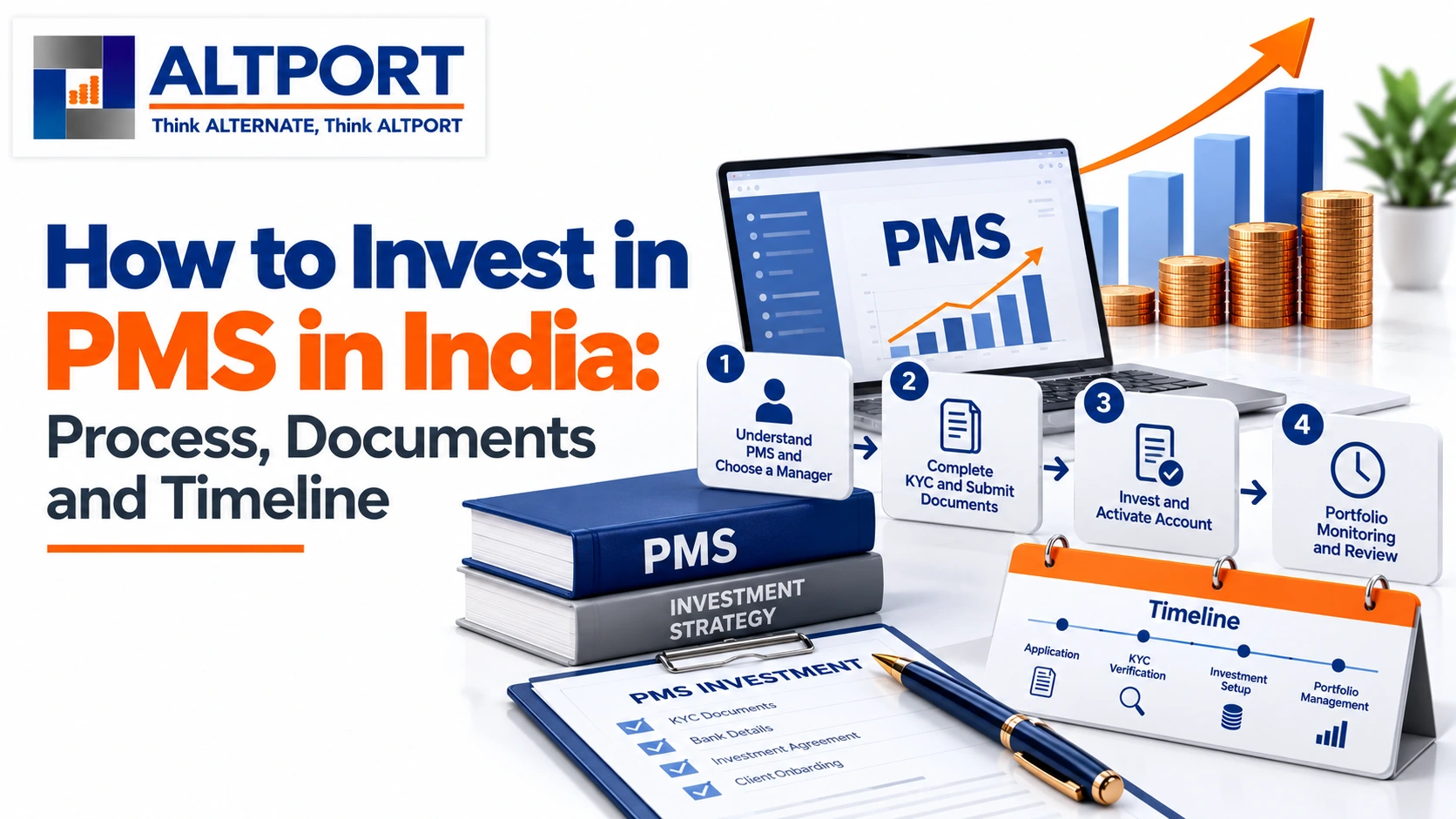
Investing in Portfolio Management Services (PMS) in India involves selecting a suitable portfolio manager, completing Know Your Customer (KYC) formalities, reviewing the investment agreement, submitting the required documents and arranging the transfer of funds or eligible securities.
For most investors, the minimum investment required for PMS is ₹50 lakh under the applicable SEBI framework, subject to relevant provisions and exemptions. The onboarding timeline depends on the investor's KYC status, documentation, account setup and the portfolio manager's procedures.
This guide explains how to invest in PMS in India, the documents required to open a PMS account, the step-by-step investment process, the expected onboarding timeline and the checks investors should complete before committing capital.
What Is Portfolio Management Services (PMS)?
Portfolio Management Services is an investment service in which a portfolio manager manages a client's portfolio of securities according to an agreed investment mandate.
Unlike a mutual fund, which generally pools money from multiple investors into a common investment vehicle, PMS typically involves securities held in the client's own name through the applicable account and custody arrangements.
Depending on the service agreement, a portfolio manager may manage investments on a discretionary basis or operate under a non-discretionary arrangement in which the client retains decision-making authority over transactions.
PMS strategies may focus on large-cap, mid-cap, small-cap, multi-cap, value-oriented, growth-oriented or other investment approaches. Each strategy has its own investment philosophy, portfolio construction process, fee structure and risk profile.
Investors considering this service can explore ALTPORT's guide to Portfolio Management Services in India to understand how PMS works and the features of different investment strategies.
Who Can Invest in PMS in India?
PMS is generally intended for investors who can commit substantial capital and understand the risks associated with investing in securities.
Eligible clients may include resident individuals, Non-Resident Indians (NRIs) and certain non-individual entities, subject to applicable regulations and the portfolio manager's onboarding requirements.
What Is the Minimum Investment Required for PMS?
The general regulatory minimum investment for a PMS client is ₹50 lakh in funds or securities under the applicable SEBI framework. Relevant regulatory provisions and exemptions should be verified for the investor's circumstances.
Individual portfolio managers may specify a higher minimum investment for particular strategies.
Investors should also consider their existing investments, emergency reserves, liquidity requirements and other financial commitments before investing.
Is PMS Suitable for First-Time Investors?
PMS may be considered by investors who understand market risk, have an appropriate investment horizon and can evaluate portfolio concentration, investment costs and potential losses.
However, meeting the minimum investment requirement does not automatically make PMS suitable. Investors should compare it with mutual funds and other investment options based on costs, transparency, flexibility, risks and their financial objectives.
How to Invest in PMS in India: Step-by-Step Process
The PMS investment process generally involves six stages, from assessing your financial requirements to monitoring the portfolio after activation.
Step 1: Assess Your Investment Goals and Risk Tolerance
Before approaching a portfolio manager, establish what you want your investment to achieve.
Consider the following factors:
- Investment objective: Long-term capital appreciation or another clearly defined financial goal.
- Investment horizon: How long you can remain invested without needing the capital.
- Risk tolerance: Your ability and willingness to withstand market volatility and temporary losses.
- Existing portfolio: Your current exposure to direct equities, mutual funds, debt instruments and other assets.
- Liquidity requirements: Whether you may need to withdraw the invested capital for future expenses.
This assessment can help you shortlist strategies that fit your circumstances rather than choosing a PMS based solely on recent returns.
Step 2: Research and Shortlist PMS Providers
After defining your requirements, compare portfolio managers and their investment strategies.
Check the portfolio manager's SEBI registration and review the relevant regulatory disclosures. You can refer to the SEBI Portfolio Managers Regulations for the applicable regulatory framework.
Evaluate each shortlisted provider based on:
- Investment philosophy and portfolio construction.
- Fund manager experience and decision-making process.
- Historical performance across different market conditions.
- Benchmark-relative performance and portfolio drawdowns.
- Portfolio concentration, sector exposure and liquidity.
- Management fees, performance-linked fees and other applicable charges.
- Reporting practices, custody arrangements and investor communication.
Historical performance is one input in the evaluation process. It does not predict future results or guarantee positive returns.
For a more structured evaluation, read ALTPORT's guide on how to select a PMS provider in India. It explains the questions investors should ask about investment philosophy, portfolio quality, performance consistency and operational practices.
Step 3: Complete KYC and Submit the Required Documents
Once you have shortlisted a suitable provider, begin the onboarding and KYC process.
The portfolio manager will provide the applicable document checklist, which may include identity and address verification, PAN, bank details, tax declarations and account-opening forms.
If your KYC records are incomplete, outdated or inconsistent across documents, additional verification may be necessary.
Before submitting your application, check that your name, PAN, address, contact details and bank information are consistent with the relevant records. Submit documents in the required format and respond promptly to any verification requests.
Step 4: Review the Disclosure Document, Fees and PMS Agreement
Before signing the agreement, understand the investment service being offered and the obligations you are accepting.
Review the portfolio manager's disclosure document, client agreement and fee annexure carefully.
Pay particular attention to:
- Investment objectives and strategy mandate.
- Permitted investments and agreed restrictions.
- Fixed management fees and performance-linked fees.
- Applicable hurdle rates and high-water-mark provisions.
- Brokerage, custody, transaction expenses and applicable taxes.
- Exit provisions and applicable exit charges.
- Portfolio reporting and account-settlement arrangements.
- The responsibilities of the investor and portfolio manager.
Do not compare PMS providers using only the headline management fee. The complete cost structure and its effect on net returns matter.
ALTPORT's detailed guide to PMS fees and charges in India explains management fees, performance fees, hurdle rates, high-water marks and other costs investors should review.
Step 5: Complete Account Setup and Transfer Funds or Securities
After the necessary documentation and agreements are completed, follow the portfolio manager's instructions for funding and account activation.
Depending on the arrangement, this may involve transferring funds through the prescribed banking channel or transferring eligible existing securities under the portfolio manager's procedures.
Before initiating a transfer, verify the beneficiary details and funding instructions through an authenticated channel. Do not transfer money to a personal bank account or an unverified intermediary.
If you intend to transfer an existing securities portfolio, clarify:
- Which securities are eligible for transfer.
- How transferred holdings will be valued.
- Whether any securities may need to be sold or replaced.
- What brokerage, transaction costs or tax consequences may arise.
- How the portfolio will be implemented after funding.
The portfolio manager can begin implementing the agreed investment strategy once the applicable onboarding, funding and operational requirements have been satisfied.
Step 6: Confirm Portfolio Activation and Reporting Arrangements
Once the account is funded and activated, confirm that the relevant account details and portfolio information are available through the designated reporting channel.
Understand how you will receive portfolio statements, transaction information, performance reports and fee disclosures.
Ask about reporting frequency, the process for raising queries and the procedure for updating personal or banking details.
PMS investing requires ongoing monitoring. Review the portfolio against your investment objectives, risk tolerance and the strategy's stated mandate rather than judging it solely on short-term returns.
Documents Required for PMS Investment in India
The exact document list varies according to the investor's status, existing KYC records, account structure and the portfolio manager's procedures.
The following checklist covers documents commonly requested during PMS onboarding.
| Document | Why It May Be Required |
|---|---|
| PAN card | Tax identification and KYC verification |
| Accepted identity proof | Identity verification |
| Accepted address proof | Residential or registered address verification |
| Cancelled cheque or bank statement | Bank account verification |
| Photograph and signature | Where required for onboarding |
| KYC forms and declarations | Completion of regulatory and account-opening formalities |
| FATCA/CRS declarations | Applicable tax residency and reporting information |
| PMS client agreement and fee annexure | Documentation of service terms, obligations and charges |
| Demat account details | Where required by the selected account and custody arrangement |
| Source-of-funds or other supporting documents | Where requested for compliance or due diligence |
Not every investor will be asked for every document listed above. Obtain the current checklist from the portfolio manager before submitting your application.
Additional Documents for NRIs Investing in PMS
NRIs may need additional documentation depending on their residential status, tax residency, banking arrangements and investment structure.
Documents commonly requested may include:
- PAN and accepted identity documents.
- Overseas address proof.
- Applicable NRE or NRO bank account details.
- FATCA/CRS and tax residency declarations.
- Passport, visa or other supporting documents, where required.
- Attested or notarised documents if required by the verification process.
- Additional declarations relating to applicable FEMA, RBI and tax requirements.
The precise requirements depend on the investor's circumstances and the proposed investment. NRIs should obtain a current checklist from the portfolio manager before beginning onboarding.
For further details, see ALTPORT's dedicated guide to PMS for NRIs in India.
PMS Investment Timeline: How Long Does It Take?
There is no single guaranteed end-to-end onboarding timeline for every PMS provider. The duration depends on KYC status, document completeness, verification requirements, account setup and funding arrangements.
The following table provides illustrative planning estimates, not regulatory deadlines or guaranteed completion times.
| Stage | Illustrative Time Required | What Happens |
|---|---|---|
| Initial discussion and strategy selection | 1–3 working days | Discuss investment requirements and shortlist a strategy |
| Document collection and submission | 1–3 working days | Submit KYC and account-opening documents |
| Verification and account setup | 2–5 working days | Complete verification and resolve documentation gaps |
| Agreement review and execution | 1–3 working days | Review and sign the client agreement and fee annexure |
| Funding and portfolio activation | 1–3 working days | Complete funding and operational formalities |
These stages may overlap, so the estimates should not simply be added together to calculate a completion date. A straightforward application may be completed within several working days, while additional verification or account-related issues can extend the process.
Certain regulatory activities have their own prescribed timelines. These should not be confused with the time required to complete the entire PMS onboarding process.
What Can Delay PMS Account Opening?
Common reasons for delays include:
- Incomplete or inconsistent KYC information.
- Mismatches in PAN, name, address or bank details.
- Pending signatures, declarations or supporting documents.
- Additional verification for NRI or non-individual investors.
- Delays in banking, Demat or custody arrangements.
- Questions about the fee structure or investment agreement.
- Delays in transferring funds or eligible securities.
To reduce avoidable delays, submit complete documents, respond promptly to verification requests and clarify funding instructions before initiating a transfer.
What Should You Check Before Investing in PMS?
Completing the paperwork is only one part of the decision. Before committing capital, evaluate whether the selected PMS is appropriate for your financial circumstances.
Verify the Portfolio Manager's Registration
Check the portfolio manager's registration through official SEBI resources. Confirm the legal identity of the entity with which you are entering into an agreement.
If you are investing through a distributor, understand the relevant distribution arrangement and verify the applicable registration details.
Understand the Investment Strategy
Read the investment mandate and understand the portfolio's investment universe, stock-selection approach, concentration limits and risk characteristics.
A strategy focused on small-cap companies, for example, may have a different risk profile from a large-cap or diversified strategy.
Compare Fees and Charges
Review the complete fee structure rather than comparing only the headline management fee.
Consider management fees, performance-linked fees, brokerage, custody expenses, other applicable costs and exit charges.
Understand Liquidity and Exit Provisions
PMS is not generally subject to a mandatory regulatory lock-in in the same way as certain other investment products. However, the client agreement may specify exit charges, termination procedures and settlement terms.
The time required to sell securities and settle the account may affect when you receive the proceeds. Review these provisions before investing.
Review Historical Performance and Risks
Examine performance across different market cycles and compare it with the appropriate benchmark. Understand drawdowns, portfolio concentration, market-cap exposure and the possibility of losses.
SEBI registration does not constitute an endorsement of a particular PMS strategy or guarantee investment returns.
Watch: Questions to Ask Before Choosing a Fund
ALTPORT's video library includes educational discussions on evaluating investment strategies, understanding PMS fees and selecting portfolio managers. These can supplement your due diligence before completing onboarding.
PMS Investment Process: Final Checklist
Before completing your investment, make sure you have:
- Assessed your investment goals, time horizon and risk tolerance.
- Confirmed that you meet the applicable minimum investment requirement.
- Verified the portfolio manager's registration.
- Reviewed the investment approach, risks and historical disclosures.
- Submitted the required KYC and supporting documents.
- Read the client agreement and fee annexure.
- Understood the funding, custody and account-settlement process.
- Confirmed how portfolio statements and performance reports will be provided.
- Retained copies of signed agreements and relevant confirmations.
Conclusion
Investing in PMS in India involves evaluating a portfolio manager, understanding the investment strategy and fees, completing KYC, signing the relevant agreements and arranging the transfer of funds or eligible securities.
The process may take several working days when documentation and verification proceed smoothly, but the actual timeline depends on the investor's circumstances and the provider's procedures.
Before committing ₹50 lakh or more, verify the portfolio manager's registration, review the investment mandate and fee disclosures, understand the risks and exit provisions, and confirm that PMS fits your wider financial plan.
Disclaimer: This article is for educational and informational purposes only and should not be construed as investment advice or a recommendation to invest in any specific PMS. Investments in securities are subject to market risks. Historical performance does not guarantee future results. Investors should review the relevant disclosures and seek independent professional advice where appropriate.