
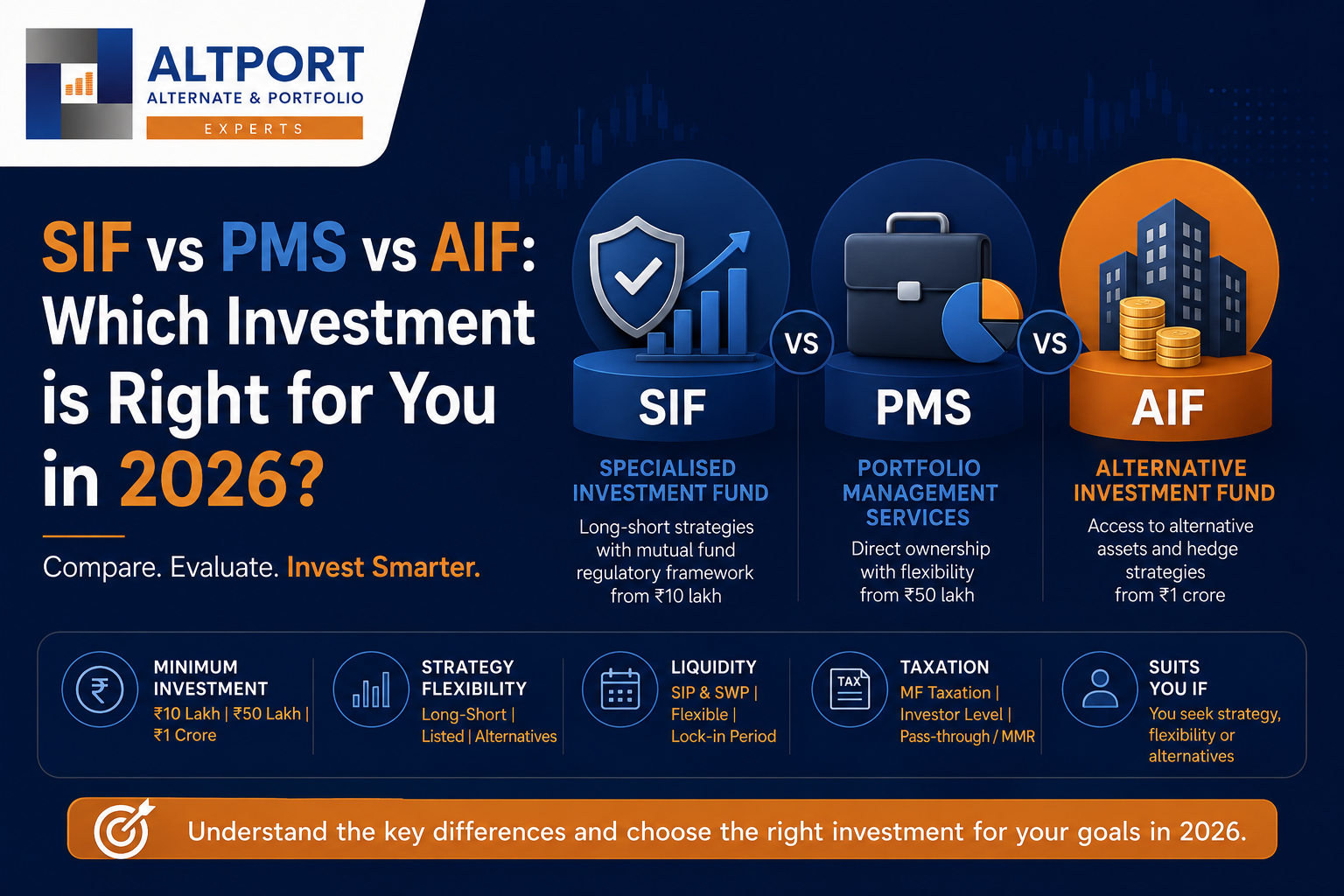
Until April 2025, high net worth investors in India choosing sophisticated investment products beyond traditional mutual funds typically had two regulated options - Portfolio Management Services (PMS) with a minimum investment of Rs 50 lakh and Alternative Investment Funds (AIF) with a minimum investment of Rs 1 crore. SEBI's introduction of the Specialised Investment Fund (SIF) in April 2025 added a third choice with a lower entry threshold of Rs 10 lakh, bringing long-short investment capabilities within the mutual fund framework and its associated tax treatment.
As a result, the SIF vs PMS vs AIF decision has become one of the most important considerations for investors evaluating investment products for HNIs in 2026. This guide compares all three across investment minimums, taxation, liquidity, ownership, flexibility, and suitability to help you identify which structure best aligns with your portfolio objectives.
The Three Products at a Glance
SIF, PMS, and AIF are all SEBI-regulated investment vehicles designed for sophisticated investors, but they differ significantly in their structure, minimum investment requirement, investment universe, liquidity, and taxation. Before deciding which suits your portfolio, it helps to compare their key features side by side.
SIF vs PMS vs AIF Overview
| Feature | SIF | PMS | AIF (Category II) | AIF (Category III) |
| Full form | Specialised Investment Fund | Portfolio Management Services | Alternative Investment Fund Category II | Alternative Investment Fund Category III |
| SEBI framework | Mutual Fund Regulations (amended 2025) | Portfolio Managers Regulations, 2020 | Alternative Investment Funds Regulations, 2012 | Alternative Investment Funds Regulations, 2012 |
| Minimum investment | Rs 10 lakh (PAN level) | Rs 50 lakh | Rs 1 crore | Rs 1 crore |
| Securities ownership | Fund units (pooled) | Direct ownership through investor's Demat account | Fund units (pooled) | Fund units (pooled) |
| Investment universe | Long-short equity, debt, and hybrid strategies (listed securities) | Listed equity and debt | Private equity, private credit, real estate and other alternative assets | Listed equity using long-short, hedge and quantitative strategies |
| Long-short allowed | Yes - up to 25% derivatives exposure | No | No | Yes - leverage permitted |
| Liquidity | SIP and SWP permitted; mutual fund-style redemption | No lock-in; exit load may apply for 1 to 3 years | Typically 5 to 7 year lock-in | Typically 1 to 3 year lock-in |
| Taxation | Mutual fund framework - 20% STCG and 12.5% LTCG (tax generally payable on redemption) | Investor pays tax on realised gains from each trade - 20% STCG and 12.5% LTCG | Pass-through taxation - investors pay tax based on applicable rates | Fund-level taxation under the Maximum Marginal Rate (approximately 42.744%) |
| Distributor | SEBI-certified SIF distributor | APMI APRN-registered distributor | SEBI-registered intermediary | SEBI-registered intermediary |
| Available from | April 2025 onwards | Established investment product | Established investment product | Established investment product |
Minimum Investment Comparison
One of the biggest changes in the SIF vs PMS vs AIF comparison is the entry threshold. For years, investors seeking strategies beyond traditional mutual funds had to commit Rs 50 lakh for PMS or Rs 1 crore for an AIF. With the launch of SIF in April 2025, sophisticated listed-market strategies became accessible from Rs 10 lakh, significantly expanding access for affluent investors.
This lower entry point is particularly important because it bridges the gap between conventional mutual funds and higher-ticket investment vehicles. For investors comparing SIF vs AIF minimum investment, the difference is substantial. While both PMS and AIF remain suited to larger portfolios, SIF allows investors with a relatively smaller investable corpus to access strategies such as long-short investing without waiting until they accumulate Rs 50 lakh or more.
Another important distinction is that the Rs 10 lakh minimum for SIF is calculated at the PAN level across all SIF strategies offered by the same asset management company (AMC). In other words, the combined investment across eligible SIF schemes within one AMC must meet the prescribed threshold.
How Investment Choices Expand with Portfolio Size
| Investable Corpus | Products Available |
| Below Rs 10 lakh | Mutual funds only |
| Rs 10 lakh to Rs 49 lakh | Mutual funds + SIF (available from April 2025) |
| Rs 50 lakh to Rs 99 lakh | Mutual funds + SIF + PMS |
| Rs 1 crore and above | Mutual funds + SIF + PMS + AIF Category I, II and III |
| Rs 25 crore and above (Accredited Investor) | All of the above, plus Large Value Fund AIFs |
A Practical Example
Consider an investor with an investable equity corpus of Rs 30 lakh. Before April 2025, their realistic choice was limited to mutual funds because they did not meet the minimum investment requirements for either PMS (Rs 50 lakh) or AIF (Rs 1 crore).
Today, the same investor can allocate capital to a Specialised Investment Fund and gain access to professionally managed long-short strategies within the mutual fund regulatory framework. This creates a new middle ground for investors who want more sophisticated portfolio construction than traditional mutual funds can offer but are not yet ready for the higher capital commitment required by PMS or AIF.
The lower entry threshold does not automatically make SIF the right choice for every investor. Instead, it expands the range of regulated investment options available, allowing HNIs and affluent investors to select a structure that better matches both their portfolio size and investment objectives.
Investment Universe - What Each Product Invests In
The investment universe is one of the clearest differentiators in the SIF vs PMS vs AIF comparison. SIF is limited to listed markets, investing across equity, debt, and hybrid strategies while allowing controlled long-short exposure through derivatives. PMS primarily focuses on long-only listed equity and debt securities held directly in the investor's Demat account. AIF Category II extends beyond public markets into private equity, private credit, venture capital, and real estate opportunities that are unavailable through SIF or PMS. Meanwhile, AIF Category III also invests in listed markets but can employ higher leverage and more sophisticated long-short and hedge fund strategies than SIF.
When the Investment Universe Decides the Choice
| Investment Objective | Most Suitable Option |
| Want exposure to private equity or pre-IPO companies | AIF Category II |
| Want access to private credit targeting yields of 12 to 18% | AIF Category II |
| Want long-short equity strategies with a Rs 10 lakh minimum investment | SIF |
| Want a personalised portfolio with direct ownership of listed securities | PMS |
| Want long-short investing with higher leverage and hedge fund-style strategies | AIF Category III |
Taxation - The Most Important Difference in 2026
For many HNIs comparing SIF vs PMS returns or asking which is better PMS or AIF, taxation can have a greater impact on post-tax wealth creation than small differences in gross returns. PMS investors are taxed whenever the portfolio manager realises gains by buying and selling securities, meaning there is no tax deferral.
SIF follows the mutual fund taxation framework, where tax is generally payable only when units are redeemed - 20% STCG if held for less than 12 months and 12.5% LTCG after 12 months on gains exceeding Rs 1.25 lakh. Category II AIFs follow a pass-through model, with investors paying tax at the applicable rates, while Category III AIFs are generally taxed at the fund level at the Maximum Marginal Rate (approximately 42.744%) before distributions.
For high-turnover long-short strategies, SIF is therefore considerably more tax-efficient than Category III AIF. However, for low-churn, long-only equity portfolios, the long-term capital gains treatment for PMS and SIF is broadly similar.
Taxation Comparison
| Tax Aspect | SIF | PMS | AIF Category II | AIF Category III |
| When tax is paid | On redemption only | On every trade executed by the manager | Pass-through - on distribution | At the fund level before distribution |
| STCG rate | 20% (holding period below 12 months) | 20% (on each short-term capital gain transaction) | Pass-through at applicable rates | Fund taxed at MMR |
| LTCG rate | 12.5% (holding period above 12 months, subject to Rs 1.25 lakh annual exemption) | 12.5% (on each long-term capital gain transaction) | Pass-through at applicable rates | Fund taxed at MMR |
| Tax deferral | Yes - tax deferred until redemption | No - tax triggered whenever gains are realised | No | Not applicable - fund pays tax |
| Tax efficiency (equity strategies) | High | Moderate | High | Lower |
Liquidity - When Can You Get Your Money Back?
Liquidity is another major differentiator in the SIF vs PMS vs AIF comparison. SIF follows the mutual fund framework, allowing investors to redeem units much like a mutual fund.
Facilities such as SIP, SWP, and STP are available, provided the Rs 10 lakh PAN-level minimum investment is maintained.
PMS generally does not have a mandatory lock-in, although most portfolios levy an exit load if you redeem within the first 1 to 3 years, and partial withdrawals are usually permitted.
AIFs require greater patience, with Category II typically locking capital in for 5 to 7 years and Category III for 1 to 3 years, subject to limited early exit provisions.
Investors who may need access to capital within the next three years will generally find SIF or PMS more suitable, while AIFs are designed for genuinely long-term allocations.
| Investment Scenario | Most Suitable Choice |
| Need capital access within 12 months | SIF (mutual fund-style redemption) or PMS (subject to applicable exit load) |
| Can commit for 3 to 5 years | SIF, PMS, or AIF Category III, depending on investment objectives |
| Can commit for 5 to 7 years | AIF Category II, where the illiquidity premium may be justified |
| Want SIP or SWP facility | SIF only (PMS and AIF do not typically offer standard SIP or SWP structures) |
Returns Comparison - What to Expect
When evaluating SIF vs PMS returns, it is important to compare both the strategy and the investment structure rather than focusing solely on headline performance numbers.
Top-quartile PMS strategies have historically delivered 14 to 20% CAGR over 10-year periods on a Time-Weighted Rate of Return (TWRR) basis, as disclosed under SEBI's reporting framework.
Within AIFs, Category II private credit funds often target yields of 12 to 18%, while Category II private equity funds may target 18 to 25% net IRR over the life of the fund. Category III long-short strategies generally target 15 to 22% net returns, depending on their investment approach.
Since SIF was introduced only in April 2025, there is no meaningful long-term performance history. Investors should therefore assess the investment manager's track record in managing similar strategies rather than relying on SIF-specific performance data.
Important: Past performance is not indicative of future results. All return figures mentioned above are indicative historical ranges or strategy targets, not guarantees. Actual returns may vary significantly and can be lower than expected or even negative depending on market conditions and portfolio performance.
SIF vs PMS vs AIF - Who Each Suits
There is no single best investment option for HNI investors. The right choice depends on your investable corpus, desired asset exposure, liquidity requirements, tax considerations, and whether you prefer direct ownership or a pooled investment structure. If you're wondering which is better PMS or AIF, or where SIF fits into the picture, the answer lies in matching each product to its intended use rather than searching for a universal winner.
Choose SIF If...
SIF may be the right fit if:
- Your equity corpus earmarked for long-short strategies is Rs 10 lakh to Rs 50 lakh.
- You want exposure to long-short investing without meeting the Rs 1 crore minimum investment required for an AIF.
- You prefer the mutual fund taxation framework, where tax is generally payable only upon redemption rather than on every portfolio transaction.
- You want the flexibility to make additional investments through SIP after your initial investment.
- You are already familiar with the fund manager's investment philosophy through their PMS or AIF track record and want access to a similar strategy in the SIF structure.
Choose PMS If...
PMS may be more suitable if:
- Your equity corpus is Rs 50 lakh or more and you want direct ownership of securities.
- You value complete transparency, with every stock held in your own Demat account.
- You want a portfolio tailored to your preferences, such as excluding specific sectors or maintaining a preferred level of concentration.
- You prefer a professionally managed long-only listed equity strategy.
- Tax management through direct ownership and tax-lot selection is an important consideration.
Choose AIF If...
An AIF may be the better choice if:
- You want exposure to private equity, private credit, venture capital, or real estate, which are available through Category II AIFs.
- You can invest Rs 1 crore or more and are comfortable committing capital for 5 to 7 years with limited liquidity.
- You want a long-short strategy with greater leverage and flexibility than SIF permits through a Category III AIF.
- You are an ultra-high-net-worth investor seeking diversification beyond listed markets and into India's private economy.
- The pass-through taxation framework of Category II AIFs aligns well with your broader tax planning strategy.
Decision Matrix
| Your Situation | Recommended Choice |
| Rs 10 lakh to Rs 50 lakh, want long-short exposure | SIF - the only regulated long-short option available at this investment level |
| Rs 50 lakh or more, want a personalised direct equity portfolio | PMS - direct ownership with full portfolio customisation |
| Rs 50 lakh to Rs 1 crore, tax-sensitive and want long-short exposure | SIF - generally offers better tax efficiency than AIF Category III for long-short strategies |
| Rs 1 crore or more, want private equity or private credit exposure | AIF Category II - the only route to these private market opportunities |
| Rs 1 crore or more, want long-short investing with higher leverage | AIF Category III - permits greater leverage than SIF |
| Rs 1 crore or more, building a diversified alternative portfolio | Consider all three - SIF for long-short listed strategies, PMS for direct listed equity, and AIF for private market exposure |
| NRI with a rupee-denominated corpus | All three can be accessed through eligible NRE/NRO structures, with GIFT City AIFs providing an additional investment avenue |
Can You Hold SIF, PMS and AIF Together?
Yes. In fact, many UHNIs use all three because each plays a different role within an overall portfolio rather than competing with the others. A Rs 2 crore+ portfolio, for example, could use PMS as the core listed equity allocation with direct ownership, SIF for tax-efficient long-short and tactical strategies, and AIF Category II for diversification into private equity, private credit, and real estate. Together, they provide exposure to different asset classes, liquidity profiles, and return drivers, creating a more diversified investment portfolio.
Why SEBI Created SIF - The Regulatory Context
SEBI introduced the Specialised Investment Fund to bridge the investment gap between traditional mutual funds and higher-ticket products such as PMS and AIF, creating a new category within the broader SEBI investment categories. By setting the minimum investment at Rs 10 lakh, SIF makes sophisticated long-short strategies accessible under the mutual fund regulatory and taxation framework. Its potential is reflected in the fact that established investment managers, including Nuvama, Marcellus, and ASK Investment Managers, have sought mutual fund licences to launch SIF offerings, signalling strong industry confidence in this emerging investment category.
Frequently Asked Questions
What is the difference between SIF, PMS and AIF?
The main difference lies in their structure, investment threshold, and tax treatment. SIF is a pooled investment vehicle with a Rs 10 lakh minimum investment that offers long-short strategies within the mutual fund regulatory and taxation framework. PMS requires a Rs 50 lakh minimum and provides direct ownership of securities in the investor's Demat account, with taxes payable whenever gains are realised through portfolio transactions. AIF has a Rs 1 crore minimum investment and covers a broad range of strategies, from private equity and private credit in Category II to leveraged long-short strategies in Category III.
Which is better - SIF or PMS?
Neither is universally better because they serve different purposes. SIF is well suited to investors with a Rs 10 lakh to Rs 50 lakh allocation seeking long-short strategies and the potential tax advantages of the mutual fund framework. PMS is more appropriate for investors with Rs 50 lakh or more who want direct ownership of securities, portfolio customisation, and a professionally managed long-only equity portfolio. The better choice depends on your investment objectives, portfolio size, and preferred investment structure.
Can I invest in both SIF and PMS?
Yes. Many HNIs with portfolios above Rs 50 lakh allocate capital to both. PMS can serve as the core long-only listed equity allocation with direct ownership, while SIF can provide tactical long-short exposure and additional diversification within the same overall portfolio.
Is SIF better than AIF Category III for long-short investing?
For many investors, SIF offers two significant advantages: a lower minimum investment of Rs 10 lakh compared with Rs 1 crore for AIF Category III, and the mutual fund taxation framework, which is generally more tax-efficient than fund-level taxation under the Maximum Marginal Rate. However, AIF Category III allows greater leverage and more complex hedge fund-style strategies. The appropriate choice depends on your investment objectives and risk tolerance.
What is the minimum investment for SIF vs AIF?
The minimum investment for SIF is Rs 10 lakh, calculated at the PAN level across SIF strategies offered by the same asset management company. For AIFs, the standard minimum investment is Rs 1 crore across Categories I, II, and III. An exception applies to Angel Funds under AIF Category I, where the minimum investment is Rs 25 lakh.
Is PMS or AIF better for NRIs?
Both PMS and AIF are available to eligible NRIs, subject to applicable regulations and product-specific requirements. PMS generally offers greater liquidity and direct ownership of listed securities, while AIF Category II provides access to private market opportunities that are not available through PMS. Depending on the investor's jurisdiction and objectives, GIFT City AIFs may also offer a tax-efficient investment structure for eligible NRIs.
Conclusion
The introduction of SIF in 2025 has fundamentally reshaped the investment landscape for HNIs in India. Instead of choosing only between PMS and AIF, investors now have a third regulated option that fills an important gap in terms of minimum investment, tax treatment, and strategy access. The most suitable solution depends on your investable corpus, time horizon, tax position, liquidity requirements, and the role each product is expected to play within your portfolio. As a platform that provides access to ALTPORT's investment ecosystem across SIF, PMS, and AIF solutions, ALTPORT enables investors to evaluate these options within a broader portfolio framework rather than in isolation.
Disclaimer: This article is intended for informational purposes only and should not be construed as investment, tax, or legal advice. Investments are subject to market risks, and past performance is not indicative of future results. Please consult your financial and tax advisors before making any investment decisions.