

About Company
ICICI Prudential AMC Ltd.
Icici Prudential is a major asset management company in the country, focusing on bridging the gap between saving and investing and building long-term wealth for investors through a variety of easy and relevant investment solutions. The AMC is a joint venture between ICICI Bank and Prudential plc, one of the major financial services companies in the United Kingdom.
Fund Snapshot
| Feature | Details |
| Strategy Name | ETF Strategy |
| Investment Objective | Capital appreciation through a basket of market-available ETFs. |
| Inception Date | March 18, 2015 |
| Benchmark | Nifty 50 TRI |
| Minimum Investment | ₹50 Lakh |
| Fund Manager | Chockalingam Narayanan |
| Asset Class | Equity (ETF Focused) |
| AUM (Scheme Level) | ~₹12.75 Cr |
| 1-Year Performance | ~ -5.99% (Benchmark: -3.99%) |
| Returns (Since Inception) | ~8.25% CAGR (Benchmark: 10.22%) |
Investment Philosophy
ICICI Prudential AMC follows a disciplined, research-driven investment approach focused on delivering consistent, risk-adjusted returns across market cycles:
- Focus on Risk-Adjusted Returns Core objective is to generate superior returns while managing downside risks across varying market conditions.
- Blend of Quantitative & Qualitative Research Investment decisions are driven by a mix of financial analysis, macro insights, and evaluation of management quality and governance standards.
- Asset Allocation & Diversification Strong emphasis on diversified portfolios across equity, debt, and hybrid strategies to balance growth and stability.
- Fixed Income Discipline Debt investments prioritize safety, liquidity, and optimal returns, ensuring capital protection alongside yield generation.
- Robust Risk Management Framework Independent risk oversight, continuous monitoring, and proactive measures help safeguard investor interests and manage volatility.
- Long-Term Investing Approach Encourages disciplined investing through SIPs and long-term holding to benefit from compounding and market cycles.
- Investor-Centric Strategy Product innovation and portfolio positioning are aligned with evolving investor needs, risk appetites, and market opportunities.
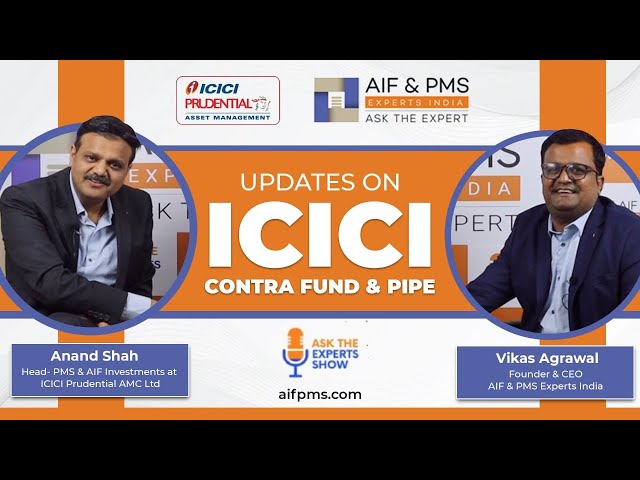
Listen to expert conversations and investment insights anytime on Spotify.

Track how the fund has performed against its benchmark over time through a comparative line graph analysis.
ICICI Prudential PMS ETF Strategy
Benchmark: Nifty 50 TRI
Compare fund returns and benchmark performance across multiple investment periods using a visual bar graph.
Review and compare fund returns against benchmark performance across different investment periods in a detailed tabular format.
ICICI Prudential Asset Management Company Ltd
| AUM(Cr.) | 1M | 3M | 6M | 1Y | 2Y | 3Y | 4Y | 5Y | Ince. | |
| Performance | ₹13.72 | -1.03 | 3.23 | -4.64 | -2.86 | -2.96 | 8.05 | 9.15 | 8.54 | 8.64 |
| Benchmark | NA | -1.14 | 2.89 | -3.60 | -0.35 | -1.19 | 9.00 | 9.13 | 8.32 | 10.63 |
Learn about the experienced fund managers responsible for investment decisions, portfolio strategy, and long-term fund performance.

Nimesh Shah
View Profile →Our Investment Experts
Our experts will understand your goals, map the right strategy across AIFs, PMS, Mutual Funds and Wealth Solutions, and guide you through every step.
Find answers to common questions about fund investments, performance, portfolio strategy, and investor services.
This strategy is based on the concept of passive investing, which suggests that it is often difficult for active managers to consistently outperform the market after fees. By investing in ETFs, the portfolio gains exposure to entire indices or sectors instantly, ensuring the performance closely tracks the benchmark while reducing the risks associated with picking individual stocks.
The portfolio manager evaluates ETFs based on factors such as liquidity, tracking error (how closely the ETF follows its index), and expense ratios. The strategy may tilt toward different segments—such as large-cap, mid-cap, or specific sectors—by choosing corresponding ETFs based on the prevailing macroeconomic outlook.
Because ETFs generally have much lower internal management fees compared to active mutual funds or individual stock-picking strategies, the overall cost of the portfolio is often lower. However, investors should still account for the PMS management fee and the internal expense ratios of the underlying ETFs.
Diversification is inherently high because even a single ETF can hold dozens or hundreds of stocks. The manager enhances this by diversifying across different types of ETFs, which may include broad market indices, factor-based ETFs (like Value or Low Volatility), or thematic ETFs, depending on the strategy's mandate.
This strategy is well-suited for investors who prefer a systematic, rule-based approach to the market and wish to avoid the "manager risk" associated with active stock selection. It is ideal for those with a 3- to 5-year investment horizon who want a liquid and transparent way to participate in India's equity market growth.
Subscribe to the ALTPORT newsletter
Join HNIs, family offices and NRI investors reading with us.
You're on the list
Thanks — we've added your email to the ALTPORT newsletter.