

About Company
Alchemy Capital Management Pvt Ltd
Alchemy Group, a leading investment management firm in India, has been operating successfully since 2002. Founded by four seasoned equity market professionals, each with more than 30 years of experience, the group boasts a strong foundation. Under the leadership of its Chief Investment Officer, Hiren Ved, the team, which has collaborated for over two decades, has fostered a culture of excellence and established an institutional pedigree focused on consistently delivering superior performance to its clients. The Alchemy Group currently manages assets worth USD 1.2 billion. Alchemy is led by Co-Founder Hiren Ved, who also serves as the Director & CIO. With a strong continuity in investment philosophy and strategy, Hiren and the Alchemy team have cultivated a culture of performance excellence. This has been instrumental in maintaining a consistent track record in their investment strategy. Alchemy boasts a comprehensive network of relationships developed over decades. This network provides the team with valuable insights into stocks, sectors, businesses, and potential investment opportunities, ensuring they remain ahead of market trends.
Alchemy Ascent is a quantitative PMS strategy designed to seek long-term risk-adjusted returns through a data-intensive, research-driven approach to equity investing across market capitalisations. The strategy uses an objective, multi-parameter framework to evaluate companies across growth, valuation, quality of earnings and balance-sheet health. It was launched on 3 September 2019 and has an indicative investment horizon of 3–5 years.
Alchemy Ascent is part of Alchemy Capital Management's Quant strategy range. As a separate managed account, the approach combines systematic stock selection with active capital allocation and portfolio monitoring.
What Is Alchemy Ascent Quant PMS?
Alchemy Ascent is a flexi-cap quantitative PMS strategy that uses a systematic, data-driven process to identify and rank listed equities. Rather than relying primarily on discretionary stock-picking decisions, the strategy applies an objective framework to assess companies and generate portfolio signals.
The investment process is designed to reduce the influence of behavioural biases such as fear, greed and hope. Its framework has been back-tested across more than 21 years and multiple market cycles, while the live strategy began in September 2019.
The strategy can invest across market capitalisations and generally seeks to construct a portfolio of up to 35 stocks across sectors. The portfolio can be allocated up to 100% to equities, subject to the applicable investment framework and market conditions.
For investors researching the broader structure of managed accounts, our guide to Portfolio Management Services (PMS) explains how PMS differs from pooled investment structures and how securities are held for investors.
Alchemy Ascent Fund Snapshot: Benchmark, Minimum Investment & Key Terms
| Key Term | Alchemy Ascent |
| Strategy | Equity Diversified |
| Investment Universe | Flexi-cap Growth |
| Management Style | Quant |
| Structure | Separate Managed Account |
| Benchmark | BSE 500 TRI |
| Launch Date | 3 September 2019 |
| Indicative Horizon | 3–5 years |
| Minimum Investment | ₹50 lakh |
| Risk Profile | High Risk |
| Equity Allocation | Up to 100% |
The strategy's primary benchmark is the BSE 500 TRI. The minimum investment is ₹50 lakh, while the stated indicative investment horizon is 3–5 years. The strategy is classified as high risk, and investors should consider the possibility of substantial fluctuations in equity markets.
APMI's current investment-approach record also reports a ₹234.24 crore AUM figure, with the data on that page identifying Alchemy Ascent's inception date as 3 September 2019 and minimum investment as ₹50 lakh. AUM is market-sensitive and should therefore be read with its applicable reporting date.
Alchemy Ascent Investment Strategy: Data-Driven Multi-Factor Equity Investing
The central feature of Alchemy Ascent is its quantitative and systematic investment process. The approach begins with an investible universe and applies filters before stocks are assessed using quantified fundamental parameters.
The July 2026 strategy document describes a process that considers the top 500 companies by market capitalisation before applying additional filters and analysis. Stocks are evaluated using quantified parameters and ranked according to their scores and combinations of attributes.
The framework is intended to combine fundamental information with market-cycle research and risk-reward analysis. This creates a rules-based process for stock selection, portfolio construction and subsequent monitoring.
Growth, Valuation, Earnings Quality and Balance-Sheet Health
Alchemy Ascent evaluates companies across four broad dimensions:
- Growth: Assessment of business growth characteristics and their potential contribution to investment returns.
- Valuation: Consideration of the price paid for a company's underlying business and earnings.
- Quality of earnings: Evaluation of the quality and sustainability of reported earnings.
- Balance-sheet health: Assessment of financial strength and balance-sheet characteristics.
The July 2026 material also describes quantified parameters around valuation, price action, business growth momentum and quality of business as part of the algorithmic process.
This multi-factor framework means the strategy does not depend on a single stock characteristic. Instead, stocks are ranked based on combinations of attributes, with portfolio decisions driven by the resulting signals.
Portfolio Construction, Cash Allocation and Risk Management
Capital allocation is an important part of the Alchemy Ascent framework. The strategy does not treat stock selection as the only source of portfolio outcomes; allocation, relative ranking, timing and risk controls also form part of the process.
A typical portfolio generally contains up to 35 stocks. The July 2026 strategy document states that a particular stock generally receives an allocation of around 3%–5%, while exceptional cases may have a maximum allocation of up to 10% at cost.
Portfolio signals are generated daily, and the portfolio is monitored using the algorithm. When the combination of relevant attributes deteriorates, a stock may exit and be replaced by another qualifying stock.
The strategy can also create cash when the risk-reward opportunity in equities is considered unfavourable. Cash or cash equivalents may therefore form part of the portfolio rather than maintaining a permanently full equity allocation.
Alchemy Ascent Portfolio, Holdings & Market-Cap Allocation
Latest available portfolio data: 30 June 2026. The July 2026 strategy document reports the following market-cap allocation:
| Market-Cap Category | Allocation |
| Large Cap | 32% |
| Mid Cap | 35% |
| Small Cap | 30% |
| Gold ETF | 1% |
| Cash & Equivalent | 2% |
| Total | 100% |
This allocation highlights the flexi-cap nature of the strategy, with exposure distributed across large-, mid- and small-cap companies rather than being restricted to a single market-cap segment.
The same June 2026 portfolio disclosure lists the top 10 holdings by weight as:
| Rank | Holding | Portfolio Weight |
| 1 | Apar Industries Ltd | 5.8% |
| 2 | Eicher Motors Ltd | 4.9% |
| 3 | CCL Products India Ltd | 4.6% |
| 4 | Glenmark Pharmaceuticals Ltd | 4.4% |
| 5 | Muthoot Finance Ltd | 4.1% |
| 6 | SPR Auto Technologies Ltd | 4.1% |
| 7 | Usha Martin Ltd | 4.0% |
| 8 | L&T Finance Ltd | 4.0% |
| 9 | Acutaas Chemicals Ltd | 3.5% |
| 10 | HDFC Asset Management Company Ltd | 3.4% |
These holdings are dated 30 June 2026 and may change as portfolio signals, market conditions and investment decisions evolve. The disclosed holdings should not be interpreted as a guarantee that the same securities will be present in an individual client's portfolio.
Alchemy Ascent Performance vs BSE 500 TRI
The displayed performance module on this page should be read alongside the benchmark and the applicable measurement period. Alchemy Ascent uses the BSE 500 TRI as its primary benchmark. The latest official strategy material provides performance data as of 30 June 2026, calculated using the TWRR methodology and presented net of applicable fees, expenses and taxes where stated.
For context, the July 2026 disclosure reports Alchemy Ascent's since-inception return at 13.4% versus 15.9% for the BSE 500 TRI, with the performance period beginning on 3 September 2019. It also reports a since-inception standard deviation of 17.9%, Sharpe ratio of 0.4 and beta of 0.8 for Alchemy Ascent.
Past performance is not indicative of future performance, and aggregate PMS performance may differ from the experience of an individual client because portfolios, cash flows and implementation can vary. Performance information should therefore be considered alongside the displayed performance table and the relevant product documents.
Alchemy Ascent Minimum Investment, Fees & Exit Load
The minimum investment for Alchemy Ascent is ₹50 lakh.
PMS fees can vary according to the fee arrangement selected by the investor. Alchemy states that its PMS offerings generally use fixed-fee, hybrid or variable-fee structures. The currently available public Alchemy Ascent product material does not state a single universal fee rate for every investor; therefore, the applicable management and performance fee should be confirmed from the current client agreement and commercial terms before investment.
Operating charges and expenses are charged as applicable under the PMS arrangement. Alchemy's current PMS FAQ states that there is no lock-in period, while an exit load of 1% may apply when an investment is redeemed within one year of opening the account. Applicable fees and charges should be verified against the latest client documentation before any transaction.
Key Risks of Alchemy Ascent Quant PMS
Alchemy Ascent carries a high-risk profile, and investors should understand the specific risks associated with a quantitative equity strategy.
Model and factor risk: A systematic model may underperform when the factors or relationships used by the framework are temporarily out of favour or fail to behave as expected.
Equity market risk: The strategy can have substantial equity exposure, potentially up to 100%, so portfolio values may decline materially during adverse market conditions.
Market-cap rotation risk: Exposure across large-, mid- and small-cap stocks can change. Smaller companies may experience greater volatility and liquidity constraints than larger companies.
Valuation risk: A stock may remain undervalued or experience further price declines even when it meets the framework's quantitative criteria.
Concentration risk: Although the strategy can invest across sectors, a portfolio of up to 35 stocks can still have meaningful exposure to individual companies or sectors.
Benchmark risk: The strategy may perform differently from the BSE 500 TRI because its portfolio construction, cash allocation and stock selection can differ significantly from the benchmark.
Systematic-model risk: Back-tested results are not a guarantee of future live performance. Market structures and company fundamentals can change, potentially affecting the effectiveness of historical relationships.
Investors should review the applicable disclosure document and client agreement carefully before investing.
Listen to expert conversations and investment insights anytime on Spotify.

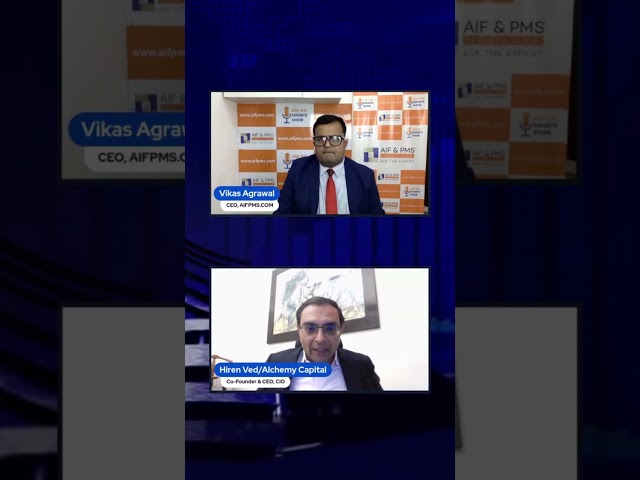
Watch our podcast episodes featuring expert interviews, market insights, investment strategies, and in-depth discussions on the latest financial trends.
Learn about the experienced fund managers responsible for investment decisions, portfolio strategy, and long-term fund performance.

Alok Agarwal
He is the current APMI-listed fund manager for the strategy. He has more than two decades of experience in equity fund management and joined Alchemy in 2022 after previously working with PGIM India AMC, Deutsche Asset Management, KR Choksey Securities, Tata Group and Pinnacle Academy. He holds CA, CFA and CMT qualifications along with a Master's in Commerce and Finance.
View Profile →
Deven Ved
Deven Ved is a Co-Fund Manager, Quant at Alchemy Capital Management, with nearly two decades of experience spanning quantitative research, financial modelling, analytics and investment management. His background in statistics and actuarial science has shaped a data-driven approach to equity investing, combining financial modelling, systematic research and quantitative analysis. At Alchemy, he contributes to the development and implementation of quantitative investment strategies across selected PMS mandates.
View Profile →Our Investment Experts
Our experts will understand your goals, map the right strategy across AIFs, PMS, Mutual Funds and Wealth Solutions, and guide you through every step.
Find answers to common questions about fund investments, performance, portfolio strategy, and investor services.
Alchemy Ascent is a quantitative, flexi-cap PMS strategy that uses a data-intensive and systematic approach to equity investing. It seeks long-term risk-adjusted returns through a framework based on multiple investment parameters.
Yes. Alchemy classifies Alchemy Ascent under its Quant management style. The strategy uses an algorithm-based process for stock selection, portfolio construction and monitoring.
The strategy uses quantified parameters to evaluate and rank stocks across areas including growth, valuation, quality of business and price action, supported by fundamental and risk-reward analysis.
The framework focuses on growth, valuation, quality of earnings and balance-sheet health. The July 2026 material additionally describes parameters relating to valuation, price action, business growth momentum and quality of business.
The primary benchmark is the BSE 500 TRI.
The minimum investment is ₹50 lakh.
Alchemy Ascent is managed by Alok Agarwal and Deven Ved. Alok Agarwal is Deputy CIO, while Deven Ved is Co-Fund Manager, Quant.
The strategy can actively create cash when the risk-reward opportunity in equities is considered unfavourable. Portfolio signals are generated daily, with systematic monitoring and replacement of stocks when relevant parameters deteriorate.
The latest disclosed portfolio data is dated 30 June 2026. It shows 32% large-cap, 35% mid-cap, 30% small-cap, 1% Gold ETF and 2% cash and equivalents. Holdings can change over time.
The applicable fee depends on the fee arrangement selected. Alchemy generally offers fixed, hybrid and variable PMS fee structures. Its current PMS FAQ states that a 1% exit load may apply if an investment is redeemed within one year of opening the account. Investors should verify the exact applicable charges in their current client agreement.
The performance module on this page provides the relevant period-wise comparison with the BSE 500 TRI. The latest July 2026 disclosure reports data through 30 June 2026. Performance should be assessed in the context of the benchmark, investment period and applicable risk measures rather than viewed in isolation.
Key risks include equity-market volatility, model and factor risk, market-cap rotation, valuation risk, concentration risk, liquidity considerations and the possibility of underperformance relative to the benchmark. Back-tested results also do not guarantee future performance.
Subscribe to the ALTPORT newsletter
Join HNIs, family offices and NRI investors reading with us.
You're on the list
Thanks — we've added your email to the ALTPORT newsletter.