
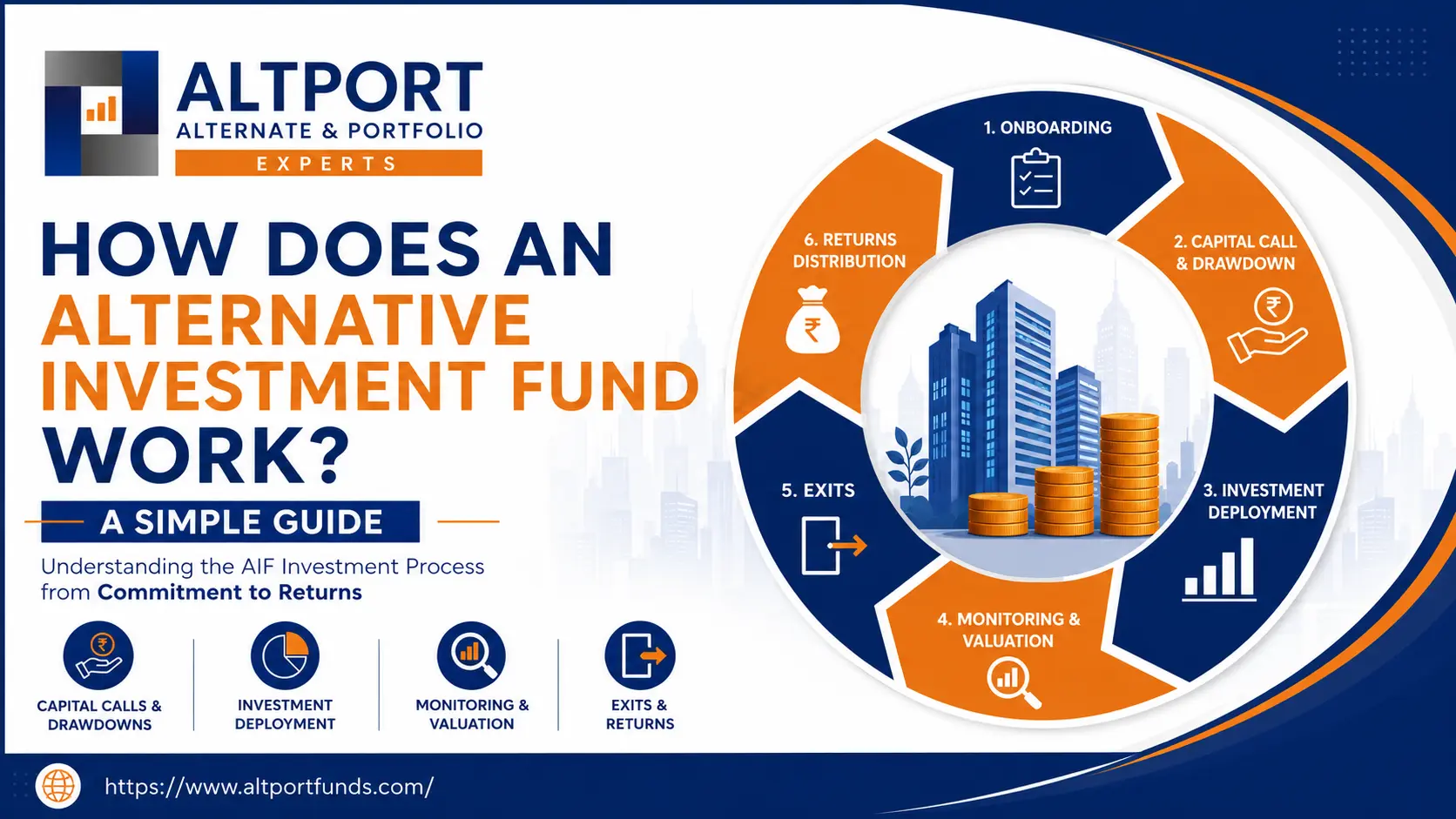
If you've been exploring private market investments, you've probably wondered how does an alternative investment fund work. Unlike mutual funds, where you invest and the money is deployed almost immediately, an Alternative Investment Fund (AIF) follows a structured investment lifecycle that can span several years.
Understanding how an Alternative Investment Fund works is important before investing because it operates differently from traditional investment products. There are capital commitments, capital calls, investment periods, exits, and distributions—all of which happen over time rather than instantly.
In India, the AIF industry has expanded rapidly. According to SEBI, cumulative commitments raised by AIFs stood at ₹15.74 lakh crore as on 31 December 2025, with net investments of ₹6.45 lakh crore — both growing at roughly 30% CAGR over the last five years. The number of registered AIFs has risen to 1,849 as on 31 March 2026, up from 732 five years earlier. That growth is being driven largely by HNIs, family offices and institutions looking beyond stocks and mutual funds.
This guide breaks down how an alternative investment fund works, step by step — covering the complete AIF investment process from the day you sign the subscription documents to the day the fund distributes your returns.
What Is an Alternative Investment Fund?
Before exploring the investment lifecycle, it is helpful to understand what an AIF is. An Alternative Investment Fund is a privately pooled investment vehicle regulated by SEBI. Instead of investing in publicly traded securities alone, AIFs may invest in startups, private companies, listed equities, private credit, infrastructure, real estate or other alternative assets depending on the AIF category.
Unlike mutual funds, AIFs accept investments only through private placement and are generally meant for sophisticated investors.
Snapshot of the AIF Fund Structure
| Component | Role |
| Investors | Commit capital to the fund |
| Sponsor | Establishes the fund |
| Fund Manager | Makes investment decisions |
| Trustee/Trust | Protects investor interests and oversees governance |
| Portfolio Companies | Businesses or assets where the fund invests |
This AIF fund structure creates clear responsibilities and strong regulatory oversight throughout the investment lifecycle.
Who Manages an AIF?
An AIF is not run by a single entity. Three separate parties operate it, and SEBI requires their roles to stay distinct:
- Sponsor – Sets up the fund and contributes a minimum continuing interest as required by regulations.
- Fund Manager – Identifies opportunities, performs due diligence, negotiates investments and manages the portfolio.
- Trustee (or equivalent governance structure) – Ensures the fund operates according to SEBI regulations and the fund documents.
This separation matters in practice: the party making investment decisions is not the party holding the assets or overseeing compliance. It is one of the core investor protections built into the AIF structure.
How Does AIF Onboarding Work? PPM, KYC and Subscription
The AIF investment process begins well before any money changes hands. Once you have selected a suitable fund, you receive the Private Placement Memorandum (PPM) — the single most important document to read before committing. It sets out:
- Investment strategy
- Risk factors
- Fees
- Expected tenure
- Exit strategy
- Rights and obligations
Once you are satisfied with the terms, you complete KYC, execute the subscription documents and sign a capital commitment agreement — the point at which your commitment becomes legally binding.
Capital Commitment, Capital Call and Drawdown: What's the Difference?
One important concept is capital commitment and minimum investment.
Instead of transferring the entire investment immediately, investors usually commit a fixed amount.
For most AIFs in India, the minimum commitment is ₹1 crore (subject to applicable regulations and investor category).
One of the most misunderstood parts of how does an alternative investment fund work is the difference between capital call in AIF and drawdown in AIF. A capital commitment is simply the amount an investor promises to invest over the life of the fund. The manager does not usually collect the full amount on Day 1. Instead, money is collected gradually through capital calls whenever attractive investment opportunities arise.
| Term | Meaning |
| Capital Commitment | Total amount an investor agrees to invest |
| Capital Call | Formal request from the fund asking investors to transfer part of their commitment |
| Drawdown | The actual amount collected after the capital call |
For example, if you commit ₹2 crore, the manager may initially call only ₹40 lakh. Additional amounts are requested over time as investments are identified.
This staged funding approach makes the AIF investment cycle more efficient because idle cash does not sit inside the fund for long periods.
What Happens If You Miss a Capital Call?
A capital call is a contractual obligation, not an optional request. If you fail to transfer the money within the timeline specified in the drawdown notice, the fund documents set out exactly what happens next. Depending on the PPM, the consequences can include:
- Interest or penalty charges
- Suspension of investor rights
- Reduction of ownership interest
- Forfeiture of committed capital in severe cases
Since every fund has its own terms, investors should understand these provisions before signing the subscription documents.
How Does the Fund Manager Deploy Capital?
Once the drawdown is received, the manager deploys the capital according to the strategy set out in the PPM. This is rarely a quick decision — a single investment typically passes through:
- Market research
- Due diligence
- Financial modelling
- Legal review
- Investment committee approval
- Portfolio allocation
This disciplined process explains how AIF works in India, where regulated fund managers follow clearly defined investment mandates rather than making ad hoc decisions. The deployment phase may continue over two to four years depending on the fund strategy.
How Are Portfolio Investments Monitored?
Understanding how does an alternative investment fund work also means knowing what happens after investments are made. Fund managers continuously monitor portfolio companies through:
- Periodic financial reporting
- Operational reviews
- Board participation (where applicable)
- Independent valuation
- Regulatory compliance
- Risk management
Investors usually receive periodic reports showing portfolio updates, valuations and fund performance. This continuous monitoring forms an important stage of the alternative investment fund working process.
How Does an AIF Exit Investments?
No investment lasts forever. Eventually, the manager looks for opportunities to realise gains through various exit routes.
Common AIF Exits and Maturity Options
| Exit Route | How It Works |
| IPOs | Company lists on the stock exchange |
| Merger & Acquisition | Company is acquired by another business |
| Secondary Sale | Stake sold to another investor |
| Strategic Sale | Sold to an industry participant |
These exits generate cash that is distributed to investors according to the fund's distribution policy.
Understanding AIF exits and maturity is important because returns are often realised only after successful exits rather than through regular income.
How Do AIF Fees Affect Returns?
AIF fees are higher than mutual fund fees and are structured differently. There are three components to look for in the PPM:
| Fee Type | Purpose |
| Management Fee | Covers ongoing fund management and operations |
| Carried Interest | Performance-linked share of profits after agreed conditions are met |
| Administrative Expenses | Audit, legal, compliance and fund administration |
Understanding how AIF fees affect returns helps investors evaluate the net return instead of focusing only on gross performance.
Ultimately, how does an alternative investment fund work depends on disciplined capital deployment, careful portfolio management and successful exits over the life of the fund.
How Are Returns Distributed?
The final stage explains how does an alternative investment fund work from an investor's perspective. Most AIFs distribute proceeds through a waterfall mechanism.
A simplified order looks like this:
- Return of invested capital.
- Preferred return or hurdle rate (if applicable).
- Remaining profits shared between investors and the fund manager through carried interest.
Final Thoughts
An AIF works on a planned lifecycle rather than a single transaction: you commit capital, the manager calls it in stages, deploys it over two to four years, monitors the portfolio, exits over the following years, and distributes proceeds through a waterfall.
The practical implication is that timing and terms matter as much as the manager's track record. Before you commit, be clear on the fund's expected tenure, its drawdown schedule, its default provisions and its full fee structure — all of which sit in the PPM.
ALTPORT helps investors discover, compare and evaluate SEBI-registered AIF opportunities across Category I, II and III. Explore all AIF funds or book a consultation to discuss which structure suits your portfolio.
Disclaimer
This article is published by ALTPORT solely for educational and informational purposes. It should not be considered investment, legal, tax or financial advice. Alternative Investment Funds involve market risks, liquidity risks and strategy-specific risks. Past performance does not guarantee future returns, and returns are never assured. Investors should carefully read the Private Placement Memorandum (PPM), understand all terms and risks, and consult qualified financial, legal and tax professionals before making any investment decisions.