If you follow the Indian stock market, you have probably seen traders checking GIFT Nifty before the NSE opens. It is often mentioned alongside global markets, overnight US cues and expectations of a gap-up or gap-down opening for the Nifty 50.
But what is GIFT Nifty actually?
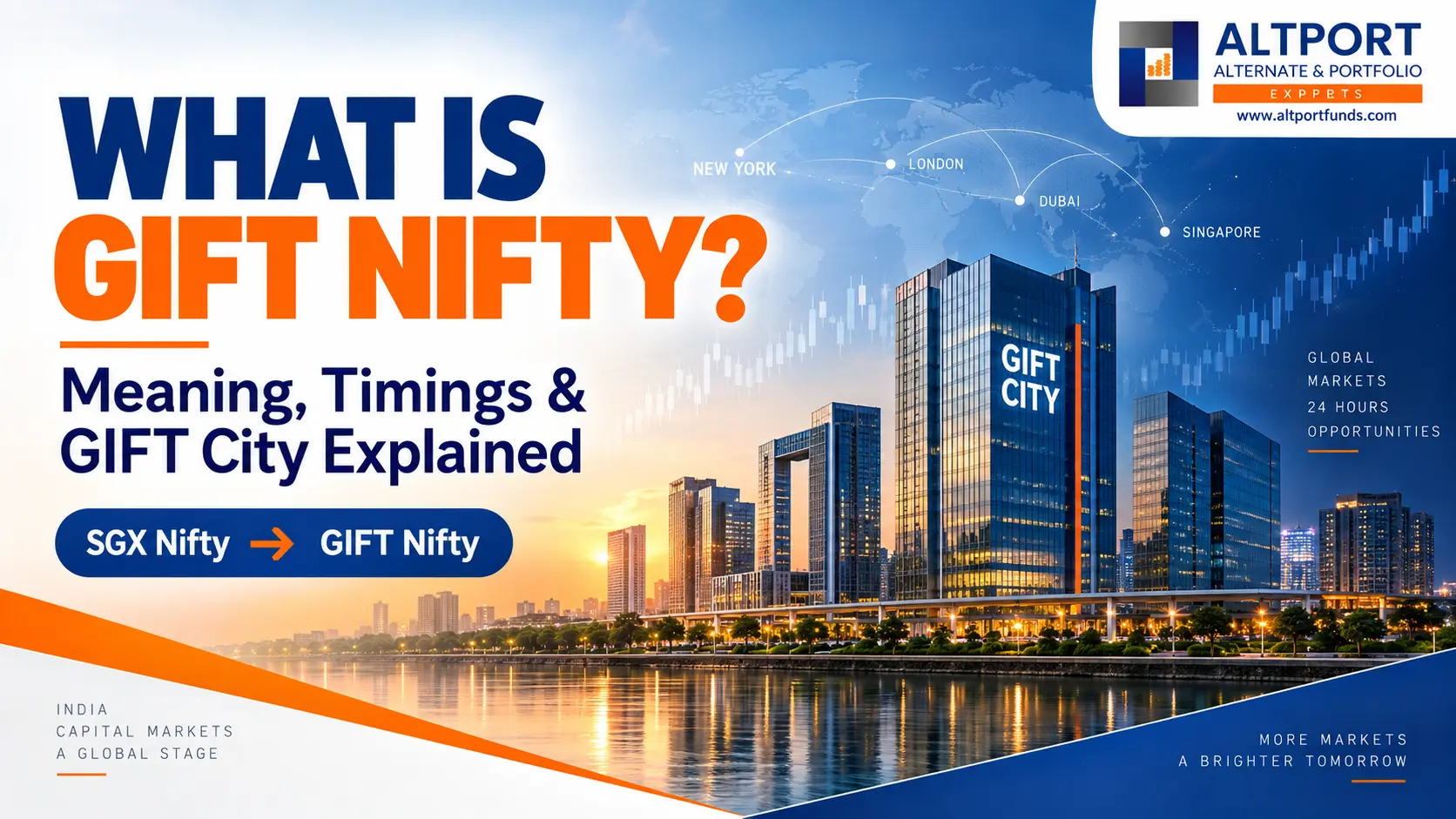
In simple terms, GIFT Nifty is a US dollar-denominated Nifty 50 futures contract traded on the NSE International Exchange (NSE IX) at GIFT City, Gujarat. It replaced the earlier SGX Nifty arrangement in July 2023 and gave international market participants a longer trading window for Nifty-linked derivatives.
For investors, understanding what is GIFT Nifty can help explain why its movement is closely watched before the Indian equity market opens. However, it is important to remember that GIFT Nifty is a derivatives contract, not the Nifty 50 index itself.
What Is GIFT Nifty?
So, what is GIFT Nifty in practical terms?
GIFT Nifty is a futures contract based on the Nifty 50 index. It is traded on NSE IX, which operates from the International Financial Services Centre (IFSC) at GIFT City in Gandhinagar, Gujarat.
The contract is denominated in US dollars and is designed to provide international investors with access to Nifty-linked derivatives through the IFSC framework.
The important point is that GIFT Nifty does not mean that the Nifty 50 index has moved to GIFT City. The Nifty 50 remains the benchmark index of the National Stock Exchange of India. GIFT Nifty is a derivative whose underlying reference is the Nifty 50.
That distinction makes understanding what is GIFT Nifty much easier.
NSE and Singapore Exchange (SGX) created the NSE IX-SGX GIFT Connect arrangement, under which orders from SGX members can be routed to NSE IX for trading and execution. The arrangement brought the trading activity associated with the earlier SGX Nifty contract into the GIFT IFSC ecosystem.
What Is the Full Form of GIFT Nifty?
The question what is GIFT Nifty often leads to another common question - what does GIFT stand for?
GIFT stands for Gujarat International Finance Tec-City.
Therefore, GIFT Nifty refers to Nifty-linked derivative contracts traded through the international financial market infrastructure located at GIFT City.
It is worth noting that GIFT City and GIFT Nifty are not interchangeable terms. GIFT City is the financial and business district, while GIFT Nifty is a specific market product traded through NSE IX.
How Does GIFT Nifty Work?
Understanding what is GIFT Nifty also requires understanding how a futures contract works.
A futures contract allows market participants to take a position on the future value of an underlying asset or index. In the case of GIFT Nifty, the underlying reference is the Nifty 50.
For example, if global markets move sharply overnight and traders expect Indian equities to open lower, GIFT Nifty may trade below the previous Nifty-related reference level. Conversely, positive global cues can push GIFT Nifty higher.
This is why GIFT Nifty is frequently used as a pre-market indicator.
However, it is not a guaranteed prediction of where the Nifty 50 will open. The actual NSE opening can be influenced by domestic news, institutional flows, currency movements, company announcements, geopolitical developments and the opening auction.
Another important point is that GIFT Nifty is traded in US dollars. It therefore provides an international trading route for Nifty derivatives rather than functioning as a normal Indian equity investment.
What Are the Trading Timings of GIFT Nifty?
One of the biggest reasons people search what is GIFT Nifty is its unusually long trading window.
GIFT Nifty operates in two sessions:
| Session | Trading time in IST |
| Session 1 | 6:30 AM to 3:40 PM |
| Break | 3:40 PM to 4:35 PM |
| Session 2 | 4:35 PM to 2:45 AM the next day |
This gives market participants roughly 21 hours of trading access on a normal trading day. Current market references continue to report these session timings.
The long trading window allows GIFT Nifty to respond to developments across Asian, European and US markets.
For Indian traders, the most watched period is often the early morning session before the NSE opens at 9:15 AM. Movements during this period can provide an indication of how global sentiment may influence the Indian market.
Trading holidays and special sessions can affect these timings, so traders should always check the latest NSE IX trading calendar before relying on a particular schedule.
Why Is GIFT Nifty Important for Investors?
Once you understand what is GIFT Nifty, its relevance becomes fairly straightforward.
1. It provides an early market signal
GIFT Nifty starts trading well before the Indian equity market opens. This allows traders to observe market sentiment following overnight developments.
2. It captures global cues
The extended trading window allows the contract to react to international developments, including US market movements, crude oil prices, interest-rate decisions and major geopolitical events.
3. It provides international access to Nifty derivatives
GIFT Nifty was designed as an international market for Nifty-linked derivatives. The NSE IX-SGX arrangement also allows international participants to access the contract through the connected market infrastructure.
4. It supports price discovery
Because trading continues outside normal Indian market hours, GIFT Nifty can incorporate information that emerges when the NSE cash market is closed.
Still, investors should not treat GIFT Nifty as a crystal ball. A positive GIFT Nifty reading does not guarantee a positive Nifty 50 opening.
GIFT Nifty vs GIFT City: What Is the Difference?
This is one of the most common areas of confusion when people ask what is GIFT Nifty.
The simplest explanation is:
- GIFT City is a financial and business hub in Gujarat.
- GIFT IFSC is the International Financial Services Centre located within GIFT City.
- NSE IX is an international exchange operating in the IFSC.
- GIFT Nifty is a Nifty-linked derivatives product traded on NSE IX.
So, GIFT City is the location and financial ecosystem. GIFT Nifty is one of the financial products operating within that ecosystem.
GIFT City hosts several types of financial activities, including banking, capital markets, fund management, insurance and other international financial services. IFSCA is the unified regulator for financial products, financial services and financial institutions operating in India's IFSC.
Why Did SGX Nifty Become GIFT Nifty?
To understand what is GIFT Nifty today, it helps to look at its history.
Before GIFT Nifty, international investors knew the product as SGX Nifty. It was traded through Singapore Exchange and provided offshore access to Nifty-linked derivatives.
On July 3, 2023, the NSE IX-SGX GIFT Connect became fully operational. The SGX Nifty trading activity was migrated to GIFT IFSC and the contracts were rechristened GIFT Nifty. SGX Nifty trading in Singapore ceased as the Nifty derivatives activity shifted to the new structure.
This was more than a name change.
The arrangement was designed to bring the trading and price discovery of Nifty derivatives into India's IFSC while retaining connectivity with international participants through Singapore.
That is why the answer to what happened to SGX Nifty is simple: SGX Nifty was replaced by GIFT Nifty as the Nifty-linked international derivatives framework shifted to NSE IX at GIFT IFSC.
Who Regulates GIFT Nifty?
Another important part of what is GIFT Nifty is understanding its regulatory framework.
GIFT Nifty trades on NSE IX in GIFT IFSC. The regulatory authority for financial markets and activities within the IFSC is the International Financial Services Centres Authority (IFSCA).
IFSCA was established in 2020 under the International Financial Services Centres Authority Act, 2019. It functions as the unified regulator for financial products, financial services and financial institutions in India's IFSC.
Therefore, when asking who regulates GIFT Nifty, the relevant regulator is IFSCA, while NSE IX provides the exchange platform on which the contracts are traded.
Who Can Trade GIFT Nifty?
GIFT Nifty is not structured like a regular NSE equity product that any Indian retail investor can simply buy through a standard domestic trading account.
Eligible participants can access GIFT Nifty through members of NSE IX, subject to the applicable rules and requirements.
According to NSE IX's FAQ, NRIs, FPIs and Eligible Foreign Investors can trade these products by becoming clients of an NSE IX trading member. NRIs do not require prior approval to trade the specified products, although the trading member has to complete the required client-code process.
This makes GIFT Nifty particularly relevant for international investors, NRIs and other eligible participants looking for access to Nifty derivatives through the IFSC.
How to Track GIFT Nifty Today
If you are trying to understand what is GIFT Nifty from a practical market-tracking perspective, you will usually see its live or delayed price displayed on financial market platforms.
When tracking it, look at:
- Current GIFT Nifty price
- Previous close
- Absolute change
- Percentage change
- Trading session
- Time of the latest update
The most useful comparison is not simply whether GIFT Nifty is "green" or "red". Look at how much it has moved relative to its previous close and consider the global market backdrop.
For example, a modest GIFT Nifty decline after a major overnight sell-off in US markets may tell a different story from a decline occurring despite broadly positive global markets.
It is also important to remember that GIFT Nifty is a futures contract. Futures prices can differ from the spot index because of factors such as time to expiry, interest rates, dividends and market positioning.
How Does GIFT Nifty Differ From Nifty 50?
If someone asks what is GIFT Nifty and whether it is the same as Nifty 50, the answer is no.
The Nifty 50 is a stock market index tracking 50 major companies listed on the National Stock Exchange of India.
GIFT Nifty, on the other hand, is a derivative contract based on the Nifty 50 and traded on NSE IX.
Here is the difference in simple terms:
| Feature | GIFT Nifty | Nifty 50 |
| What it is | Futures contract | Equity market index |
| Underlying | Nifty 50 | 50 constituent stocks |
| Trading venue | NSE IX | NSE |
| Location | GIFT IFSC, Gujarat | India |
| Currency | US dollars | Indian rupees for domestic index quotation |
| Trading hours | Around 21 hours | Regular NSE market hours |
| Primary use | Derivatives trading and global market positioning | Benchmarking and tracking Indian equities |
This distinction matters because a movement in GIFT Nifty should not be interpreted as an identical movement in the Nifty 50.
Conclusion: Understand GIFT Nifty Before You Act
GIFT Nifty has become an important part of the global trading ecosystem around Indian equities. It gives investors an extended trading window to track Nifty-linked derivatives and observe how global market movements may influence sentiment before the Indian market opens. But it should be viewed as a market indicator and derivatives instrument, not as a guaranteed prediction of Nifty 50's opening direction.
For HNIs, NRIs and investors exploring opportunities around GIFT City and IFSC, understanding the difference between GIFT Nifty, GIFT City funds, AIFs and other alternative investment routes is equally important.
At ALTPORT, investors can explore AIF, PMS, GIFT City, SIF and other alternative investment opportunities through a process-driven platform. ALTPORT provides information and access to curated investment options to help investors evaluate opportunities based on their portfolio requirements and objectives.
Looking to explore GIFT City funds or other alternative investment opportunities? Connect with ALTPORT to understand the available options and make a more informed decision.
Disclaimer
This content is provided solely for educational and informational purposes and should not be construed as investment advice, a recommendation, solicitation or an offer to buy or sell any financial product or security. GIFT Nifty and derivatives involve market risk and may not be suitable for every investor. Past performance or market indicators do not guarantee future results.
ALTPORT is an APMI-registered investment platform/distributor (APMI Registration: APRN00074) and does not guarantee or claim any returns. Information presented is for understanding and evaluation purposes only. ALTPORT does not represent or act on behalf of a product issuer or authorised channel partner unless expressly stated otherwise. Investors should independently evaluate the relevant product documents, risks, costs, taxation and eligibility requirements and consult their qualified financial, legal or tax professional where appropriate.