
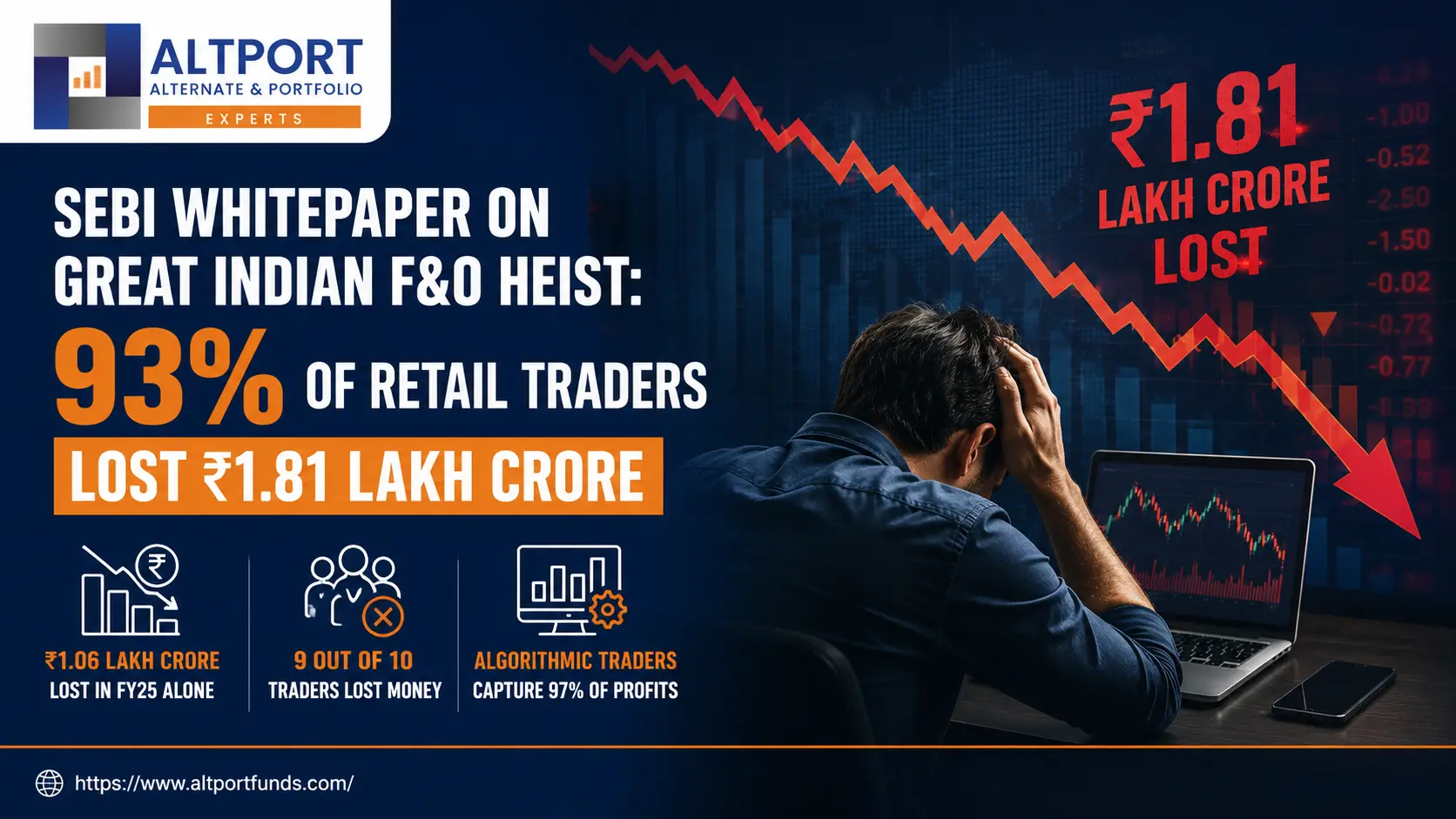
Imagine a casino where 9 out of 10 players lose money, yet they keep coming back, betting their life savings. This isn't fiction—it's India's Futures and Options (F&O) segment, where SEBI's landmark study has exposed a devastating truth: 93% of individual traders lost over ₹1.81 lakh crore in just three years, with average losses exceeding ₹2 lakh per trader.
The Staggering Scale of Losses in Futures and Options
Between FY22 and FY24, 11.3 million retail traders bled money in the equity derivatives segment. The carnage didn't stop there. In FY25 alone, retail losses surged 41% to ₹1.06 lakh crore, with 91% of traders ending the year in the red. The average per-person loss stood at ₹1.10 lakh, a figure that masks the deeper devastation faced by the worst-hit 3.5% of traders, who lost an average of ₹28 lakh each over three years.
What makes these numbers even more shocking is the demographic profile of the victims. Over 72% of loss-making traders hail from Tier-2 and Tier-3 cities, with 75% earning less than ₹5 lakh annually. These are not wealthy speculators playing with surplus capital—they are salaried workers, small business owners, and students betting their hard-earned savings on weekly options expiries.
The Algorithmic Onslaught
The data reveals a brutal reality: 97% of profits in the derivatives sector are captured by algorithmic and institutional traders, leaving retail participants at a crushing structural disadvantage. Algorithmic trading now accounts for 70% of all Futures and Options trades on the NSE, with high-frequency trading (HFT) firms executing thousands of orders per second—far beyond human capability.
While only 13% of retail traders use algorithms, 96-97% of proprietary and FPI profits come from algo-driven strategies. This creates an uneven battlefield where retail traders, armed with basic technical analysis and gut instinct, compete against AI-powered systems with millisecond execution speeds and deep liquidity access.
SEBI's Regulatory Response
Faced with what it termed a macro-economic concern, SEBI implemented sweeping reforms in 2024-25:
- Increased contract sizes to reduce leverage and speculative trading
- Restricted weekly options to one per exchange per underlying
- Raised margin requirements, mandating 50% cash-equivalent components
- Tightened qualification criteria for derivatives participation
- Enhanced risk disclosures by brokers and exchanges
Despite these measures, FY25 data shows no improvement in the percentage of loss-making traders, which remained at 91%. The reforms may have cooled the frenzy slightly, but the fundamental asymmetry between retail and algorithmic traders persists.
A Call for Radical Protection
The Futures and Options segment has become a wealth transfer mechanism from India's middle class to institutional players. With ₹1.81 lakh crore evaporating from retail hands in three years, the question is no longer whether stricter norms are needed, but whether retail participation in such a structurally skewed market should be allowed at all.
For aspiring traders in smaller cities, the message is clear: the derivatives market is not a shortcut to prosperity—it's a financial minefield where the house always wins.
Disclaimer
This article is intended solely for informational and educational purposes and should not be construed as investment, financial, legal, tax, or trading advice. The information presented is based on publicly available data, regulatory publications, and market reports believed to be reliable at the time of writing. However, accuracy, completeness, or continued validity cannot be guaranteed.
Investments in securities, including futures and options (F&O), involve substantial risk and may result in significant financial losses. Past performance is not indicative of future results, and returns are neither guaranteed nor assured. Market conditions, regulatory changes, liquidity, and other factors may materially affect investment outcomes.
Readers should conduct their own research and consult a SEBI-registered investment adviser, financial planner, tax consultant, or other qualified professional before making any investment or trading decisions. The views expressed in this article are for general awareness and should not be relied upon as the sole basis for any financial decision.
The publisher and author disclaim any liability for losses or damages arising directly or indirectly from the use of, or reliance on, the information contained in this article.