
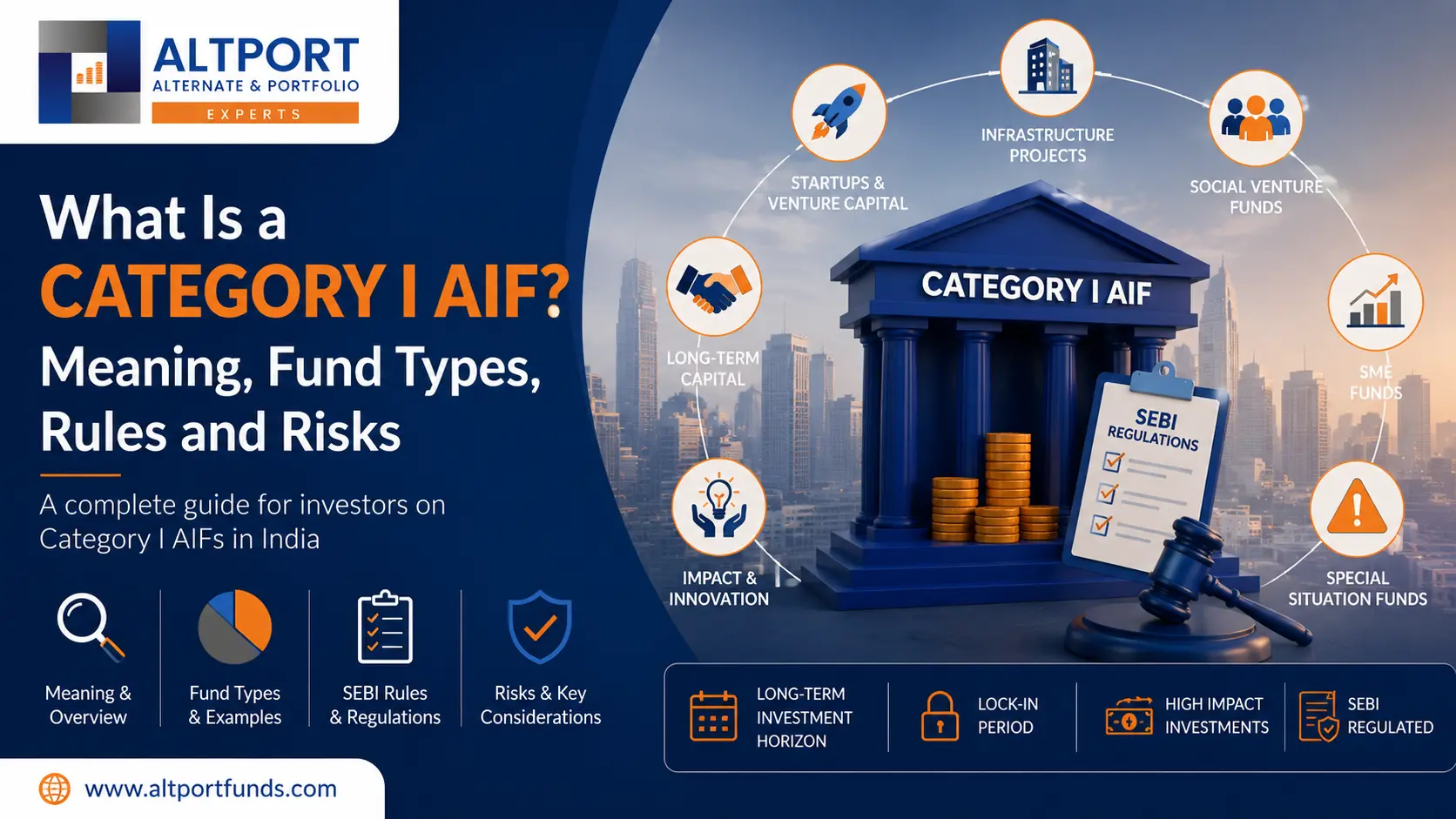
If you’ve been scanning the AIF landscape in India, Category I funds are the ones that get the most regulatory goodwill—and for good reason. They’re built to channel capital into sectors that matter for the economy: startups, SMEs, infrastructure, and even distressed assets.
Alternative Investment Funds (AIFs) are privately pooled investment vehicles regulated by SEBI. Category I AIFs sit at the top of the “policy priority” list because they invest in areas the government deems socially or economically desirable.
This guide breaks down what Category I AIFs are, how they work, where they can invest, what rules apply, and what risks and tax implications you should know—written for HNIs, family offices, and sophisticated investors evaluating this route.
What Is a Category I AIF?
A Category I alternative investment fund is a SEBI-regulated fund that primarily invests in start-ups, early-stage ventures, SMEs, infrastructure projects, social ventures, or “special situation” assets.
In simple terms: the Category I AIF meaning is investors’ pool money → the fund deploys into high-impact, early-stage or strategic assets → returns flow back to investors as per SEBI norms.
Category I AIF Examples
| Type | What it invests in | Typical minimum investment | Typical fund life / horizon | Key features & limits |
| Venture Capital Fund (VCF) | Early-stage and growth-stage startups (tech, biotech, consumer, etc.) | ₹1 crore per investor (₹25 lakh for employees/directors) | 7–10 years (close-ended) | Focus on unlisted equity/equity-linked; strong policy support; pass-through tax. |
| Angel Fund (sub-class of VCF) | Very early-stage startups; smaller cheques, diversified portfolio | ₹25 lakh per angel investor | 4–7 years typical | Designed for angel investors; faster decisions; still SEBI-regulated. |
| SME Fund | Small and medium enterprises needing growth capital | ₹1 crore | 5–8 years typical | Aims at expansion-stage SMEs; specific disclosure and lock-in norms for SME investments. |
| Infrastructure Fund | Roads, power, logistics, renewable energy, urban infra SPVs | ₹1 crore | 7–10+ years (long-cycle assets) | Invests in core infrastructure; often structured around project cashflows. |
| Social Venture Fund | Impact-driven businesses with social + financial returns | ₹1 crore | 5–8 years typical | Targets measurable social outcomes alongside returns. |
| Special Situation Fund (SSF) | Distressed assets, stressed loans, IBC resolutions, turnarounds | ₹10 crore (₹5 crore for accredited investors) | 5–7 years typical | Category I sub-category for “special situation” assets; minimum scheme corpus ₹100 crore. |
Category I AIF features
- General Category I AIF in India rule: Minimum investment is ₹1 crore per investor, with exceptions for angel funds and employees/directors (₹25 lakh).
- Fund life: Most Category I AIFs are close-ended with 7–10 year life; individual investments may have a 3-year minimum holding/lock-in.
- Leverage: Category I AIFs cannot borrow or use leverage except for temporary funding needs: up to 30 days, max 4 times/year, not more than 10% of investible funds.
How the pieces fit together
Think of Category I as a “family” of funds, each with a clear economic mandate:
- Startups and innovation → VCFs and Angel Funds.
- Growth-stage SMEs → SME Funds.
- Nation-building assets → Infrastructure Funds.
- Impact + returns → Social Venture Funds.
- Distressed opportunities → Special Situation Fund.
All share common traits: close-ended structure, high minimums, limited leverage, and pass-through taxation—making them suitable for HNIs, family offices, and sophisticated investors who can tolerate illiquidity for potentially higher alpha.
How Does a Category I AIF Work in India?
To understand the broader investment lifecycle, investors can learn how an Alternative Investment Fund works from capital commitment and drawdowns to portfolio management and exit. Category I AIFs raise capital from eligible investors (typically HNIs, family offices, corporates, NRIs) and invest in unlisted securities of target sectors. They’re usually structured as close-ended schemes with a defined life. The fund manager sources deals, conducts due diligence, negotiates terms, and manages the portfolio until exit (via IPO, strategic sale, secondary transaction, or IBC resolution in special situation fund).
What Are the Key Features of a Category I AIF?
- Policy-aligned mandate: Must invest in sectors considered economically or socially desirable.
- Close-ended structure: Typically 7–10 years, with lock-ins per investment.
- Pass-through taxation: Income is taxed in the hands of investors, not at fund level (subject to conditions).
- Leverage restrictions: Borrowing is tightly limited to short-term, temporary needs only.
- High minimums: Generally ₹1 crore per investor; ₹25 lakh for angel fund investors and employees/directors.
What Types of Funds Are Classified as Category I AIFs?
Investors can also compare the differences between Category I, II and III AIFs to understand how their strategies, leverage rules and liquidity vary. Category I includes the following sub-categories:
- Venture Capital Funds (VCFs) – early-stage and growth-stage startups.
- Angel Funds – a sub-set of VCFs with lower minimums (₹25 lakh).
- SME Funds – focused on small and medium enterprises.
- Infrastructure Funds – roads, energy, logistics, etc.
- Social Venture Funds – impact-driven investments.
- Special Situation Funds (SSFs) – distressed assets, stressed loans, IBC resolutions.
Where Can Category I AIFs Invest?
Category I AIFs primarily invest in:
- Unlisted equity or equity-linked instruments of start-ups, SMEs, infrastructure SPVs, and social ventures.
- Units of other AIFs in the same sub-category (cross-investment allowed within limits).
- Special situation assets (for SSFs), including stressed loans and assets under IBC.
They cannot invest in listed securities as a primary Category I AIF investment strategy, and FoF structures are restricted for Category I.
What Investment Rules Apply to Category I AIFs?
Key SEBI-mandated Category I AIF investment rules include:
- Minimum corpus: ₹20 crore for most AIFs; ₹5 crore for angel funds.
- Minimum investment: ₹1 crore per investor (₹25 lakh for angel funds and employees/directors).
- Concentration: At least 2/3 of investible funds must go into unlisted securities of the target sector.
- SME lock-in: Specific disclosure and lock-in obligations apply for SME investments.
- SSF specifics: Minimum scheme corpus of ₹100 crore; minimum investment of ₹10 crore (₹5 crore for accredited investors).
Can Category I AIFs Use Leverage or Borrow Money?
No, not in the typical sense. Category I AIFs cannot borrow or use leverage except for temporary funding needs: up to 30 days, not more than 4 times a year, and not exceeding 10% of investible funds.
This keeps the structure clean and aligned with the policy intent of long-term, equity-like capital.
What Is the Tenure of a Category I AIF?
Most Category I AIF tenure is close-ended with a typical life of 7–10 years, including any extensions approved by investors.
Individual investments often carry a minimum holding period (e.g., 3 years), and exits are planned via IPOs, strategic sales, or secondary transactions.
Who May Consider a Category I AIF?
Category I AIFs suit:
- HNIs and UHNIs seeking high-growth, early-stage exposure.
- Family offices and corporates looking for strategic or impact-aligned allocations.
- NRIs (subject to FEMA and fund-specific eligibility).
- Accredited investors comfortable with long lock-ins and illiquidity.
What Are the Benefits of Investing in a Category I AIF?
- Policy tailwinds: Government considers these sectors desirable; some sub-types get incentives.
- Pass-through tax: Fund-level tax is avoided; income taxed in investors’ hands as per asset class.
- Early-stage alpha: Potential for outsized returns from startups, infra, or distressed turnarounds.
- Founder-friendly: VC and angel structures often align with long-term value creation.
What Are the Key Risks of a Category I AIF?
- Illiquidity: Close-ended, long lock-ins; no easy exit before maturity.
- Execution risk: Returns depend on successful exits (IPO, M&A, IBC resolution).
- Concentration risk: Heavy exposure to unlisted, early-stage, or stressed assets.
- Valuation uncertainty: Unlisted securities can be hard to value transparently.
How Is a Category I AIF Taxed?
Category I AIFs enjoy pass-through status under Section 115UB: the fund doesn’t pay tax on investment income; investors are taxed based on the nature of income and their investor type. For a more detailed explanation of pass-through treatment, capital gains and business income, read the guide to AIF taxation in India.
- Capital gains: Taxed in the hands of investors (LTCG/STCG rules apply; for unlisted securities, LTCG often after 24 months).
- Business income: If classified as business income, taxed at investor’s slab.
- Budget 2025 clarity: From AY 2026–27, securities held by Category I/II AIFs are treated as capital assets, so gains are taxed under “capital gains” head.
How to Invest in a Category I AIF — Step-by-Step
- Check eligibility: Confirm you meet minimum investment (₹1 crore or ₹25 lakh for angel funds/employees).
- Review PPM: Read the Private Placement Memorandum for strategy, fees, lock-in, and risk factors.
- KYC and documentation: Complete KYC, AML, and subscription documents.
- Commit capital: Sign the commitment letter; funds are called as per drawdown schedule.
- Hold and monitor: Track portfolio updates; plan for exits as per fund life.
Conclusion
Category I AIFs are India’s most regulator-friendly vehicle for channeling capital into startups, SMEs, infrastructure, and special situations. They offer pass-through tax, policy alignment, and the potential for high alpha—but demand comfort with illiquidity, long tenures, and execution risk. Eligible investors can explore Category I AIF funds and compare their strategies, terms and risk considerations before proceeding.
About ALTPORT
ALTPORT is a platform simplifying access to high-quality alternative investments for sophisticated investors in India. Explore strategies, compare funds, and get expert guidance at our website.
Disclaimer
This article is for information purposes only. It does not constitute investment advice, consultation, or a recommendation to buy/sell any security or fund. Returns are not guaranteed. Past performance is not indicative of future results. Please consult a qualified financial advisor and read the scheme’s PPM before investing.