
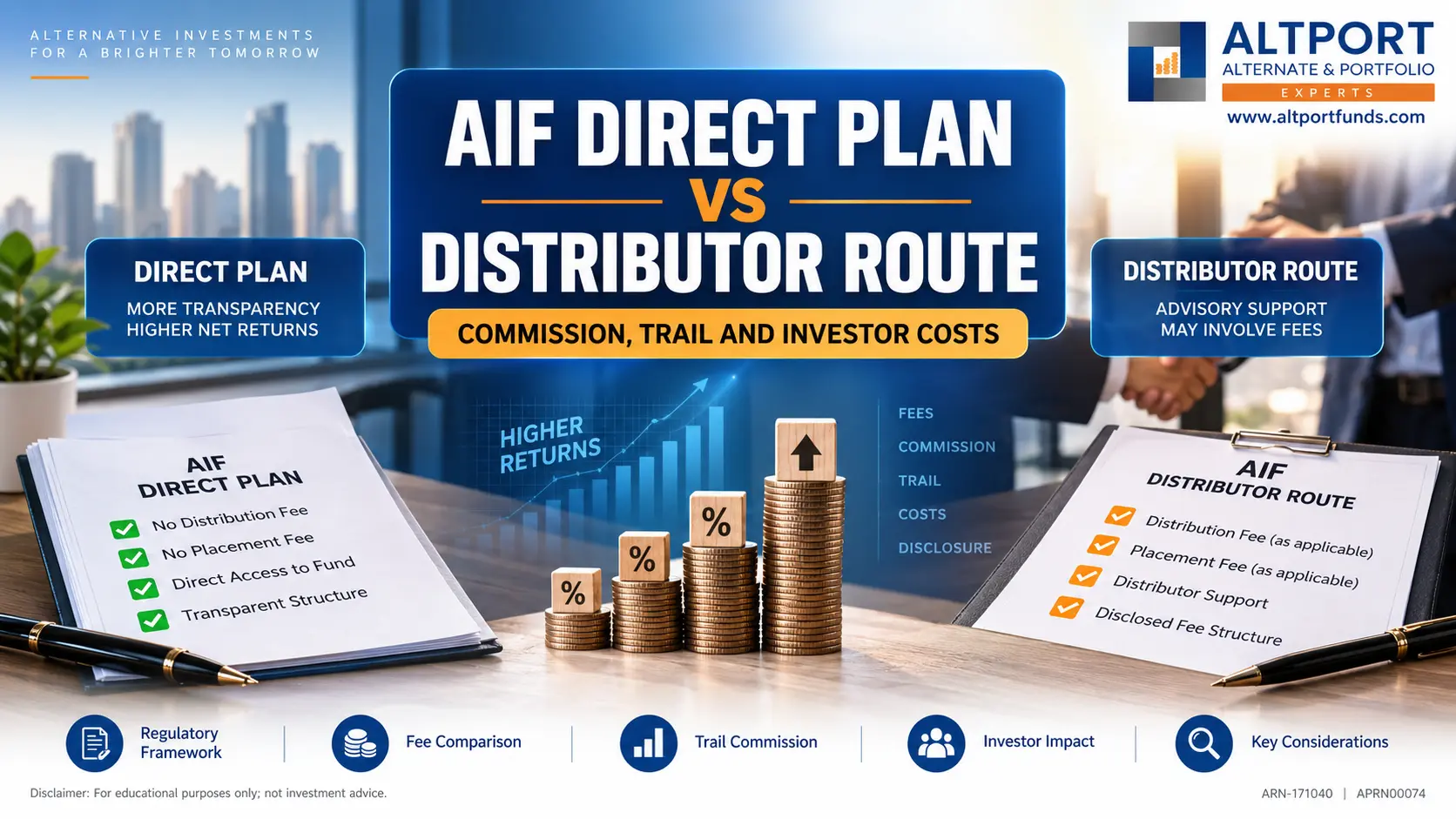
AIF direct plan vs distributor is an important cost and transparency question for investors considering an Alternative Investment Fund in India.
An AIF can generally be accessed through a distributor or through the fund's direct plan. The difference is not simply about who completes the paperwork. It can affect distribution fees, placement fees, commission arrangements, investor-level costs and, over a long holding period, the amount of return retained by the investor.
SEBI's framework now requires schemes of AIFs to offer a Direct Plan and establishes specific rules for distribution and placement fees. The current SEBI Master Circular for AIFs states that a Direct Plan cannot entail a distribution fee or placement fee. It also requires certain investors approaching an AIF through a SEBI-registered intermediary that separately charges them a fee to be onboarded through the Direct Plan.
That makes understanding AIF direct plan vs distributor especially relevant before signing the contribution agreement or committing capital.
This guide explains how the two routes work, how AIF distributor commission and trail arrangements operate, where costs should be disclosed and what investors should check in the PPM.
AIF Direct Plan vs Distributor Route: Key Differences
The basic distinction is straightforward.
Under a direct AIF investment, the investor approaches the AIF or its manager without routing the investment through a distributor for distribution-related services. The Direct Plan does not carry a distribution fee or placement fee.
Under the AIF distributor route, an intermediary may facilitate access, explain fund documentation, assist with onboarding and provide other distribution-related services. Where applicable, a distribution or placement fee can be charged, subject to SEBI's disclosure and trail requirements.
| Factor | Direct Plan | Distributor Route |
| Distribution fee | Not applicable under the Direct Plan | May apply if permitted and disclosed |
| Placement fee | Not applicable under the Direct Plan | May apply if permitted and disclosed |
| Distributor involvement | No distribution intermediary required | Distributor involved |
| Investor support | Investor handles the process directly or through permitted services | Distributor may assist with onboarding and documentation |
| Commission | No distribution commission attached to the Direct Plan | May be paid subject to applicable rules |
| Disclosure | Direct-plan structure and fees disclosed in scheme documents | Distribution/placement fee must be disclosed at onboarding |
| Return impact | Avoids distribution-related cost | Distribution cost can reduce net economics |
Therefore, AIF direct plan vs distributor should be evaluated alongside the actual fee structure rather than simply by looking at whether a distributor is involved.
Why Did SEBI Introduce the AIF Direct Plan?
SEBI introduced the framework to provide investors with greater flexibility, improve transparency around expenses and reduce potential mis-selling concerns.
The April 2023 SEBI circular mandated the Direct Plan option for AIF schemes and introduced the trail model for distribution commission. SEBI's consultation paper had highlighted a concern that investors using an Investment Adviser or Portfolio Manager could potentially bear both the intermediary's fee and an AIF distribution fee. Check out our Top AIF Funds here!
The current framework addresses this by requiring:
- A Direct Plan option for AIF schemes.
- No distribution or placement fee under the Direct Plan.
- Disclosure of distribution or placement fees at onboarding.
- Equal trail treatment for Category III AIF distribution fees.
- A defined upfront and trail structure for Category I and Category II AIFs.
For investors, this makes AIF direct plan vs distributor a regulatory and cost-comparison issue, not merely a choice between two onboarding channels.
Does Every AIF Scheme Have to Offer a Direct Plan?
Yes. Under the current SEBI AIF Master Circular, schemes of AIFs shall have an option of Direct Plan for investors.
The Direct Plan cannot entail a distribution fee or placement fee.
However, the existence of a Direct Plan does not mean every investor must independently manage every aspect of the investment process. Investors can still receive permitted services from intermediaries, subject to the applicable regulatory framework and the way those intermediaries charge their fees.
The key point is that the Direct Plan itself cannot carry a distribution or placement fee.
This distinction matters when evaluating AIF direct plan vs distributor, because the investor should identify whether a separate intermediary fee exists and whether that fee is distinct from the AIF's distribution-related expenses.
Who Must Be Onboarded Through the Direct Plan?
SEBI specifically requires AIFs to onboard investors through the Direct Plan when those investors approach the AIF through a SEBI-registered intermediary that separately charges the investor a fee, such as an advisory fee or portfolio management fee.
For example, consider an investor who works with a SEBI-registered Investment Adviser and pays that adviser a separate advisory fee. If the investor approaches the AIF through that intermediary, the AIF should onboard the investor through its Direct Plan.
This rule is relevant to the distinction between an AIF distributor vs investment adviser.
A distributor's role may involve facilitating the AIF investment and receiving permitted distribution compensation. An Investment Adviser operates under a different regulatory framework and may charge the investor an advisory fee.
The investor should therefore identify:
- Who is the intermediary?
- What regulatory registration does the intermediary hold?
- Is the intermediary charging a separate fee?
- Is that fee paid by the investor directly?
- Is a distribution or placement fee also applicable to the AIF investment?
These questions can make the economics of AIF direct plan vs distributor much clearer.
What Distribution or Placement Fees Apply Through a Distributor?
An AIF may have distribution or placement-related costs where permitted under the applicable framework and disclosed in the scheme documents.
Terms such as AIF distribution commission, AIF distribution fee, AIF placement fee, AIF intermediary fee and AIF PPM distribution fee may appear in the fund's documentation.
The terminology can vary, so investors should not assume that different labels necessarily represent different economic costs.
The important questions are:
- What is the total distribution or placement fee?
- Who pays it?
- Is it charged directly or indirectly?
- Is it paid upfront, through trail payments or both?
- Is it borne by the investor or paid from management fees?
- How does the arrangement affect the investor's net return?
- Is the amount clearly disclosed in the PPM?
SEBI requires the distribution fee or placement fee, if any, to be disclosed to investors at onboarding irrespective of the manner in which the fee is charged.
What Is Trail Commission in an AIF?
AIF trail commission refers to distribution compensation paid over time rather than entirely at the beginning of the investment relationship.
SEBI's trail model is intended to align distribution compensation with the tenure of the investment.
The rules differ by AIF category.
For Category III AIFs, any distribution or placement fee must be charged only on an equal trail basis. Category III AIFs cannot charge investors an upfront distribution or placement fee directly or indirectly. Further, any distribution fee or placement fee paid must come only from the management fee received by the Category III AIF manager.
For Category I and Category II AIFs, up to one-third of the total distribution or placement fee can be paid upfront, with the remaining amount paid on an equal trail basis over the tenure of the fund.
Therefore, AIF direct plan vs distributor involves more than comparing a headline fee. Investors should understand the timing and source of the distribution compensation as well.
Can an AIF Distributor Receive an Upfront Commission?
Yes, but the rules depend on the AIF category.
For Category I and Category II AIFs, the current SEBI framework permits up to one-third of the total distribution or placement fee to be paid to distributors on an upfront basis. The remaining distribution or placement fee is to be paid on an equal trail basis over the tenure of the fund.
This means the concept of an AIF upfront commission is not prohibited across all AIF categories.
However, Category III AIFs are treated differently. Their distribution or placement fee, if any, must be on an equal trail basis, with no upfront distribution or placement fee charged directly or indirectly to investors.
Investors should therefore avoid applying mutual fund commission rules mechanically to AIFs.
How Do Commission Rules Differ for Category I and II AIFs?
Category I and Category II AIFs have a specific flexibility under the SEBI trail model.
They may pay:
- Up to one-third of the total distribution or placement fee upfront.
- The remaining distribution or placement fee on an equal trail basis.
- The trail component over the tenure of the fund.
This means Category I AIF distributor commission and Category II AIF distributor commission can include an upfront component, subject to the one-third limit prescribed by SEBI.
For example, if a hypothetical scheme has a total permitted distribution fee of ₹9 lakh for an investor relationship, up to ₹3 lakh could be paid upfront under the one-third rule, with the balance ₹6 lakh paid on an equal trail basis over the fund tenure.
This is only an illustration. The actual fee depends on the AIF's disclosed arrangement and scheme documentation.
For investors comparing AIF direct plan vs distributor, the key issue is whether such costs are actually applicable to their investment and how they are reflected in the net economics.
How Do Commission Rules Differ for Category III AIFs?
Category III AIFs have a stricter trail requirement.
SEBI states that Category III AIFs may charge distribution or placement fees, if any, to investors only on an equal trail basis. There can be no upfront distribution or placement fee charged directly or indirectly to investors. SEBI also specifies that any distribution or placement fee paid must come only from the management fee received by the Category III AIF manager.
Therefore, Category III AIF trail commission cannot be structured in the same way as the Category I and Category II model.
The practical takeaway is simple: always identify the AIF category before interpreting its commission structure.
A statement such as "the distributor gets an upfront fee" is incomplete without knowing whether the investment is in Category I, II or III.
Where Must Distribution and Placement Fees Be Disclosed?
Distribution and placement fees should not be treated as a hidden cost.
SEBI's AIF framework requires the distribution fee or placement fee, if any, to be disclosed to investors at onboarding, irrespective of how the fee is charged. The PPM templates also provide for disclosure of the Direct Plan and the constituents of fees that may be charged by the AIF or scheme, including distribution and placement fees.
This is why the PPM should be one of the first documents reviewed when assessing AIF direct plan vs distributor.
Look for sections covering:
- Management fees
- Performance fees or carried interest
- Distribution fee
- Placement fee
- Other expenses
- Investor-level charges
- GST or applicable taxes
- Exit-related costs
- Distribution arrangements
- Direct Plan terms
The AIF commission disclosure should be sufficiently clear for the investor to understand what is being charged and how it is paid.
How Do Distribution Charges Affect Investor Returns?
Any cost associated with distribution can reduce the amount of return ultimately retained by the investor.
Suppose two otherwise identical investments generate the same gross portfolio performance. If one route involves an additional distribution-related cost and the other does not, the investor's net outcome can differ.
The effect becomes more important over long investment periods because recurring or trail-based costs can compound over time.
This is also why investors should not look only at the fund's gross performance when comparing AIF direct plan vs distributor.
Consider:
Gross investment return - management and operating expenses - applicable distribution-related costs = investor's net return before taxes and other investor-specific costs
The actual calculation will depend on the AIF's fee structure, valuation methodology, timing of charges, distributions and other expenses.
Does a Direct Plan Always Produce a Higher Net Return?
No.
A Direct Plan eliminates distribution and placement fees applicable to the distributor route, but that does not automatically mean that every investor will earn a higher net return.
Investment performance depends on the underlying portfolio, strategy, market conditions, expenses, taxation, timing of cash flows and other factors.
A Direct Plan may have lower distribution-related costs, but it does not change the underlying investment strategy simply because the investor has selected that route.
Therefore, AIF direct plan returns should not be presented as guaranteed to be higher.
Similarly, direct vs regular AIF returns should be compared using actual disclosed costs and comparable periods rather than assuming that the Direct Plan will outperform.
The correct comparison is generally:
Same scheme or strategy + same gross performance assumptions + different applicable costs = potential difference in net outcome
What Services May an AIF Distributor Provide?
A distributor may provide a range of administrative and distribution-related services, depending on the arrangement.
These can include:
- Explaining the fund's basic structure and process
- Coordinating application documentation
- Helping investors understand onboarding requirements
- Assisting with KYC-related coordination
- Coordinating communication with the AIF manager or fund administrator
- Sharing scheme documentation
- Helping with operational follow-ups
- Supporting subscription and capital-call processes where relevant
- Providing ongoing communication about the investment
These AIF distributor services can be valuable for investors who prefer operational support.
However, distribution support should not automatically be treated as investment advice.
Investors should distinguish between distribution, execution, administrative assistance and regulated investment advisory services.
This distinction becomes particularly important when evaluating AIF direct plan vs distributor alongside an Investment Adviser relationship.
What Responsibilities Remain with a Direct-Plan Investor?
Choosing a Direct Plan does not remove the investor's due-diligence responsibilities.
A direct investor should still review:
- The PPM
- Contribution agreement
- Fee structure
- Investment strategy
- Risk factors
- Lock-in and exit provisions
- Redemption or withdrawal provisions
- Valuation methodology
- Performance fee structure
- Conflict-of-interest disclosures
- Related-party transactions
- Tax considerations
- Capital-call terms, where applicable
- Reporting arrangements
The Direct Plan removes distribution or placement fees from the Direct Plan itself. It does not remove investment risk or the need to understand the AIF.
Investors should also not confuse lower distribution costs with lower investment risk.
How Does AIF Onboarding Differ Between the Two Routes?
The broad investment process can be similar, but the point of interaction differs.
Direct AIF onboarding
The investor typically engages directly with the AIF manager, fund team or permitted platform and completes the required documentation.
The process can include:
- Selecting the AIF scheme.
- Reviewing the PPM and related documents.
- Completing KYC and other eligibility checks.
- Completing application and contribution documentation.
- Transferring the required commitment or contribution.
- Completing ongoing compliance and reporting requirements.
Distributor-led onboarding
The investor works with the distributor as an intermediary during the process.
The distributor may assist with documentation and coordination before the investor completes the formal investment process with the AIF.
Importantly, AIF direct onboarding does not mean the investor bypasses KYC, eligibility checks or fund documentation.
The regulatory and documentation requirements still apply.
Can an Existing Investor Switch to the Direct Plan?
Potentially, but investors should not assume that a switch is automatic.
The process depends on the AIF scheme, its documentation, the existing arrangement and the operational mechanism offered by the manager.
An investor considering whether to switch AIF investment to direct plan should ask the AIF manager:
- Is a route change permitted?
- Does the investor need to submit a fresh request?
- Will the existing units or commitment continue under the same terms?
- Will any exit, transfer or administrative cost apply?
- What happens to existing distributor compensation?
- From what date will Direct Plan treatment apply?
- Will the change affect the investor's documentation?
The investor should obtain the answer in writing rather than assuming that moving from a distributor to the Direct Plan automatically changes every existing fee arrangement.
Direct Plan vs Distributor Route: Worked Cost Example
Consider a hypothetical AIF investment of ₹1 crore.
Assume:
- Gross portfolio return: 12%
- Other applicable costs: ignored for simplicity
- Distributor-related cost under the distributor route: 1% for illustration
- Direct Plan distribution cost: 0%
The simplified first-year illustration would look like this:
| Particular | Direct Plan | Distributor Route |
| Initial investment | ₹1 crore | ₹1 crore |
| Gross return at 12% | ₹12 lakh | ₹12 lakh |
| Illustrative distribution cost | ₹0 | ₹1 lakh |
| Return after this cost | ₹12 lakh | ₹11 lakh |
This is not a representation of actual AIF pricing. It is simply an illustration of how a distribution-related cost can affect investor economics.
Actual AIF fees may be calculated differently, and the timing of charges can materially affect the outcome.
For example, a trail arrangement may create costs over multiple years rather than as a single first-year deduction.
This is why AIF direct plan vs distributor should be evaluated using the actual fee schedule rather than a generic assumed percentage.
What Should Investors Check in the PPM and Contribution Agreement?
The PPM is one of the most important documents for understanding an AIF's economics.
Before investing, check the following:
1. Management fee
Understand the percentage, calculation methodology and frequency.
2. Performance fee
Check the hurdle rate, catch-up provisions, crystallisation mechanism and high-water mark, where applicable.
3. Distribution fee
Look specifically for any AIF distribution expenses.
4. Placement fee
Check whether an AIF placement fee applies and how it is calculated.
5. Trail arrangement
Identify whether an AIF trail commission is applicable and for how long.
6. Direct Plan fee structure
Review the AIF direct plan fees and confirm that distribution and placement fees are not charged under the Direct Plan.
7. Investor-level charges
Check whether there are costs outside the scheme-level expenses.
8. Platform costs
If investing through an online or wealth platform, check any AIF investment platform fees separately.
9. Tax and statutory costs
Understand applicable taxes, stamp duty and other statutory charges.
10. Exit-related costs
Review exit charges, transfer fees and other costs applicable when leaving or transferring an investment.
A detailed review is particularly important because AIF direct plan vs distributor is not simply a comparison between "zero fee" and "commission". The Direct Plan eliminates distribution and placement fees, but other AIF expenses can still apply.
Questions to Ask an AIF Distributor Before Investing
Before choosing to invest in AIF through distributor, ask the distributor for clear answers to these questions:
- What is the total distribution or placement fee?
- Is the fee paid upfront, through trail, or both?
- What percentage is paid upfront?
- What percentage is paid as trail?
- Who ultimately bears the cost?
- Is the fee already disclosed in the PPM?
- Is the distributor receiving any other compensation?
- Are there separate investor-level charges?
- Does the distributor provide only distribution support or regulated advisory services?
- What would my costs look like under the Direct Plan?
- Is the Direct Plan available for the same scheme?
- Would selecting the Direct Plan change any non-distribution fees?
- Are there any AIF distributor fees outside the disclosed distribution arrangement?
- Can the fee structure change during the fund tenure?
A distributor should be able to explain the economics clearly enough for the investor to compare both routes.
Which Route May Suit Different Types of Investors?
There is no single route that fits every investor.
Direct Plan may be relevant for investors who:
- Are comfortable conducting their own fund comparison.
- Can independently review the PPM.
- Understand AIF fee structures.
- Do not require distribution support.
- Want to avoid distribution or placement fees.
- Already work with a separately paid SEBI-registered intermediary where the Direct Plan requirement applies.
Distributor route may be relevant for investors who:
- Prefer assistance with onboarding.
- Want operational support.
- Need help coordinating documentation.
- Prefer having an intermediary as a point of contact.
- Value ongoing distribution-related support and understand its cost.
The decision should be based on the services required and the actual fee structure.
The key point in AIF direct plan vs distributor is not that one route is universally suitable for everyone. It is that investors should understand what they are paying for and compare the net cost before committing capital.
Conclusion
Understanding AIF direct plan vs distributor is ultimately about understanding what you are paying, what services you receive and how those costs may affect your investment economics.
A Direct Plan removes distribution and placement fees, while a distributor route may provide additional onboarding and ongoing distribution support for a disclosed cost. The right comparison should therefore go beyond the headline commission and include management fees, performance fees, other expenses, platform charges, service levels and the terms specified in the PPM.
If you are evaluating AIFs, ALTPORT can help you explore available investment opportunities and compare fund information in one place. Use the platform to research AIF strategies, review relevant fund details and make a more informed portfolio selection based on your own investment requirements.
Explore AIF opportunities with ALTPORT and evaluate the available options before making your investment decision.
Disclaimer: The information provided in this article is for educational and informational purposes only and should not be construed as investment, legal, tax or financial advice. ALTPORT is an APMI-registered investment platform/distributor and is not SEBI-registered as an investment adviser. ALTPORT does not advise, suggest or advertise any investment product and does not guarantee or make any claim regarding returns or investment outcomes. Investments in AIFs involve market, liquidity, credit, concentration and other risks, and investors should independently review the PPM, contribution agreement, fee structure and applicable disclosures before investing. ALTPORT is not a chartered accountant and does not provide tax advice. ALTPORT does not represent the product issuer or act as an authorised channel partner unless specifically stated. Investors should consult appropriately qualified professionals for independent legal, tax or financial advice wherever required.