
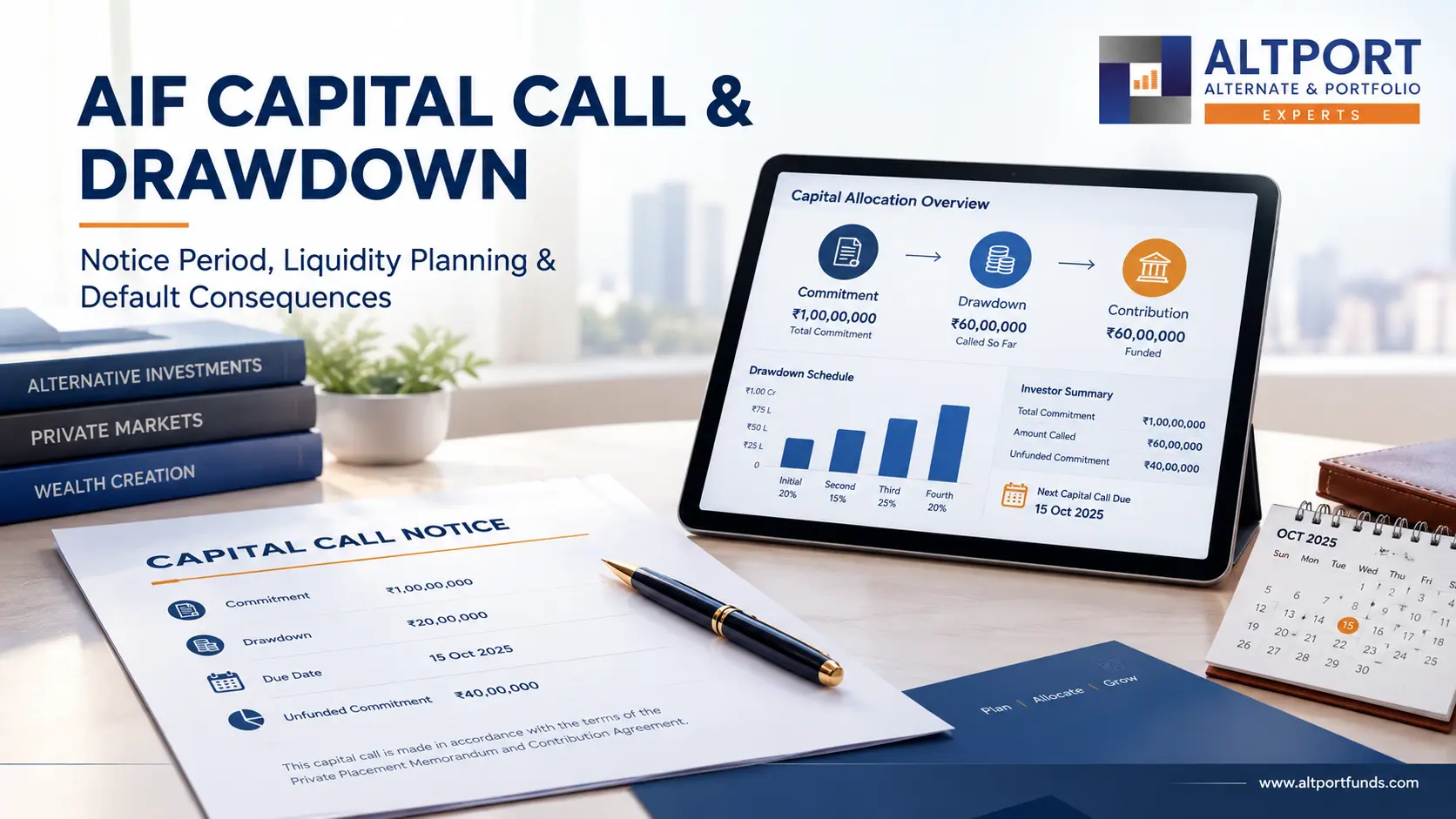
An Alternative Investment Fund (AIF) does not always require an investor to transfer the entire committed amount on day one. In many closed-ended AIF structures, investors make a commitment and the fund calls that commitment progressively as investments and expenses require funding.
This is where an AIF capital call becomes important.
For an investor, understanding the timing, calculation and consequences of each call is just as important as evaluating the investment strategy itself. A commitment that looks manageable on paper can create liquidity pressure if multiple calls arrive close together.
SEBI's current AIF framework recognises drawdown-based structures, while the specific mechanics are generally governed by the fund's Private Placement Memorandum (PPM), contribution agreement and other fund documents. SEBI's master circular also requires disclosures around defaulting investors and actions that may be taken against them.
What Is a Capital Commitment in an AIF?
An AIF capital commitment is the amount an investor agrees to contribute to an AIF, subject to the terms of the fund documents.
For example, an investor may commit ₹1 crore to a Category II AIF. The investor does not necessarily transfer ₹1 crore immediately. Instead, the manager may request portions of the commitment over the investment period.
The amount actually contributed at any point is the capital contribution in AIF, while the remaining amount represents the investor's obligation to fund future calls, subject to the applicable documents.
This distinction matters because an investor should not treat the unfunded portion of an AIF commitment as completely available cash.
What Is a Capital Call or Drawdown?
An AIF capital call is a formal request from the AIF to an investor to contribute a specified portion of their committed capital.
An AIF drawdown refers to the actual amount of the investor's commitment that the fund calls and collects.
In simple terms:
Commitment → Capital call/drawdown request → Investor payment → Capital contribution
The capital call in AIF is therefore not usually a fresh investment decision each time. It is the mechanism through which an existing commitment is funded.
Capital Call vs Drawdown: Is There a Difference?
The terms are often used interchangeably, but there can be a practical distinction.
| Term | Meaning |
| AIF capital commitment | Total amount the investor has agreed to provide |
| Capital call | Request made by the fund for part of that commitment |
| AIF drawdown | Amount called from the investor |
| Capital contribution | Amount actually paid into the fund |
| Unfunded commitment | Portion of the commitment still available to be called |
Therefore, capital call vs drawdown is often more about terminology than a fundamentally different payment mechanism. Always follow the terminology used in the relevant PPM and contribution agreement.
How Does the AIF Capital Call Process Work?
The AIF capital call process generally follows these steps:
- The manager identifies a funding requirement.
- The fund determines the amount to be called from each investor.
- An AIF drawdown notice or capital call notice is issued.
- The notice specifies the amount, payment deadline and bank/payment instructions.
- The investor transfers the required amount.
- The fund records the contribution against the investor's commitment.
The exact procedure can vary by fund. The PPM and contribution agreement should therefore take priority over generic descriptions of how an AIF works.
Why Do AIF Managers Draw Capital in Stages?
Staged funding allows an AIF to deploy capital closer to when it is required instead of holding the entire committed corpus in cash.
This can be particularly relevant for private equity, private credit, venture capital and real asset strategies where investments may be made over an extended period.
A staggered AIF capital call can also help align investor funding with the fund's investment pipeline. However, it means investors must maintain liquidity for future obligations.
What Information Does an AIF Drawdown Notice Contain?
An AIF drawdown notice or capital call notice generally provides information such as:
- Amount being called
- Investor's remaining commitment
- Payment due date
- Bank account and payment instructions
- Purpose or nature of the call, where disclosed
- Applicable contribution or unit details
- Consequences of delayed payment, where applicable
The exact contents depend on the fund documentation.
Investors should read every capital call notice carefully rather than relying only on an expected AIF drawdown schedule, because actual calls may depend on investment opportunities, expenses and fund-level requirements.
How Is the Drawdown Amount Calculated?
The calculation depends on the fund's structure and the terms agreed with investors.
For example, if an investor commits ₹1 crore and the fund calls 20%, the investor may be required to contribute ₹20 lakh.
The manager may calculate calls pro rata across investors, subject to the applicable fund documents and unit class terms.
An initial drawdown AIF amount could be followed by several subsequent calls. There is no universal requirement that every AIF must follow an identical percentage or schedule.
What Is an Unfunded Commitment?
An unfunded commitment AIF amount is the portion of the investor's total commitment that has not yet been called and paid.
Suppose:
- Total commitment: ₹1 crore
- Amount already contributed: ₹40 lakh
- Unfunded commitment: ₹60 lakh
The ₹60 lakh should be considered a potential future liquidity requirement, not surplus cash.
How Much Notice Does an Investor Receive Before Payment Is Due?
There is no single universal capital call notice period that investors should assume applies to every AIF.
The applicable period should be checked in the PPM, contribution agreement and other fund documents. Some funds may provide a defined number of business days, while the timing can vary depending on the structure and circumstances.
Therefore, investors should not plan liquidity based on an assumed industry-wide notice period.
The AIF drawdown notice should be treated as the operative communication for the particular call.
Capital Call Example: ₹1 Crore Commitment with Staggered Drawdowns
Consider an investor with a ₹1 crore commitment.
A possible capital call example could look like this:
- Initial drawdown: ₹20 lakh
- Second drawdown: ₹15 lakh
- Third drawdown: ₹25 lakh
- Fourth drawdown: ₹20 lakh
- Remaining commitment: ₹20 lakh
The investor has contributed ₹80 lakh but remains contractually committed to the remaining ₹20 lakh, subject to the fund documents.
This is why an AIF capital call should be incorporated into financial planning before committing to the fund.
What Happens If an Investor Misses a Capital Call?
Missing an AIF capital call can be more serious than simply paying a bill late.
The consequences depend on the fund's contractual terms. SEBI's disclosure framework specifically contemplates provisions under which a defaulter may be prevented from participating in subsequent investments until the default is cured, along with other steps against the defaulting investor.
Possible AIF default consequences can include:
- Default interest
- Restrictions on future participation
- Recovery of costs
- Transfer or sale of units
- Dilution of economic interest
- Suspension of voting rights
- Forfeiture or cancellation of units
- Other contractual or legal remedies
These consequences are not automatically identical across every AIF.
Default Interest, Dilution, Suspension and Forfeiture Clauses
The capital call default provisions should be reviewed before investing.
A fund's documents may specify late payment interest AIF terms if the investor does not pay within the stipulated period.
Similarly, dilution of investor interest AIF provisions may reduce an investor's economic participation following a default, depending on the contractual mechanism.
Some agreements can also provide for forfeiture of AIF units or cancellation of units after specified default events. SEBI enforcement material has documented AIF cases involving PPM provisions covering forfeiture, interest and sale of units following investor defaults.
A suspension of voting rights AIF clause may also restrict the rights of a defaulting investor.
The important point is simple: these are document-specific consequences. An investor should not assume that every AIF applies the same remedy.
Can an AIF Borrow to Cover a Drawdown Shortfall?
For Category I and Category II AIFs, borrowing is generally restricted, but SEBI has provided a specific framework allowing borrowing to meet a temporary shortfall in amounts called from investors for investments.
Under the current framework, such borrowing is subject to conditions including disclosure in the PPM, use only as an emergency last resort, prescribed limits and charging the borrowing cost to investors who failed to provide the required drawdown.
Therefore, Category I AIF drawdown and Category II AIF drawdown should not be interpreted as allowing unrestricted fund-level borrowing.
A fund cannot simply use borrowing as a substitute for timely investor contributions.
How Capital Calls Affect Cash-Flow Planning and the J-Curve
An AIF capital call can affect an investor's liquidity even when the overall investment thesis remains unchanged.
This is particularly important during the capital call and J curve phase. Private market funds may initially show expenses, deployment costs and limited distributions before investments mature and begin generating exits or income.
Investors should therefore consider:
- Expected commitment
- Amount already funded
- Potential future calls
- Investment horizon
- Other illiquid investments
- Emergency liquidity requirements
- Expected distributions
The objective is not merely to have enough money for the next call. It is to avoid being forced to liquidate other assets at an inconvenient time.
How Should Investors Prepare for Future Drawdowns?
A practical approach is to maintain a dedicated liquidity plan for the unfunded commitment.
Before investing, ask:
- What is the total commitment?
- What percentage is expected to be called initially?
- What is the expected investment period?
- Is there an indicative AIF drawdown schedule?
- Can calls overlap with commitments to other funds?
- What happens if a call arrives earlier than expected?
- What are the consequences of delayed payment?
An investor should also maintain a record of every capital call notice, amount paid and remaining commitment.
What Should You Check in the PPM and Contribution Agreement?
The AIF contribution agreement default provisions can be especially important because they define the investor's contractual obligations.
Before committing capital, review:
- Capital commitment mechanics
- Drawdown methodology
- Notice requirements
- Payment timelines
- Default provisions
- Interest or penalties
- Dilution provisions
- Unit transfer or sale mechanisms
- Forfeiture provisions
- Voting restrictions
- Rights of the fund following default
- Borrowing provisions for temporary shortfalls
- Expected commitment period and investment period
SEBI's PPM framework is important because fund terms and investor disclosures are documented through the placement memorandum and related fund documents. AIFs are also subject to ongoing compliance with their PPM terms.
For an HNI, the right question is not simply, "How much am I investing?" It is also, "How much may I need to fund, and when?"
Final Takeaway
An AIF capital call is a core part of how many private market funds deploy committed investor capital. It gives the fund flexibility to call money as required, but it also creates a funding obligation for investors.
The most important distinction is between committed capital, called capital, contributed capital and unfunded commitment.
For HNIs, the practical takeaway is straightforward: do not evaluate an AIF commitment only by its headline amount. Understand the potential drawdown timeline, notice period, liquidity requirement and default provisions before committing.
ALTPORT provides information to help investors understand and evaluate investment opportunities. ALTPORT is an APMI-registered investment platform/distributor and does not provide investment advice or guarantee returns. Investment decisions involve risk, and investors should independently review the PPM, contribution agreement and other applicable documents and seek professional advice where appropriate. ALTPORT is not a chartered accountant and does not represent the product issuer or act as an authorised channel partner unless specifically stated for the relevant product.