
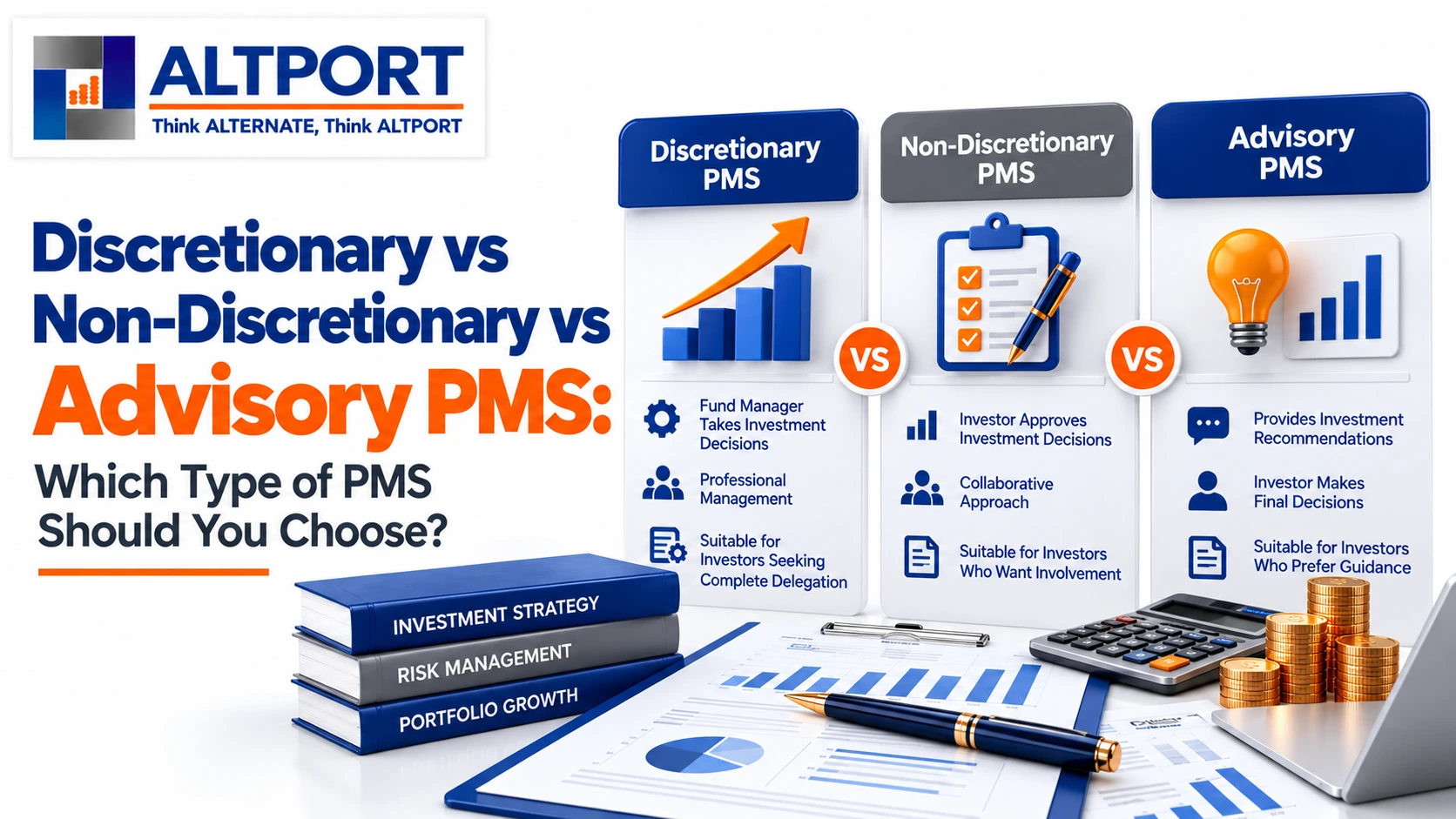
Discretionary, non-discretionary and advisory Portfolio Management Services (PMS) differ in who makes investment decisions and who executes transactions. In discretionary PMS, the portfolio manager makes and executes investment decisions within the agreed mandate. In non-discretionary PMS, the investor makes the decisions and the manager executes authorised transactions. In advisory PMS, the manager provides recommendations while the investor decides and executes trades independently.
The right arrangement depends on how much control you want to retain, how much time you can devote to reviewing investments and whether you are comfortable executing transactions yourself.
This guide compares discretionary vs non-discretionary vs advisory PMS in India, covering decision-making authority, trade execution, investor involvement, fees, risks and suitability.
What Is Portfolio Management Services (PMS)?
Portfolio Management Services (PMS) are professional investment services provided by portfolio managers registered with the Securities and Exchange Board of India (SEBI). Depending on the arrangement, a portfolio manager may manage a client's portfolio or provide investment advice under an agreed service arrangement.
PMS generally involves securities held in the client's name rather than units in a pooled mutual fund scheme. The investment mandate, permitted investments, applicable fees, risks and operating terms are documented in the relevant agreements and disclosures.
The general minimum investment for a PMS client is ₹50 lakh under the applicable SEBI framework, subject to relevant provisions and exemptions.
If you are new to this investment service, start with ALTPORT's guide to PMS full form, meaning and types.
Types of PMS in India: Discretionary vs Non-Discretionary vs Advisory
The three commonly discussed PMS service arrangements differ primarily in decision-making authority and responsibility for executing transactions.
| Feature | Discretionary PMS | Non-Discretionary PMS | Advisory PMS |
|---|---|---|---|
| Who makes investment decisions? | Portfolio manager within the agreed mandate | Investor | Investor |
| Who executes trades? | Portfolio manager | Portfolio manager, following the investor's directions | Investor |
| Approval for individual trades | Generally not required within the mandate | Investor's directions are required | Investor decides and executes independently |
| Investor involvement | Lower day-to-day involvement | Active involvement in individual decisions | Active involvement in decisions and execution |
| Role of the manager | Makes and implements investment decisions | Provides research or recommendations and executes authorised transactions | Provides investment advice or recommendations |
| Execution speed | Does not generally require individual trade approvals | Depends partly on how promptly the investor responds | Depends on the investor's decisions and execution |
| Fee structure | As specified in the agreement | As specified in the agreement | Advisory fees and applicable costs as agreed |
| Potentially suitable for | Investors who prefer to delegate investment decisions | Investors who want approval authority over transactions | Investors who want advice but prefer to manage execution themselves |
The exact responsibilities depend on the service agreement and applicable regulations. Investors should read the disclosure document and contractual terms rather than relying on the service label alone.
What Is Discretionary PMS?
Discretionary PMS is an arrangement in which the portfolio manager makes investment decisions and executes transactions within the authority and investment mandate agreed with the client. Individual trade approvals are generally not required when transactions fall within that mandate.
How does discretionary PMS work?
During onboarding, the investor and portfolio manager establish the investment mandate. This may cover investment objectives, permitted securities, portfolio restrictions and relevant risk considerations.
The investor completes the required account-opening documentation and authorises the applicable operating arrangements. The portfolio manager then makes and implements investment decisions within the agreed scope.
Investors receive applicable transaction confirmations, portfolio statements and reports according to the service arrangements and regulatory requirements.
For example, if the portfolio manager identifies a material change in a company's fundamentals, the manager may decide to reduce the portfolio's exposure within the mandate without seeking separate approval for that individual trade.
Benefits of discretionary PMS
- Lower day-to-day involvement: Investors do not generally need to approve every transaction.
- Timely execution: The manager can act without waiting for individual trade approvals, subject to operational and regulatory requirements.
- Consistent implementation: The manager can apply the strategy's research and risk-management framework across portfolio decisions.
Limitations of discretionary PMS
Investors delegate substantial investment decision-making authority to the portfolio manager. Consequently, the manager's investment philosophy, research process, risk controls and reporting quality deserve careful evaluation.
Discretionary management does not eliminate market risk or guarantee better returns. Portfolio values can decline because of market movements, security-specific developments or investment decisions.
Before signing, review the mandate and any authorisation documents carefully. ALTPORT's guide on how to select a PMS provider in India explains important due-diligence considerations.
What Is Non-Discretionary PMS?
Non-discretionary PMS is an arrangement in which the investor retains authority over investment decisions while the portfolio manager executes transactions according to the investor's directions.
The manager may provide research, analyse securities and recommend portfolio changes, but execution follows the applicable authorisation and instruction process.
How does non-discretionary PMS work?
The portfolio manager may recommend buying, selling or changing exposure to a security. The recommendation is communicated to the investor, who evaluates it and provides the required direction.
The portfolio manager executes the transaction in accordance with the agreed process and applicable permissions.
For example, if the manager recommends increasing exposure to a company, the investor may approve or decline the recommendation. If the investor responds after a delay, the prevailing market price or circumstances may have changed.
Benefits of non-discretionary PMS
- Greater involvement: Investors retain authority over individual investment decisions.
- Access to research: Investors can consider the manager's analysis before giving directions.
- Transaction-level oversight: Investors can decide whether to proceed with proposed transactions.
Limitations of non-discretionary PMS
This arrangement requires time, availability and sufficient understanding to evaluate recommendations. Investors need to understand the provider's approval process and how delays may affect execution.
Frequent delays or decisions that conflict with the strategy's investment framework can also make portfolio implementation more difficult.
Non-discretionary PMS is therefore not automatically more suitable for beginners. Investors should assess whether they can realistically evaluate recommendations and respond within the required time.
What Is Advisory PMS?
Advisory PMS is an arrangement in which the portfolio manager provides investment advice or recommendations while the investor retains responsibility for investment decisions and transaction execution.
The precise service scope depends on the agreement and applicable regulations.
How does advisory PMS work?
The investor receives recommendations concerning securities, portfolio allocation or potential investment changes. The investor evaluates the advice, decides whether to act and executes any transactions independently through the relevant brokerage and account arrangements.
For example, an advisory provider may recommend reducing exposure to a particular sector. The investor decides whether to accept the recommendation and, if so, places the necessary trades.
Benefits of advisory PMS
- Direct control: The investor decides whether to act on each recommendation.
- Independent execution: Transactions remain under the investor's control.
- Flexibility: Investors can consider advice alongside their own requirements and constraints.
Limitations of advisory PMS
Advisory PMS requires active involvement in investment decisions, execution and portfolio monitoring. Investors need sufficient time, knowledge and operational access to implement recommendations.
Receiving professional advice does not guarantee a positive investment outcome. Results also depend on the investor's decisions, execution and the performance of the underlying securities.
Which PMS Model Offers More Control?
Advisory PMS generally offers the greatest direct investor control over decisions and execution. Non-discretionary PMS allows investors to direct individual transactions while relying on the portfolio manager for execution. Discretionary PMS delegates investment decisions to the manager within the agreed mandate.
The trade-off is the amount of time and responsibility the investor retains.
Two important considerations are often overlooked.
Customisation depends on the mandate. A discretionary arrangement does not automatically provide unlimited customisation, and an advisory arrangement does not guarantee a portfolio that better matches the investor's needs. Review the restrictions and procedures for changing the mandate.
Control comes with responsibility. Discretionary investors need to monitor reporting and the manager's adherence to the mandate. Non-discretionary investors need to understand the instruction process. Advisory investors must manage their own decisions and execution.
Do PMS Fees Differ by Service Type?
PMS fees can differ by service arrangement and provider, but investors should not assume that one model is always cheaper than another.
The applicable fee structure is set out in the relevant agreement and disclosures. Depending on the arrangement, charges may include:
- Fixed management or advisory fees.
- Performance-linked fees, where applicable.
- Brokerage and transaction charges.
- Custody and Demat-related expenses.
- Applicable taxes and statutory charges.
- Exit charges, where applicable under the agreement.
When comparing providers, examine the complete cost structure rather than just the headline fee. For performance-linked fees, review the calculation method and any applicable hurdle rate or high-water-mark provisions.
Read ALTPORT's guide to PMS fees and charges in India for a more detailed explanation. You can also review GST on PMS and AIF fees and PMS taxation in India.
SEBI Rules: Minimum Investment and Regulatory Requirements
PMS service arrangements operate under the applicable SEBI regulatory framework. The general minimum investment requirement for a PMS client is ₹50 lakh in funds or securities, subject to applicable provisions and exemptions.
Investors should distinguish between the regulatory framework, the service arrangement offered by a portfolio manager and the specific contractual terms they sign.
Before investing, verify the portfolio manager's registration, read the disclosure document, understand the investment mandate and review the fee and reporting arrangements.
Do not assume that every portfolio manager offers all three service arrangements. Availability depends on the provider and the services it is authorised and equipped to offer.
NRIs may also need to consider applicable FEMA, banking, tax and documentation requirements. See ALTPORT's guides to PMS for NRI investors and the NRI Corner.
How to Choose Between Discretionary, Non-Discretionary and Advisory PMS
The most appropriate model depends on your available time, investment knowledge and preferred level of control. Consider how you would realistically handle investment recommendations and transaction execution.
Consider discretionary PMS if:
- You prefer to delegate investment decisions within an agreed mandate.
- You cannot regularly review and approve individual transactions.
- You are comfortable assessing the manager's process, risk controls and reporting rather than approving each trade.
Consider non-discretionary PMS if:
- You want access to professional research but wish to retain authority over individual investment decisions.
- You can review recommendations and respond promptly.
- You understand that delayed directions can affect execution.
Consider advisory PMS if:
- You want investment recommendations but prefer to decide and execute independently.
- You have the time, market knowledge and operational setup to implement advice.
- You are prepared to monitor your holdings and maintain your own transaction records.
The service arrangement is only one part of provider selection. You should also evaluate the investment strategy, portfolio manager, fees, risk profile and reporting practices.
Use ALTPORT's guide to compare PMS performance and understand the metrics that matter when evaluating PMS providers.
If you are still deciding whether PMS is appropriate for your circumstances, compare it with other investment options through ALTPORT's guides to mutual funds vs PMS vs AIF, AIF vs PMS and direct equity vs PMS.
Questions to ask before selecting a PMS model
Before signing an agreement, ask the provider:
- Who has authority to make investment decisions, and who executes transactions?
- What authority is granted under the account-operating and authorisation documents?
- For non-discretionary PMS, how are instructions communicated, recorded and executed?
- For discretionary PMS, how are mandate restrictions and investor concerns handled?
- Which investment strategies, securities and portfolio restrictions apply?
- What are the fixed fees, performance-linked fees and other applicable charges?
- How often are portfolio performance, risks and expenses reported?
- What are the withdrawal, termination and exit provisions?
- Can the service arrangement be changed later, and what process would apply?
Ensure the answers are consistent with the written agreement and disclosure document.
Conclusion
Discretionary PMS may suit investors who prefer to delegate investment decisions within an agreed mandate. Non-discretionary PMS may suit investors who want to retain authority over individual transactions while relying on the manager for execution. Advisory PMS may suit investors who want professional recommendations but prefer to make and execute investment decisions themselves.
Before selecting a model, consider your investment knowledge, available time, desired control, risk tolerance and ability to implement recommendations. Review the service agreement, fee structure, reporting arrangements and relevant disclosures before committing capital.
The most appropriate arrangement is the one that fits your circumstances and the level of involvement you can realistically maintain.
For further information, explore ALTPORT's PMS resources or visit the PMS FAQ page.
Disclaimer: This article is for educational and informational purposes only and should not be treated as investment advice or a recommendation to buy or sell any security. PMS investments are subject to market risks. Investors should review the relevant disclosure documents and agreements and consider their financial circumstances before making investment decisions.